Author: Samuel M. Goldwasser
For contact info, please see the Sci.Electronics.Repair FAQ Email Links Page.
Copyright © 1994-2022
Reproduction of this document in whole or in part is permitted if both of the
following conditions are satisfied:
1. This notice is included in its entirety at the beginning.
We will not be responsible for damage to equipment, your ego, county wide
power outages, spontaneously generated mini (or larger) black holes, planetary
disruptions, or personal injury or worse that may result from the use of this
material.
Switchmode supplies had been commonplace in military and avionic
equipment long before they found their way into consumer electronics.
I have some DC-DC and DC-AC converter modules from a Minuteman I missile
from around 1962 as one example. I suppose that the cost of the switching
transistors wasn't as big a deal with a $100 million missile as a $300 TV
(even in 1960s dollars).
Nowadays, all TVs, monitors, PCs; most laptop and camcorder power packs;
many printers, fax machines, and VCRs; and even certain audio equipment
like portable CD players use this technology to reduce cost, weight, and
size.
Having said that, repairing a power supply yourself may in fact be the
only economical option. It is very common for service centers to simply
replace the entire power supply board or module even if the problem is a
25 cent capacitor. It may simply not pay for them to take the bench time
to diagnose down to the component level. Many problems with switchmode
power supplies are easy to find and easy and inexpensive to fix. Not
all, but surprisingly many.
This document will provide you with the knowledge to deal with a large
percentage of the problems you are likely to encounter with the common
small switchmode power supplies found in many types of consumer electronic
equipment including PCs, printers, TVs, computer monitors, and laptop or
camcorder power packs. It will enable you to diagnose problems and
in many cases, correct them as well. With minor exceptions, specific
manufacturers and models will not be covered as there are so many
variations that such a treatment would require a huge and very detailed
text. Rather, the most common problems will be addressed and enough
basic principles of operation will be provided to enable you to narrow
the problem down and likely determine a course of action for repair.
In many cases, you will be able to do what is required for a fraction
of the cost that would be charged by a repair center - assuming they would
even bother.
Should you still not be able to find a solution, you will have learned a great
deal and be able to ask appropriate questions and supply relevant information
if you decide to post to sci.electronics.repair. It will also be easier to do
further research using a repair text such as the ones listed at the end of
this document. In any case, you will have the satisfaction of knowing you
did as much as you could before taking it in for professional repair.
With your new-found knowledge, you will have the upper hand and will not
easily be snowed by a dishonest or incompetent technician.
In all cases, bad solder connections are a possibility as well since there
are usually large components in these supplies and soldering to their pins
may not always be perfect. An excessive load can also result in most of
these symptoms or may be the original cause of the failure. And don't
overlook the trivial: a line voltage select switch in the wrong position
or between positions (possibly by accident when moving the supply,
particularly with PCs), or damaged.
Nothing really degrades in a switchmode power supply except possibly the
electrolytic capacitors (unless a catastrophic failure resulted in a total
meltdown) and these can usually be replaced for a total cost of a few dollars.
Therefore, it usually makes sense to repair a faulty supply assuming it can be
done reasonably quickly (depending on how much you value your time and the down
time of the equipment) and, of course, assuming that the equipment it powers
is worth the effort. Most replacement parts are readily available and kits
containing common service components are also available for many popular
power supplies (such as those found in some terminals, MacIntosh and other
Apple computers, various brands of video monitors, and some TVs and VCRs).
Where an exact replacement power supply is no longer available or excessively
expensive, it may be possible to simply replace the guts if space allows and
the mounting arrangement is compatible. For example, for an older full size
PC tower, the original power supply may be in a non-standard box but the
circuit board itself may use a standard hole configuration such that an
inexpensive replacement may be installed in its place.
Alternatively, many surplus electronics distributors have a wide selection
of power supplies of all shapes, sizes, output voltages, and current
capacities. One of these may make a suitable replacement for your custom
supply with a lot less hassle than attempting to repair your undocumented
original. It will likely be much newer as well with no end-of-life issues
like dried up electrolytic capacitors to deal worry about. Of course, you
must know the voltage and current maximum current requirements of each of
the outputs in order to make a selection.
For the specific case of SMPSs for standard computers (PC, Macs, workstations,
servers), it often doesn't make sense to spend much time or money on repair.
The cost of replacement of power supplies for PCs in particular is so low,
that just buying a new power supply may be the best course of action.
Furthermore, the risk of a faulty repair causing expensive or fatal
damage to the mainboard and peripherals including total loss of all
data stored on disk, makes repair a risky endeavor unless thorough testing
can be performed before installation. However, it won't hurt to check for
obvious problems like bad connections. Put the dead one aside and considering
trying to repair it if there isn't anything better to do. Realistically,
this will be never. :)
Lazar's SMPS Design Corner has many links
to switchmode power supply information and suppliers.
Where regulation is important - that is, it is desirable for the
output voltage to be relatively independent of line or load variations,
a regulator stage is added. This may take the form of a Zener diode if
the current requirements are modest, discrete transistor circuit, or an
integrated 3 terminal regulator like an LM317 (variable), 7805 (+5), or
7912 (-12). There are many more as well as linear regulators for higher
voltages such as +115 VDC or +125 VDC for TV power supplies and multiple
output (e.g., +5.1 VDC, +12 VDC) hybrid regulators for VCRs.
The regulator circuit essentially compares the output (possibly only
one if there are multiple outputs in the same package) with a reference
and adjusts the current flow to make the output(s) as nearly equal to the
desired voltage as possible. However, a significant amount of power may
be lost in the regulator especially under high line voltage/high load
conditions. Therefore, the efficiency of linear power supplies is
usually quite low - under 50% overall is typical.
Notable characteristics of LPSs are excellent regulation and low output
ripple and noise.
Most small SMPSs use BJTs or MOSFETs. IGBTs may be found in large systems
and SCRs or triacs are used where their advantages (latching in the on
state and high power capability) outweigh the increased complexity of
the circuitry to assure that they turn off properly (since except for
special Gate Turn Off (GTO) thyristors, the gate input is pretty much
ignored once the device is triggered and the current must go to zero
to reset it to the off state.)
The input to the switches is usually either 150-160 VDC after rectification
of 115 VAC, or 300-320 VDC after doubling of 115 VAC or rectification of
220-240 VAC. Up to this point, there is no line isolation as there is no
line connected (large, bulky, heavy) power transformer.
A relatively small high frequency transformer converts the pulsed
waveform into one or more output voltages which are then rectified and
filtered using electrolytic capacitors and small inductors in a 'pi'
configuration C-L-C, or for outputs that are less critical, just a
capacitor.
This high frequency transformer provides the isolation barrier and the
conversion to generate the multiple voltages often provided by a SMPS.
Feedback is accomplished across the isolation barrier by either a small
pulse transformer or opto-isolator. The feedback controls the pulse
width or pulse frequency of the switching devices to maintain the
output constant. Since the feedback is usually only from the "primary"
output, regulation of the other outputs, if any, is usually worse than
for the primary output. Also, because of the nature of the switching
designs, the regulation even of the primary output is usually not nearly
as good both statically and dynamically as a decent linear supply.
DC-DC converters are switchmode power supplies without the line input
rectification and filtering. They are commonly found in battery operated
equipment like CD players and laptop computers. They have similar
advantages to SMPSs in being compact, light weight, and highly efficient.
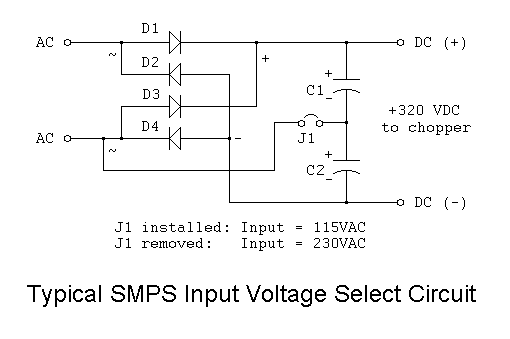
Line rectification is usually via a voltage doubler or diode bridge. One
common circuit uses a bridge rectifier as a doubler or normal bridge by
changing one jumper. The voltage across the switching transistor is usually
around 160-320 V. Some universal supplies are designed to accept a wide
range of input voltages - 90-240 VAC (possibly up to 400 Hz or more) or
DC - and will automatically work just about anywhere in the world as long
as a suitable plug adapter can be found.
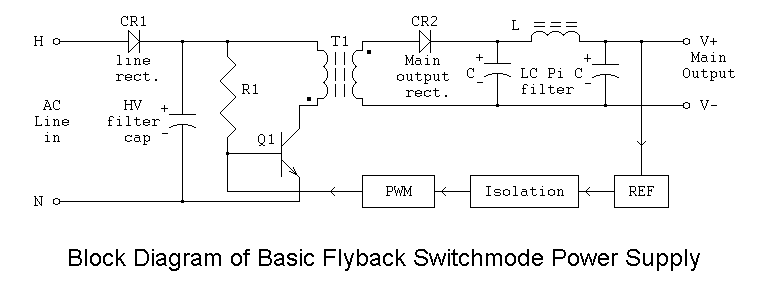
When Q1 turns on, current increases linearly in T1 based on the voltage
applied and the leakage inductance of T1's primary winding. Little power
is transferred to the secondary during this phase of the cycle. When Q1
turns off, the field collapses and this transfers power to the output.
The longer Q1 is on, the more energy is stored (until saturation at which
point it blows up). Thus, controlling the pulse width of the Q1 on-time
determines the amount of power available from the output.
The output rectifier, CR2, must be a high efficiency, high frequency unit - a
1N400X will not work. The pi filter on the output smooths the pulses
provided by CR2. Sometimes, a full wave configuration is used with a
center tapped transformer secondary.
Note that the transformer, T1, is a special type which includes an air gap
in its core (among other things) to provide the inductive characteristics
needed for operation in flyback mode.
Multiple output windings on T1 provide for up to a half dozen or more
separate (and possibly isolated as well) positive or negative voltages
but as noted, only one of these is usually used for regulation.
A reference circuit monitors the main output and controls the duty
cycle of the switching pulses to maintain a constant output voltage.
(Secondary outputs are not shown in the above schematic.)
R1 is the startup resistor (some startup circuits are more sophisticated)
and provides the initial current to the switchmode transistor base. In the
old days, SMPS controllers were designed with discrete components. Assuring
stable operation is a challenge with any SMPS but particularly with the
flyback topology where leaving the drive on for too long will result in
transformer core saturation and instant smoke. Nowadays, an IC PWM
controller chip is almost always used. The block diagram of a one very
popular PWM controller IC is shown below.
Many small SMPSs use opto-isolators for the feedback. An opto-isolator
is simply an LED and a photodiode in a single package. As its name implies,
an opto-isolator provides the isolation barrier (between the low voltage
secondary outputs and the line connected primary) for the feedback circuit.
Typically, a reference circuit on the output side senses the primary output
voltage and turns on the LED of the opto-isolator when the output voltage
exceeds the desired value. The photodiode detects the light from the LED
and causes the pulse width of the switching waveform to be reduced enough
to provide just the right amount of output power to maintain the
output voltage constant. This circuit may be as simple as putting
the photodiode across the base drive to the BJT switch thus cutting
it off when the output voltage exceeds the desired value. The reference is
often a TL431 or similar shunt regulator chip monitoring a voltage divided
version of the primary output. When the shunt regulator kicks in, the
opto-isolator LED turns on reducing the switchmode transistor drive.
There may be an adjustment for the output voltage.
Other designs use small pulse transformers to provide isolated feedback.
Where additional regulation is needed, small linear regulators may be
included following the output(s).
There are many other topologies for switching power supplies. However, the
basic principles are similar but the detail differ depending on application.
The flyback topology described above is one of the most common for small
multi-output supplies. However, you may find other types of circuits
in TVs and monitors. Some are downright strange (to be polite). I sometimes
wonder if engineers are given bonuses based on the uniqueness and difficulty
level of understanding their designs!
Since the advent of the laptop computer, cellular phone, and other portable
devices, the importance of optimizing power utilization has increased
dramatically. There are now many ICs for controlling and implementing
SMPSs with relatively few external components. Maxim, Linear Technology,
and Unitrode (now part of Texas Instruments) are just a few of the major
manufacturers of controller ICs.
In additional, you will find DC-DC converters which are SMPSs without
the AC line connection, internally in an increasing number of consumer
and industrial applications including things like portable CD players.
The up side is that they are usually quite reliable, efficient, and cool
running.
The down side is that when a failure occurs, it may take out many parts
in the supply, though not usually the equipment being powered unless the
feedback circuitry screws up and there is no overvoltage protection.
WARNING: The filter capacitors used in many switchmode power supplies can
store an amount of energy that can kill - always discharge and confirm
this before touching anything.
There is also risk of instantly destroying expensive parts of the supply
(and any attached equipment as well) like the switchmode power transistor
if your probe should slip and short something either directly or by killing
the feedback circuit.
These guidelines are to protect you from potentially deadly electrical shock
hazards as well as the equipment from accidental damage.
Note that the danger to you is not only in your body providing a conducting
path, particularly through your heart. Any involuntary muscle contractions
caused by a shock, while perhaps harmless in themselves, may cause collateral
damage - there are many sharp edges inside this type of equipment as well as
other electrically live parts you may contact accidentally.
The purpose of this set of guidelines is not to frighten you but rather to
make you aware of the appropriate precautions. Repair of TVs, monitors,
microwave ovens, and other consumer and industrial equipment can be both
rewarding and economical. Just be sure that it is also safe!
However, the cause of many problems are immediately obvious and have simple
fixes - the blown chopper transistor or dried up main filter capacitor.
Don't assume your problem is complex and convoluted. Most are not.
You should not avoid attempting a repair just because there is a slight
chance it will be more challenging!
A low power (e.g., 25 W) fine tip soldering iron and fine rosin core solder
will be needed if you should need to disconnect any soldered wires (on purpose
or by accident) or replace soldered components. A higher power iron or small
soldering gun will be needed for dealing with larger components. Never use
acid core solder or the type used for sweating copper pipes!
CAUTION: You can easily turn a simple repair (e.g., bad solder connections)
into an expensive mess if you use inappropriate soldering equipment and/or
lack the soldering skills to go along with it. If in doubt, find someone else
to do the soldering or at least practice, practice, practice, soldering and
desoldering on a junk circuit board first! See the document:
Troubleshooting and Repair of Consumer Electronic
Equipment for additional info on soldering and rework techniques.
CAUTION: If the SMPS (or any other piece of equipment) is capable of producing
voltages beyond 1,000 V (or the max range on your meter), make sure you use a
proper high voltage probe or high voltage meter - fault conditions could
easily result in voltages in the system that are way beyond those that are
expected, even if run at reduced input voltage and/or with a series current
limiter.
In designs using controller ICs, an oscilloscope comes in handy when there
are startup or overcurrent/voltage shutdown or cycling problems. Since
everything runs at a relatively low frequency, almost any scope will do.
Note: Some SMPS designs require power to be applied instantly to provide
the startup voltage to the controller. If this is the case with yours,
it won't be possible to bring up the voltage slowly (unless you power that
chip separately). However, it should still be possible to run the unit
somewhat reduced line voltage. Also, running any SMPS at reduced line
voltage is stressful. It may also result in outputs that are not properly
regulated and go much higher than normal. Thus, a Variac should be used
with caution - with the outputs connected to dummy loads instead of the
powered equipment and a series current limiter (e.g., light bulb) in the
input.
There is absolutely no imaginable reason not to use an isolation
transformer for troubleshooting SMPSs except possibly for the final test
where confirmation is needed that the inrush from a direct line connection
(which will have virtually unlimited instantaneous current capability)
will not damage the newly repaired supply.
The technique I recommend is to use a high wattage resistor of about
5 to 50 ohms/V of the working voltage of the capacitor. This isn't critical -
a bit more or less will be fine but will affect the time it takes to fully
discharge the capacitor. The use of a current limiting resistor will
prevent the arc-welding associated with screwdriver discharge but will
have a short enough time constant so that the capacitor will drop to
a low voltage in at most a few seconds (dependent of course on the
RC time constant and its original voltage).
Then check with a voltmeter to be double sure. Better yet, monitor
while discharging.
Obviously, make sure that you are well insulated!
For the power supply filter capacitors which might be 400 uF at 200 V, a
2 K ohm 10 W resistor would be suitable. RC=.8 second. 5RC=4 seconds.
A lower wattage resistor (compared to that calculated from V^^2 / R) can
be used since the total energy stored in the capacitor is not that great
(but still potentially lethal).
The discharge tool and circuit described in the next two sections can be
used to provide a visual indication of polarity and charge for TV, monitor,
SMPS, power supply filter capacitors and small electronic flash energy
storage capacitors, and microwave oven high voltage capacitors.
Reasons to use a resistor and not a screwdriver to discharge capacitors:
This discharge tool will keep you safely clear of the danger area.
Again, always double check with a reliable voltmeter or by shorting with
an insulated screwdriver!
A visual indication of charge and polarity is provided from maximum input
down to a few volts.
The total discharge time is approximately 1 second per 100 uF of capacitance
(5RC with R = 2 K ohms).
Safe capability of this circuit with values shown is about 500 V and 1000 uF
maximum. Adjust the component values for your particular application.
Safety note: always confirm discharge with a voltmeter before touching any
high voltage capacitors!
(From: Ian Field (ionfieldmonitors@ic24.net).)
The version of the checker that I have, also contains a miniature 12 V
battery for continuity checking - any resistance less than about 22K will
produce some glow. It's handy for quick checks of semiconductor junctions -
in general if it produces a slight glow it's leaky, but transistor B/E
junctions have an inherent zener voltage, so there is usually some glow.
Also schottky-barrier diodes give a reverse leakage glow - this does not
mean they're faulty, check the Vf with the diode-check on a DMM before
binning! Any zener diode above 10-11 V can be given a quick test for S/C,
lower Vz will produce some glow - again check Vf before binning.
These checkers are getting hard to obtain, most of the component stockists
here only carry vastly over complicated (and expensive) versions with
built-in measurement computer and LCD - these wouldn't last 5 min's around
flyback circuitry! Some Automotive accessory shops have a simpler version
with no battery - always check that it's stated to be capable of measuring
AC or DC at 4 to 380 V before parting with money! The internal circuit should
contain the LED's, a 15 ohm resistor to limit the maximum surge current when
the PTC is cold and the special PTC film-thermistor. The battery can be
added with a button from a VCR front panel - but don't blame me if you kill
yourself because you didn't insulate the added components properly! There is
a more complicated non-battery version with 2 LED's close to the front of
the handle to indicate polarity and a row of LED's along the length of the
handle to indicate the voltage-range. This version contains 2 special PTC's
and a discrete-transistor bargraph circuit - there might be room to add a
battery inside the case. As for the special PTC this is the only place I've
seen them - one possibility that might be worthy of looking into is the
Siemens PTC SMPSU startup thermistor for TDA4600 control chips, this usually
has a series resistor of at least 270 ohms and is more likely to turn-up in
European TV set's, but I have seen it in early Matsushita IBM displays and a
few others (possibly Tandon) the PTC thermistor is always blue and looks
like a very-miniature copy of the Philips white-plastic PTC degauss
thermistor.
Actually using a series load - a light bulb is just a readily available
cheap load - is better than a Variac (well both might be better still) since
it will limit current to (hopefully) non-destructive levels.
CAUTION: Running any SMPS at greatly reduced line voltage will be stressful
for it, especially if the output load is a significant fraction of its full
load ratings. In addition, at some range of line voltage, the output
regulation may not work properly and the output(s) may go much higher than
expected. Use dummy loads in place of the valuable equipment if possible
when doing such testing!
What you want to do is limit current to the critical parts - usually the
switchmode (chopper) power transistor of an SMPS or horizontal output
transistor (HOT) of a TV or monitor. Most of the time you will get away with
putting it in series with the AC line. However, sometimes, putting a light
bulb directly in the B+ circuit will be needed to provide adequate protection.
In that location, it will limit the current to the HOT from the main filter
capacitors of line connected power supplies. This may also be required with
some switchmode power supplies as they can still supply bursts of full (or
excessive) current even if there is a light bulb in series with the AC line.
Actually, an actual power resistor is probably better as its resistance is
constant as opposed to a light bulb which will vary by 1:10 from cold to hot.
The light bulb, however, provides a nice visual indication of the current
drawn by the circuit under test. For example:
Note: for a TV or monitor, it may be necessary (and desirable) to unplug the
degauss coil as this represents a heavy initial load which may prevent the unit
from starting up with the light bulb in the circuit.
The following are suggested starting wattages:
A 50/100/150 W (or similar) 3-way bulb in an appropriate socket comes in
handy for this but mark the switch so that you know which setting is which!
Depending on the power rating of the equipment, these wattages may need to be
increased. However, start low. If the bulb lights at full brightness, you
know there is still a major fault. If it flickers or the TV (or other device)
does not quite come fully up, then it should be safe to go to a larger bulb.
Resist the temptation to immediately remove the series light bulb totally from
the circuit at this point - I have been screwed by doing this. Try a
larger one first. The behavior should improve. If it does not, there
is still a fault present.
Note that some TVs and monitors simply will not power up at all with any kind
of series load - at least not with one small enough (in terms of wattage) to
provide any real protection. The microcontroller apparently senses the drop
in voltage and shuts the unit down or continuously cycles power. Fortunately,
these seem to be the exceptions.
At a pinch, discharging BIG electrolytic capacitors with a test lamp (230 V,
60 W in the UK; 115 V, 25 W in series in the US) will do, but if the lamp has
blown you are in for a nasty surprise! While I am not criticising the use of
spare high-wattage resistors, I tend to find that these get tidied away, so
there's none about when you need one!
The lamp sometimes get's used if I can't find an NTC, but I always check
with a voltage checker because of the risk! - power resistors can go O/C as
well whereas NTC thermistors generally fail S/C - which usually happens as a
result of some transient phenomenon such as a lightning-strike near the
underground power line.
This is unlikely with the energy dump of discharging an off-line
electrolytic (unless the equipment is still powered at the time!). My bench
isn't the tidiest in the world, so gadgets tend to get misplaced - including
power resistors with added discharge-progress LED indicators. This is where
an inrush-suppressor NTC comes into it's own, even without selecting the
type - it will discharge a capacitor almost instantaneously with the minimum
of arc-burn on the solder pads. Obviously the energy causes some heating -
in the case of large electrolytics direct-off-line rectifier
smoothing/reservoir the amount of heating is just sufficient to give an idea
of the condition of the capacitor - capacitor failure is comparatively rare,
so it's not often anticipated and can cause misleading symptoms - so making
this double as a routine check occasionally saves a hell of a lot of time!
The trick I have found works even better is to use a NTC inrush-current
suppressor thermistor. These items can be salvaged from a scrap monitor or
PSU, and careful selection may reveal some types with a "room temperature
resistance" of several kohms - with the line-voltage on a capacitor
discharging through them, self-heating reduces the resistance to a few
ohms. This reduces the welding-sputter as the contact current is only a few
milliamps - this rises to a few amperes as the capacitor "dumps" its charge as
the NTC resistance fall's with self-heating.
One point I would disagree on is that not all of the many electrolytics need
discharging! Most SMPSU's of any appreciable power have high energy
electrolytics in the secondary - whether this is expressed as high voltage or
high current. In the case of monitors, the post PWM-B+ rail has a large
storage electrolytic which can do appreciable damage in the event that
line-drive failure has prevented use of it's energy. The NTC thermistor method
helps here; after "dumping" the line voltage electrolytics - the NTC is at a
lower resistance and ready for following up on the lower charge electrolytics.
There is a point concerning "test-lamp dummy loads" this has more to do with
monitors than SMPSU boxes. As well as the suggested use to limit inrush
current to a safe value on SMPSU boxes - I also use this method on line-O/P
stages especially to verify that flyback-transformer failure was not the
original cause of B+PWM or SMPSU blow-up. Recently I have been caught-out a
few times because some "energy-star" designs are so efficient that the inrush
current of the lamp itself is ample to cause catastrophic damage! The UK
220/230 V 60 W test lamp I have here has a calculated operating resistance of
806.7/881.7 ohms compared to a measured cold resistance of about 67 ohms so
the PTC effect of the filament tends to limit the advantage!
To clarify my comment on confirming whether a faulty flyback transformer has
damaged the B+PWM; older circuits use a MOSFET buck-regulator, in which S/C
failure of the MOSFET feeds unregulated B+ to the line-O/P stage - This
invariably destroys the HOT and sometimes the transformer, but either could as
easily be the original cause. In any event - bypassing the B+PWM MOSFET via
the test lamp passes just enough current to see if the transformer is operable
- with the price of replacements, very few quotes are accepted - so it's well
worth making sure before ordering an expensive replacement or doing too much
repair work! More recently, the trend has been for flyback - step up B+
regulators. When the B+ MOSFET fails S/C it simply stalls the main SMPSU
(sometimes destroying the rectifier!). Since this type of B+PWM is step-up,
the operability of the flyback transformer can be checked by simply removing
the S/C MOSFET. The most recent designs appear to be based on semi-resonant
SMPSU topology - they resemble buck-regulator PWM controllers, but the PWM
MOSFET is at chassis potential and the transformer primary is at full
PSU-rail, the line-O/P transistor is between the two with the drive
transformer connected to provide an emitter-coupled blocking oscillator
configuration, to add "regen" to the base drive. The boost diode often
includes the buck-regulators "ringing-choke" in the "net inductive component"
that it recovers energy from! As the later configuration most closely
resembles the buck-regulator type, the test lamp is required to confirm
transformer operability - but the weird and wonderful circuit arrangements can
make it lots of fun working out where to connect it!
A voltage checker that I find indispensable is the Steinel Master check 3
from; Steinel GmbH & Co. (KG Dieselstrabe 80-86 D-4836 Hertzebrock 1,
Germany). The version I have consists of a pair of "inverse-parallel" LED's
in series with a metal-film PTC thermistor on a tiny ceramic tube former -
this has a very low thermal inertia so the PTC thermistor limits the current
to a safe value for the LED's for any applied voltage between 4 & 380 V the
combination of 2 LED's give a clear indication of AC or DC polarity. When
this checker is used around SMPSU's, you can clearly see the effect of
minority carrier transition time losses in the rectifiers, because the
leading-edge of the waveform pushes the rectifiers Vf well in excess of 0.7 V
for the minority carrier injection delay - before the rectifier begins to
conduct. Where a PSU rectifier has two electrolytics and a choke in a Pi
filter, the checker will often reveal negative transients on the
electrolytic closest to the rectifier - which is a clear sign of capacitor
ESR failure.
SMPS fail in many ways but the following are common:
Symptoms: Totally dead supply, fuse blows instantly (vaporizes or explodes)
even if switchmode transistor is removed unless a fusable resistor has
blown to protect the fuse. :) Test all components on line side of
high frequency transformer for short circuit failures with a multimeter.
Symptoms: Totally dead supply, fuse blows instantly (vaporizes or explodes
unless fusable resistor has opened). Measuring across C-E or D-S of
switchmode transistor yields near zero ohms even when removed from circuit.
Symptoms: In a very basic supply without overcurrent protection,
the failure of one or more of these diodes may then overload the
supply and cause a catastrophic failure of the switchmode power
transistor (see above) and related components. Thus, these should
be checked before reapplying power to a supply that had a shorted
switchmode transistor.
On short circuit protected supplies, the symptom may be a periodic
tweet-tweet-tweet or flub-flub-flub as the supply attempts to restart
and then shuts down. Any power or indicator lights may be blinking
at this rate as well.
Test with an ohmmeter - a low reading in both directions indicates a
bad diode. Sometimes these will test OK but fail under load or at
operating voltage. Easiest to replace with known good diodes to verify
diagnosis. Rectifiers either look like 1N400X type on steroids -
cylinders about 1/4" x 1/2" (example: HFR854) or TO220 packages
(example: C92M) with dual diodes connected at the cathode for positive
supplies or the anode for negative supplies (the package may include a
little diagram as well). These may either be used with a center-tapped
transformer, or simply parallel for high current capacity. If in doubt,
remove from the circuit and test with the ohmmeter again. If not the
output used for regulation feedback, try the supply with the rectifier
removed. As noted, a test with an ohmmeter may be misleading as these
rectifiers can fail at full voltage. When in doubt, substitute a known
good rectifier (one half of a pair will be good enough for a test).
Symptoms: In this case the supply will appear totally dead but all
the semiconductors will check out and no fuses will blow. Check the
startup resistors with an ohmmeter - power resistors in the AC line
input section. WARNING: there will be full voltage on the main filter
capacitor(s) - 1X or 2X peak or around 160 or 320 VDC depending on design.
Discharge before probing.
Symptoms: The main filter capacitor may dry up or open and cause the
output to be pulsing at 60 (50) or 120 (100) Hz and all kinds of
regulation problems. Measure voltage across main filter capacitor(s).
If the reading is low and drops to a much lower value or 0 instantly
upon pulling the plug, then one of these capacitors may be open or dried
up. If you have an oscilloscope, monitor for ripple (use an isolation
transformer!!). Excess ripple under moderate load is an indication of
a dried up or open capacitor.
In extreme cases, a main filter capacitor with greatly reduce capacity
or that is totally open may result in failure of the switchmode transistor
and a dead supply that blows fuses or fusable resistors. Therefore, it is
always a good idea to test the electrolytic capacitors whenever repairing
a SMPS that has blown its switchmode transistor.
Capacitors in the low voltage section may fail causing regulation problems.
Sometimes there are slew rate limiting capacitors which feed from the
primary output to the regulator controller to limit initial in-rush and
overshoot. A failure of one of these may mess up regulation at the very
least. For example, excess leakage may reduce the output of the main
output (and as a consequence, all the others as well).
Where a controller like a UC3842 is used, a failure of the capacitor on
its Vcc pin may result in a aborted startup or cycling behavior as it is
starved for juice each time it pulses the switchmode power transistor:
(From: John Hopkins (bugs71@ptdprolog.net).)
In almost all cases, when in doubt parallel a known good capacitor of
similar capacitance and at least equal voltage rating (except for these
slew rate limiting capacitors where substitution is the only sure test).
For Panasonic (and other) VCR power supplies, it is common - almost assured
after a few years - that one or more the output filter capacitors commonly
fail and replacing all of them, while perhaps a brute force solution, will
fix a whining supply or one having bad regulation or noise. However, check
the semiconductors as well before applying power. See the section:
Panasonic VCR SMPS.
These are particularly common with portable equipment. Universal AC adapters
for camcorders and laptop computers are often abused to the point of failure.
Large components like the line filter choke and high frequency transformer
are prone to crack the solder bond at their pins or even break loose from
the circuit board.
Symptoms: almost any kind of behavior is possible. The unit may be erratic,
intermittent, or totally dead. Visually inspect the solder side of the
circuit board with a bright light and magnifying glass if necessary. Gently
prod or twist the circuit board with an insulating stick to see if the
problem can be made to change. Note that a one-time intermittent can
blow many components so inspecting for intermittents is a really good
idea even you believe that all bad components have been replaced.
Symptoms: voltage has changed and adjustment pot if one exists has no
effect or is unable to set voltage to proper value. Check components
in the feedback regulator, particularly the opto-isolator and its associated
circuitry. A weak opto-isolator may allow for excessive output voltage.
A shorted photodiode in the opto-isolator may prevent startup. An open
photodiode may lead to a runaway condition. WARNING: probe these circuits
with care both because of the safety issues but also since any slip of
the probe may lead to a runaway condition and catastrophic failure of
the switchmode transistor and its related parts as well as damage to
any attached equipment.
Note that the high frequency transformer does not make the top 10 list -
failure rates for these components are relatively low. You better hope
so in any case - replacements are usually only available from the original
manufacturer at outrageous cost.
Most other parts are readily available from places service parts distributors
like MCM Electronics as well as general electronics distributors like DigiKey
and Mouser.
Rebuild kits are available for many common supplies used in VCRs, monitors,
terminals. See the section: Repair parts sources.
Also, while it is tempting to suspect any ICs or hybrid controllers
since it is thought that replacements are difficult and expensive to
obtain, these parts are pretty robust unless a catastrophic failure
elsewhere sent current where it should not have gone. And, ICs at least,
are usually readily available.
However, under various fault conditions, and sometimes when lightly loaded,
there may be tell-tail audible indications of the SMPS's state of happiness.
The cause may be in the SMPS itself or its load.
Which of (1) or (2) actually present will depend on the particular design of
the SMPS and the severity of the overload. If the design uses a hard SCR
crowbar, an overvoltage condition may trigger one of the symptoms!
(From: Charlie Allen (charlie.allen@usa.net).)
Note: Some SMPS designs require power to be applied instantly to provide
the startup voltage to the controller. If this is the case with yours,
it won't be possible to bring up the voltage slowly (unless you power that
chip separately). However, it should still be possible to run the unit
somewhat reduced line voltage.
CAUTION: Running any SMPS at greatly reduced line voltage will be stressful
for it, especially if the output load is a significant fraction of its full
load ratings. In addition, at some range of line voltage, the output
regulation may not work properly and the output(s) may go much higher than
expected. Use dummy loads in place of the valuable equipment if possible
when doing such testing!
Also see the section: Typical controller ICs found in
small switchmode power supplies for descriptions of two common integrated
controller ICs.
The following paragraphs apply to SMPSs using integrated controllers. For
those using discrete components only (no ICs), see the previous section:
Troubleshooting SMPSs using discrete controllers.
CAUTION: Running any SMPS at greatly reduced line voltage will be stressful
for it, especially if the output load is a significant fraction of its full
load ratings. In addition, at some range of line voltage, the output
regulation may not work properly and the output(s) may go much higher than
expected. Use dummy loads in place of the valuable equipment if possible
when doing such testing!
Powering the controller separately may aid in troubleshooting of these
and related problems. This will decouple the chopper drive from the
voltage usually derived via a winding on the high frequency transformer
to power the controller once the supply is running.
If available, use a Variac to bring up the input voltage slowly while
observing the main output. You should see something at about 50% of
normal input voltage - 50 or 60 V for a normal 115 VAC supply. With a
small load, the output should very quickly reach or even exceed its normal
value. Regulation at very low line voltage may be far off - this is often
normal. Just make sure you're using dummy loads so your equipment can't
be damaged.
Note: Some SMPS designs require power to be applied instantly to provide
the startup voltage to the controller. If this is the case with yours,
it won't be possible to bring up the voltage slowly (unless you power that
chip separately. So, if nothing happens when doing this, don't panic - it
may be a feature, not a bug. :) It should still be possible to run the unit
somewhat reduced line voltage on the Variac.
If you do not have a Variac, put a light bulb in series with the
line (this is desirable in any case). Use a 100 W bulb for a TV or PC,
40 W for a VCR typical. The light bulb should limit the current to a
non-destructive value long enough to determine whether everything is OK.
It may not permit normal operation under full load, however. When power
is first applied, the light bulb will flash briefly but may just barely
be glowing once the output has stabilized. If it is fairly bright
continuously, there is likely still a problem in the supply. See the
section: The series light bulb trick.
Once you are finished, save your schematic and notes for the future.
For example, multiple models of VCRs even from different manufacturers
use the same basic design, maybe even the same supply.
It is often helpful to trace the circuit by hand if a service manual is
not available. You will gain a better understanding of this supply and
be able to put the knowledge to use when the next one shows up on your
bench - there is a lot of similarity even between different manufacturers.
A bright light behind the circuit board may help to make the foil runs and
jumpers more visible. The only difficult part will be determining how the
transformer windings are hooked up. An ohmmeter will help but even if you
cannot entirely determine this, just make a note. For most purposes, the
exact topology of the windings is not critical for diagnostic procedures.
As noted elsewhere, shorted secondary components are a very likely cause
of this behavior. These include diodes, capacitors, and overvoltage SCRs.
The fact that there is some output suggests that the main switchmode
(chopper) transistor is working. There would likely be no output at all
if it were bad.
Note that an underloaded supply may be cycling due to overvoltage and there
may actually be nothing wrong! Many SMPSs require a minimum load to maintain
stability and to provide proper regulation. This is typically 20 percent of
maximum on the primary output (the one which drives the feedback loop).
However, minimum loads may also be needed on other outputs depending on
design. The only way to be sure is to check the manufacturer's specs.
Other possibilities for periodic or pulsing outputs:
This will always be a risky procedure both for you and the power supply.
The switching frequency is likely unknown but for these tests you can assume
it is in the 10 to kHz range. You can reduce the risk somewhat (to the
supply at least) by using a series light bulb load and/or running on reduced
line voltage. The most important thing to avoid is putting in an excessively
long drive pulse which will result in the high frequency transformer
saturating, huge amounts of current, and likely a dead transistor and
possibly other parts if there is nothing to limit the current. If you have
the option, start with a narrow pulse waveform to minimize on-time and don't
push your luck! :)
Similarly, where a power supply attempts to start but cycles or shuts down,
consider powering the controller chip from a separate supply to eliminate
any issues of the transformer derived voltage that normally runs it after
startup.
Common components like transistors, diodes, capacitors, and resistors, can
usually be tested with a multimeter at least for total failure. Also see
the documents: "Testing of Bipolar Transistors with a VOM or DMM" and
"Testing Capacitors with a Multimeter and Safe Discharging".
Of course, with catastrophic failures, no equipment beyond your eyeballs
and nose may be needed.
Test for shorted and open junctions. These are the most common failures
for the power transistors. Partial failure where there is some leakage or
various parameters change value are unlikely.
Substitution of a transistor with at least equal voltage and current
ratings should be fine for testing as long as you use a series light bulb
to limit the current should something still be wrong elsewhere in the
circuit. A not-exact match may run hotter than normal. Always use
a heatsink.
Testing for shorts is still possible but anything beyond the "moist finger
test" requires additional equipment than a multimeter. However, the original
problem did not blow a fuse or fusable resistor, if the MOSFET is not
shorted, there is an good chance that it is still fine and you should look
elsewhere for the problem. It may be a problem with the startup circuit
or controller. There is also usually a 15 or 18 V zener across G-S for
protection. This may blow when the MOSFET dies.
Note: if your supply produces any output (say, more than 10% of rated
voltage), it is unlikely that the chopper transistor is bad as it must
be working to some extent and, as noted, these usually blow totally.
Test for shorted and open junctions with a multimeter. Substitute with
similar known good transistor is best, however. I have seen little
silicon transistors that had developed enough leakage to prevent a
400 W supply from coming up!
Test for shorted and open junctions. However, sometimes, diodes will
only fail with full voltage in-circuit but test good with a multimeter.
Replacements for the primary side rectifiers are very inexpensive and
readily available. If the unit blows fuses with the switchmode transistor
and main filter capacitors pulled, the rectifiers may indeed be bad.
It is usually safe to remove secondary rectifiers one at a time to see
if the supply will come up. As long as you do not remove all diodes
for the output that provides the feedback for the regulation, this should
be relatively low risk. (However, do this with a dummy load - not your
expensive laptop computer just in case.) Even removing those diodes is
usually safe if you can power the supply using a Variac since you will
be able to limit the input (while monitoring the main output) should the
outputs go overvoltage.
Test for shorts if output on which SCR is connected is not coming up.
Remove the SCR. Now, using a Variac to bring up the voltage slowly,
see if the relevant output is going over voltage, is still clamped
at a low level, or is the correct voltage (under load). A momentary
overvoltage spike at turn-on could also trip the crowbar. This could be
due to a faulty inrush/slew rate limiting circuit.
Test for shorts but substitution is best. However, with care (using a
Variac AND series light bulb to limit the input current, it is possible
to determine if the circuit in which these are connected is working.
Short across TL431 - supply should either turn off or run at greatly
reduced output. Remove the TL431 - there should be no regulation - outputs
should continue to climb as Variac is increased. By monitoring input to
TL431 it should be possible to determine if it is doing its job.
Test by putting 10-20 mA through LED and measuring decrease in resistance
of reverse biased photodiode. However, this will not identify a weak
optoisolator. Swapping is best.
If no capacitor checker is available, test for opens, shorts, and leakage
with a multimeter. For electrolytics, this is straightforward. Inspect
the capacitor for any discoloration, a bulging case, or other evidence
of trauma.
An ESR meter is a convenient device for rapidly checking the health of
electrolytic capacitors. The ESR (Effective Series Resistance) of a
capacitor increases as the capacitor deteriorates ('dries up'). Even a
capacitor that tests good on a capacitor checker may not work properly due
to excessive ESR.
When in doubt, the best approach is to substitute a known good capacitor of
at least equal working voltage and similar uF rating.
Also see the document: Capacitor Testing, Safe
Discharging and Other Related Information.
(From: Steve (libertytek@aol.com).)
Whenever these crappy caps are used with even small high frequency currents
passing through them, they break down chemically causing other failures also.
Even the "high ripple current" rated caps won't tolerate what they should and
are often rated at 1,000 - 2,000 hours.
I also often find too little heat sinking and will add more surface to
improve cooling."
Test for shorts - your multimeter will probably not be able to detect
the small capacitance. Substitute if in doubt.
Note that many of these are special high quality low loss types with
regulatory approval for use across the power line in the line filter.
Exact replacements are required for safety.
Startup resistors in particular tend to go open-circuit resulting in
a dead supply but no blown fuses or fusable resistors. These are
usually high value (100K typical) medium wattage and run hot since
they are across the full rectified line voltage.
These usually serve as fuses in addition to any other fuses that may be
present (and in addition to their function as a resistor, though this isn't
always needed). If an FR type resistor has blown, you probably have shorted
semiconductors that will need to be replaced as well. Check all the
transistors and diodes in the power supply with an ohmmeter. You may
find that the main switch mode transistor has decided to turn into
a blob of solder - dead short. Check everything out even if you find one
bad part - many components can fail or cause other components to fail
if you don't locate them all. Check resistors as well, even if they look OK.
The most common location for these in a small SMPS is in the return circuit
of a the switchmode transistor. However, they may be in the power feed
as well. The value may be a fraction of an ohm but can be larger.
In TVs and monitors, these are often found in the hot power feed to the
main low voltage power supply and in various secondary supply feeds as
well. For the main supply, they will be 5-25 W rectangular ceramic power
resistors. For the secondary supplies, they may be the 1/2-2 W blue or
brown tubular variety.
Test for opens. Those in the return circuits are usually very low
value - a fraction of an ohm to a few ohms - if in the return of the
switchmode (chopper) transistor. The type in the power feeds may be
anywhere from a fraction of an ohm to several K ohms depending on the
circuit load.
For testing ONLY, a normal resistor may be substituted but the proper
replacement MUST be installed before returning the supply to service.
Since they function as fuses, flameproof resistors should not be replaced
with higher wattage types unless specifically allowed by the manufacturer.
These would not blow at the same level of overload possibly resulting in
damage to other parts of the circuitry and increasing the risk of fire.
If they are visibly damaged in any way, just remove (for now) or replace.
Test with an ohmmeter - resistance should be nearly infinite.
Test when cold and hot (use a hot air gun or hair dryer if not in-circuit).
Resistance should drop from 10s of ohms to a very low value.
The main transformer which provides line isolation and generates the multiple
output voltages from the 150-320 VDC input rail. These are usually custom
wound for each model power supply and replacements are only available from
the manufacturer. However, some distributors will stock replacements for
a few TVs and computer monitors.
Testing for opens is usually easy since connections to the input (chopper)
and output rectifiers are fairly obvious. However, feedback windings may
be involved and these are not readily determined without a schematic or
tracing the circuit (and, possibly not even then.) The good news is that
failures of these transformers is less common than one might fear.
Some supplies use small transformers for feedback rather than optoisolators.
These can be tested for opens but rarely cause problems. There may also be
transformers in series with the input that can be similary tested.
Identifying shorted turns requires a 'ring test' or measurement of the Q.
See the document: Testing of Flyback (LOPT)
Transformers.
AC line input inductors can just be bypassed if they test open.
Output 'pi' filter inductors rarely fail but if you suspect one, just
remove it and jumper across the pads for testing - ripple just won't be
quite as good.
Test for opens. Identifying shorted turns requires a 'ring test' or
measurement of the Q. See the document: Testing of
Flyback (LOPT) Transformers. These inductors can just be removed and
bypassed during testing if they are open since they only affect input line
noise filtering.
A bad or tired fan, or even clogged air filters, can result in overheating
and outright failure, or at the very least, increased stress on components
and reduced life expectancy. Thus, periodic maintenance is highly recommended.
Inspection of the fan(s) and filter(s) should be one of the first steps in
any testing procedure.
The most common problem with fans is dry/gummed up/worn bearings. Ball
bearings are rarely found in PC power supplies (the manufacturer saved
25 cents). Even on expensive workstation computers, mediocre fans may
be used (Sun Microsystems had to replace a whole bunch of fans on
state-of-the-art Ultra-Sparc systems because of bad bearings). Quick
test: With the power off, give the fan a spin. If it continues to coast
for at least a couple of seconds, the bearings are probably good. If it
stops instantly, they are gummed up. If in doubt, replace the fan with a
good quality ball bearing type. It's really not worth attempting to
disassemble and oil the bearings unless you have nothing better to do.
Fan motors do go bad but this is much less common than bad bearings. With
modern brushless DC motors, one phase could be defective resulting in sluggish
operation and/or failure to start if stopped in just the wrong position.
On more sophisticated equipment with temperature sensing to adjust fan speed,
the speed control circuitry could also be bad.
WARNING: Replacement of the fan on SMPSs requires access to the interior. Make
sure the equipment is unplugged and the large filter capacitors are fully
discharged before doing anything inside the case - both for your safety and
to prevent damage to the supply.
For more on fans, fan motors, and lubrication, see the document:
Notes on the Troubleshooting and Repair of Small
Household Appliance and Power tools.
(From: Clive Cooper (clpc@cooperware.com).)
I spent 3 days searching for a problem on a SMPS. It turned out to be a
simple fault that eluded me for some time.
The SMPS worked fine for about 10 minutes and then the output voltages
dropped slowly and eventually the supply went dead.
It turned out that the fan, although it appeared to be working fine was
only getting 60% of the supply voltage it needed. This was due to a faulty
temperature sensor that just told the fan that the supply was cold even
when it was hot.
Conclusions: A fan that is blowing is not necessarily blowing what it
should be blowing and the fact that it seems to be working doesn't mean its
working at maximum efficiency.
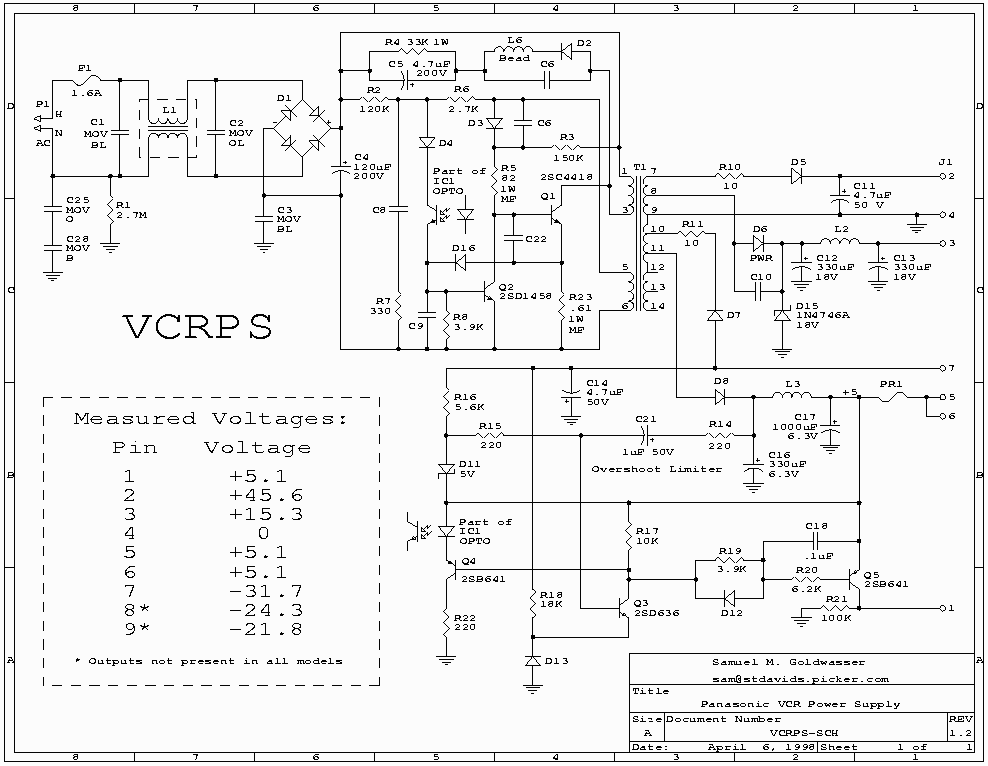
The Panasonic VCR power supply schematic is available in both PDF and GIF
format:
A Web search should easily turn up other sources.
The information below is just a summary.
These devices generate the PWM pulse control to the switchmode (chopper)
transistor as well as various fault sensing and other control functions.
Parts such as these are now found in many small switchmode power supplies
and provide much more precise control during startup and normal operation, and
better handling of fault conditions compared to most implementations using
discrete circuitry.
However, they also result in additional head scratching when troubleshooting
since many faults or incorrectly detected faults can shut down the unit or
cause a power cycling type of behavior. Therefore, a datasheet for the
controller chip will prove essential. In many cases a scope will be needed
to monitor the various sense, control, and drive signals. A systematic
troubleshooting approach must be used to eliminate power, startup, sensing,
and control components one at a time once obvious shorted or open parts or
bad connections have been eliminated from consideration.
The following pin descriptions for the Unitrode UC3840 were derived from a
Unitrode application note. Errors in interpretation are quite possible.
The following pin descriptions for the Unitrode UC3842 were derived from a
Unitrode application note. Errors in interpretation are quite possible.
In addition to the overload condition described below, a dried up electrolytic
capacitor on the Vcc line can also result in this cycling behavior since it is
unable to hold up the voltage between output pulses. In addition, the sense
inputs can trigger shutdown. In all, an often complex difficult to understand
and troubleshoot situation - sometimes too much so for its own good!
(Portions from: Yves Houbion (yves.houbion@fundp.ac.be).)
Pin 7 is the power supply (Vcc). The oscillator inside the 3842 begins to work
above 16 V on Vcc and stops working when this voltage drops below 11 V. With
a stopped oscillator, the current consumption is very low, around 1 mA; with a
working oscillator, the current is much higher, about 12 mA. (The specific
voltages and currents are typical values for one particular version of the
3842 and can vary from device to device and depending on model.)
Vcc is generally powered in two ways: a high value power (startup) resistor
connected to the main bridge (e.g., +300V) and a from a winding off the
transformer (via a rectifier/filter capacitor). The value of the startup
resistor is selected such that there is more than 16 V with 1 mA but less than
11 V at 12 mA. So the oscillator can't continue to work with only the startup
resistor supplying power.
Suppose we apply AC power to the supply. The +300V comes on. First, the
3842 consumes only 1 mA, Vcc reaches 16 V, and the oscillator starts up. If
all is well (no overloads), the transformer provides the necessary 12 mA
current to maintain Vcc at more than 11 V.
However, if the transformer is overloaded, Vcc falls under 11 V and the
oscillator stops working. The current decreases to 3 mA, the voltage increase
(coming from the +300V) the oscillator start again, ad-infinitum.
Tweet-tweet-tweet....
I don't advise it. There are many factors involved in changing a power
supply unless it is designed for dual voltage or autoswitching. They saved
a few cents if it is not easily switched, what can I say?
The problem is that it is probably a flyback converter and these are
pretty finicky about changes. In addition to the caps, and switching
transistor, the transformer would probably saturate at the higher voltage
unless the switching frequency were also doubled. Getting these things
to work normally without blowing up is touchy enough. To change one
without a thorough understanding of all the design parameters would be
really risky.
Going the other way may be more realistic if (and this is a big if) you
will not be running at anywhere near full capacity. Many switchmode
power supplies will run on much lower than their rated input voltage.
However, regulation may be poor and the switchmode transistor will need
to be passing much higher current to maintain the same power output.
To maintain specifications could require extensive changes to the circuitry
and replacement of the switchmode transistor and possibly transformer and
other parts as well. Again, I do not recommend this.
Use a small stepup or stepdown transformer instead. The only exceptions are:
CAUTION: As they say in wood-working: "Measure twice, cut once". Make sure
you are dealing with the correct jumper AND you are going the right way
(increasing or decreasing as needed). If the manufacturer didn't include
this feature, there may be a good reason!
Also see the secton: "Switching between 115 VAC and 230 VAC input".
(From: Winfield Hill (hill@rowland.org).)
Some of the PC power supplies I've dissected do have pots, by they have a
limited voltage-adjustment range. One interesting thing, every design used a
TL431 chip, which is a 3-pin TO-92 regulating IC, as the voltage reference and
opto-feedback component. Find this chip and trace out the resistors connected
to it to determine which part to change to make a higher voltage.
But, watch out for the SCR over-voltage circuit in some supplies. This is
usually set to trip around 6 to 6.5 volts, and its trip point would need to be
modified as well.
As far as the step-down transformer turns ratio, there's little trouble one
will encounter here, because the power supply is no doubt designed to function
properly with reduced AC line voltages. The penalty one will pay for turning
up the output voltage is a higher minimum AC voltage.
In most designs, the +12 and -12 V supplies merely track the 5V supply, and are
not separately regulated. They may soar to higher voltages anyway if
unloaded, but will be additionally increased in voltage by the ratio of 5V
output increase. Even though the rating of the 5V electrolytic may not be
exceeded, and still have a sufficient safety margin, this may not be the case
for the 12 V outputs. So that issue should be examined as well.
Finally, a reminder for any reader tempted to break open the box and start
experimenting. Voltages of up to 320 V are present, so be careful. Know what
you're doing. For safety, stay away from open supplies when plugged in, or
always keep one hand behind your back when probing. Remember a the AC bridge
and HV DC and flyback transformer portion of all these supplies is operating
straight from the AC line, so don't connect the ground of your oscilloscope to
any of that circuitry. A battery-operated multimeter is best.
Line filters can also be useful if power in you area is noisy or prone
to spikes or dips.
However, keep in mind that most well designed electronic equipment
already includes both surge suppressors like MOVs as well as L-C
line filters. More is not necessarily better but may move the point
of failure to a readily accessible outlet strip rather than the innards
of your equipment if damage occurs.
Very effective protection is possible through the use of a UPS (Uninterruptible
Power Supply) which always runs the equipment off its battery from the internal
inverter (not all do). This provides very effective isolation power line
problems as the battery acts as a huge capacitor. If something is damaged,
it will likely be the UPS and not your expensive equipment. Another option
is to use a constant voltage transformer (SOLA) which provides voltage
regulation, line conditioning, and isolation from power spikes and surges.
Manufacturers of these products may even provide equipment damage warranties
which will reimburse for surge damage to the powered equipment while using
their products. I am not sure how one proves that the UPS was being used at
the time, however!
It is still best to unplug everything if the air raid sirens go off or
you see an elephant wearing thick glasses running through the neighborhood
(or an impending lightning storm).
Therefore, I do not recommend the use of a GFCI for computer equipment as
long as all 3 wire devices are connected to properly grounded circuits.
The safety ground provides all the protection that is needed.
Supplies that are autoselecting with respect to input power are vulnerable
to voltages at an intermediate value between their low and high ranges. At
some values, they may autoselect the incorrect input range:
(From: Mike Diack (moby@kcbbs.gen.nz).)
A subject dear to my heart due to a recent unpleasant experience -
Was using a Picturelel videoconference ISDN codec on a job when, because
of a powerline fault, the line voltage dropped to 170 volts. The PicTel
has a big Onan switchmode PSU which is autoswitching between 100-120 and
200-240 volts. It got confused, and (regrettably) chose the former....
with very smelly results.
Moral: turn off things with cunning PSUs when brownouts occur (oh yes the
airconditioner units got very hot and tripped out, too)
(From: Ray Hackney (rhackney@unicomp.net).)
Simplistically speaking, the sound comes from something moving.
With non switch mode power supplies (SMPS), it may be ferrous material
(like a metal cover) being drawn toward the power transformer. That's
obvious since pushing on the cover will soften the hum. The frequency is
usually 60Hz or 120Hz.
The only time you should hear a "noise" from a SMPS is during a period of
"unstable" operation (i.e. their "loop" isn't stable and in regulation.)
That's why you may hear them "chirp" or whistle when you first turn them
on or off. It may also indicate a PC type power supply that's overloaded.
In years gone by, I've seen a quiet PC become a whistler after having a
new, big (30 meg, full height!) hard disk added. Sometimes the pitch of
the whistle would change depending on what parts of the system were being
accessed or what software was being executed. (Usually, when the old
Intel AboveBoard was being accessed in this '286, the audible pitch was
lower indicating greater current draw.)
For all power supplies, it may be the windings on the "magnetics"
(inductor or transformer). If they're not wound tightly and secured they
can vibrate. Many video monitors exhibit this problem when their flyback
transformer emits a whistle. It may be the windings themselves moving or
the winding assembly may be loose on the core.
Sometimes the capacitors in a SMPS will emit sound. Caps in SMPS'
frequently have high AC current levels. If the supply is supposed to have
what's known as "continuous current" and goes into "discontinuous
current" mode, the capacitor plates get stressed pretty heavily and move
in the capacitor body (but only with some types). Since the SMPS will go
into and out of discontinuous mode at a rate < 10kHz, it's audible. I've
run into this on breadboards I've built for 200W and 2.5kW SMPS'.
Electrolytic capacitors like to be kept cool! If there's anything that these
capacitors can't stand, it's heat. It causes them to dry out.
Electrolytic capacitors exist in (at least) two different temperature
ratings: 85 C and 105 C. The latter are obviously more temperature resistant.
Unfortunately they also tend to have a higher ESR than their 85 C counterparts.
So in an application where the heat is due to I^2 * ESR dissipation, the 105 C
type may actually be a *worse* choice! If the heat is due to a nearby hot
heatsink then 105 C is indeed a better choice.
(From: Lee Dunbar (dunbar@unitrode.com).)
Substitutions of low ESR caps into circuits which had lousy caps is not
always the good idea that it appears to be.... Caution is advised, as low
ESR caps will not limit surge currents.
The circuits' series impedance drops (compare substituted capacitors ESR
when new with the original capacitor's ESR was when it was a new capacitor),
which, in turn, lets the surge magnitude rise, the higher currents destroy
can semiconductors and other components.
I guess what the industry needs is a good capacitor cross reference guide
for aluminum electrolytics!
If the supplied voltage is increased further the PWM waveform will cease as
the control circuit will detect an overvoltage.
With this technique the whole power supply can be tested without fear of
destroying MOSFETs and it can be determined if the SMPS is regulating to
the correct voltage (if known!).
This will not work with all SMPS's. It depends on the design.
Switchmode power supply repairs can be difficult. The problem is manufacturers
don't usually give you an easy test set up. They should tell you if it will
run at no load or what dummy load to use. Secondly they should tell you what
voltage or resistance to use to replace the opto-isolator (or transformer) for
that load. The SMPS hot side is a high frequency oscillator whose 'on time' is
varied by feedback supplied through the opto-isolator. The troubleshooting
procedure should normally be in this order.
By using a fixed load and cutting out the feedback it is very easy to
troubleshoot. Don't forget to check the voltages and waveforms in your
test set-up and record them for future reference.
I wanted to pass on some comments on repair of switchmode power supplies.
I've fixed a few myself.
I highly recommend the Panasonic HFS series cap that can be bought from
DigiKey (and other places I'm sure). These unit are specially designed
for good size as well as use in switching supplies. They are also rated
for 105 degrees C as opposed to the more common 85 degrees C temperature
rating. I have never had to replace a HFS cap I installed, where I've had
to replace "common" caps in repair situations. (No I don't sell the HFS
or have stock in DigiKey,
I really suggest you refer to a handbook on basic switchmode power supply
design for the nitty-gritty.
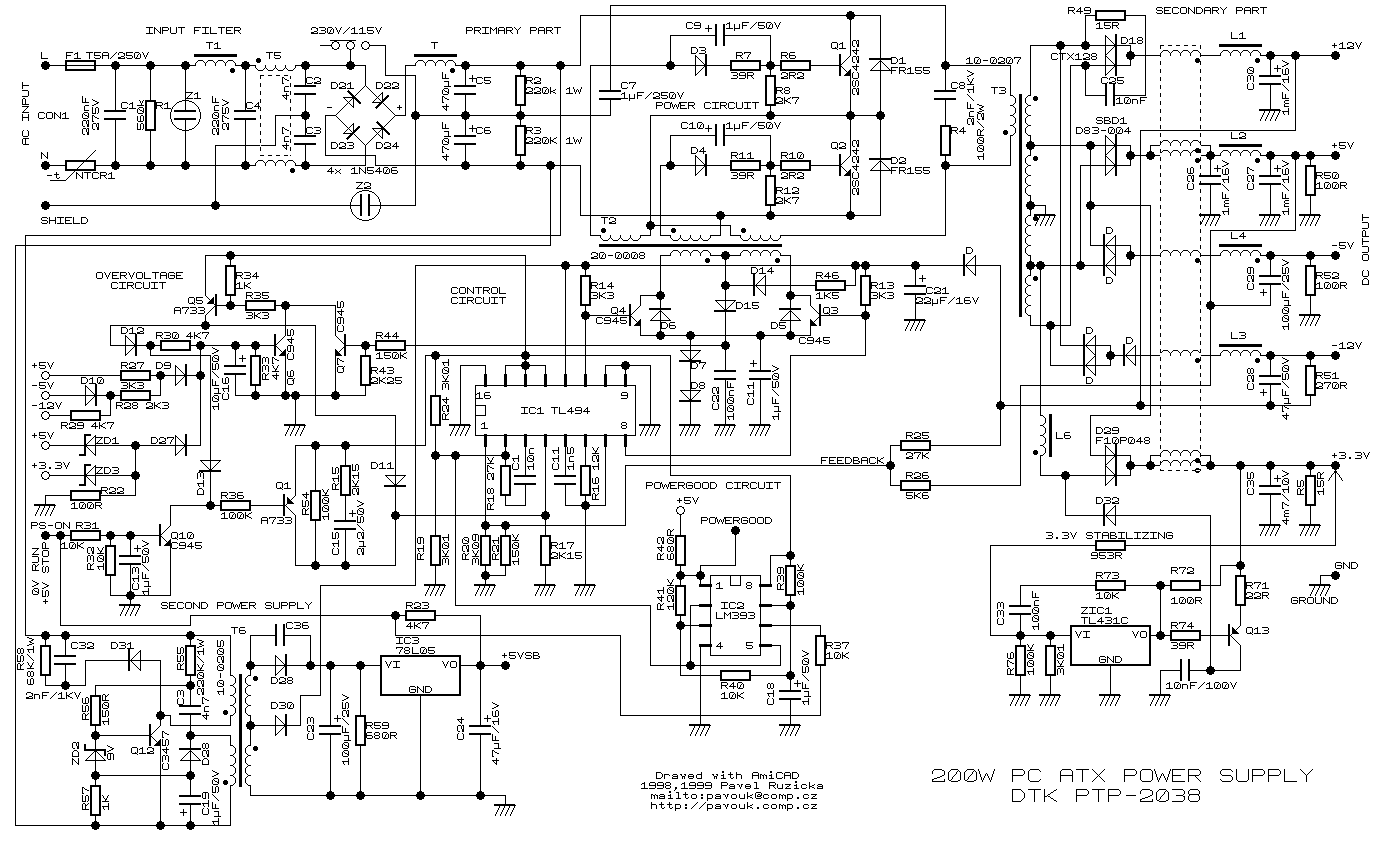
I have a schematic of a 200 Watt PC power supply, and I assure you that there
are enough cost-saving clever shortcuts in the design, that unless you know a
fair amount about the design of switchers, it will just totally and completely
baffle you.
Nearly all 200 W PC power supplies are *identical* knock offs of one-another
(except for the power-good comparator section). The transformer has a +5 V
output which is what is regulated. It also has a +12 V output and a -12 V
output. The -5 V output is derived from the -12 V output using a 7905
regulator. All transformer outputs are related in voltage by the transformer
turns ratio. The power supply topology is a Half Bridge, which normally
requires a "buck section" in each output (namely an inductor, catch diode and
capacitor). To vastly improve the cross regulation between windings, a common
core is used to wind all the 3 output inductors on.
Basically, however, a 200 W PC power supply is a half-bridge design, with a
bridge-type voltage doubler in front which simply rectifies 220 V, or doubles
110 V to 220 V. So the thing is basically a 220 Volt design.
The controller is typically a TI TL494 that operates off the output of the
supply. This means that in order to start, there must already be an output
voltage present! How they do this is really really clever, and also extremely
confusing. The power transformer is itself, self oscillating. This generates
a rudimentary output voltage that allows the thing to bootstrap up to normal
operation, and the controller chip to take over.
The +12 Volt output is what is used to power the PWM chip. Thus, the supply
runs off its own output. This is done to eliminate the need for troublesome
opto-coupler feedback. To boot itself up (after all, there is no initial +12 V
to allow itself to start), the driver transformer is modified (very cleverly)
to form part of a blocking oscillator. Thus the unit initially self oscillates
in a crude fashion until there is enough voltage on the +12 V output to allow
the PWM to start, which then swamps out the self oscillation and normal
operation commences.
Since the controller resides on the output side of the transformer, the drive
to the 2 half-bridge NPN bipolar transistors is by a driver transformer (a
direct connection cannot be made because the transistors are on the primary
side).
Frequency of operation is 50 kHz, which is low by today's standards, but this
means lower cost transformer winding (Litz wire is not needed, for example).
There are not normally schematics available for PC power supplies.
If the PC's are very old, some service manuals included the PSU schematics -
but these will be very very old, like the early Apricot that used the Astec
AC9335, the Olivetti XT, and some PC's that ran CPM like the LSI Octopus.
Most AT class computers never had schematics available for their power
supplies, the manufacturers simply intended them to be swapped out.
Schematics were produced by the power supply manufacturers for companies such
as Compaq, Sun Microsystems etc, but these where only released to their
authorized service centres. These are far and few between and sign non
disclosure agreements, so schematics are not available to anyone else. I
used to work for one such company, they repaired all of Sun's power supplies
from throughout Europe.
Here in the UK, and also in the USA, if a 'standard' AT or ATX power supply
fails it's often cheaper to replace. Many PC power supplies aren't
standard - we repair many from Compaq, Elonex, HP, Apple, Sun etc that are
non standard and can be repaired far cheaper than the manufacturers exchange
unit. Also in many countries a swap out isn't available or can be costly.
Even without schematics power supplies can be repaired. The same type of
circuitry repeats itself. Older power supplies often used the TL494C pwm IC,
newer use the UC3842/3/4/5 series driving MOSFETs. Some older still used the
NE5560, SG3524 etc., many didn't use a PWM IC, but instead discrete
components. Data sheets on the IC's used are very useful.
Considering the 'standard' 200 W AT PSU, these usually use 2 T0220 power
transistors, and at power on a resistor, usually around 270 - 330 K turn on
the top transistor, and current flows in the inverter transformer. A winding
on the secondary supplies a voltage that is rectified and smoothed to feed
the PWM IC and its drivers. These then drive the 2 transistors via a
transformer and the power supply is running. The 5 V output voltage is then
sensed and fed back to the PWM IC to maintain regulation. Most faults on
these types of power supplies involve the high value resistors failing
associated with the inverter transistors, the transistors and associated
components, bridge rectifier shorted - also check inrush thermistor for
cracks or pinholes. Secondary rectifiers can fail, and electrolytic caps can
fail if the fan stops. The PWM circuitry can always be fed with an external
DC supply and checked independently.
The other type of power supply, less common in older power supplies, uses
the UC3842 series PWM IC driving a single MOSFET. This IC sits on the primary
side, so its ground is floating high. An isolating transformer is needed
when scoping anything on the primary, with the scope ground clip to primary
ground.
Sourcing substitute components isn't normally difficult. I'd start by
obtaining some decent transistor, diode and MOSFET data books so you can
relate faulty parts to what's available locally.
If the power supplies are all 200 W, a simple resistive load will suffice for
testing made from large ally clad resistors on a substantial heat sink.
These will toast when running for longer, so will need fan cooling - a cheap
desk fan is sufficient. If you are going to be repairing a lot of varying
power and type over a prolonged period, it may be better to build an active
load. This is basically banks of 2N3055's (for 5V & 3.3V) and 2N3773 (for
12 V upwards) in series with low value power resistors than can have their
conduction varied and current monitored by other circuitry. You simply have
a lead for each power supply type you test/repair. Also don't forget to
check the PG o/p on the power supply.
To test the supply, you want to:
(Some newer supplies may have a +3.3 output as well which may be green).
I use an old dual beam auto headlight. It adds a touch of class as well
to an otherwise totally boring setup. :-) You can also use auto tail light
bulbs or suitable power resistors or old disk drives you don't really care
about (you know, those boat anchors).
Note: for an XT only, J8-Pin 1 is Gnd, J8-Pin 2 is no connect.
CAUTION: Usually, a PC power supply will just shut down with too little load.
However, some may be much more unhappy. Thus attempting to determine a safe
minimum load does entail some risk of letting the smoke out.
The reason that you need a load is that the PWM controller can't do down
to really small duty cycles needed for low loading. The design would need to
be changed and differs from unit to unit.
(From: Stefan Krommes (stkro@gmx.net).)
There is a wire (Power_Supply_On) on the ATX connector that will turn on
the main supply when pulled low. This color of that wire is mostly
labeled on the side of the supply - or (as with fortron supplies) it is
the one that is not labeled (green). If you look on top of the ATX
connector as if it was plugged into the board the wire in question is
the 4th from the right hand side on the top row (where there is the
clip) - a look into your mainboard manual might give you a visual idea
since the ATX connector is often depicted there with pins labeled.
As said if you fire up your supply it would be wise to load it. Check
the label on the supply and load the main +5V and +12 V line to about
15-20% of their max. current capability. - Some automotive bulbs
(headlight, brakelight, etc.) come handy not only for the 12 V but for the
main 5 V line too. Below about 20% load there is the chance of the supply not
regulating the voltage properly but it should start.
The 5 V standby line does not need any load - it should read a clean 5 VDC
as soon as the supply is plugged in and the mains power switch is
switched on.
The main supply should get on-line as soon as the Power_Supply_On wire
gets pulled to ground and the voltages should measure within 5% if
loaded to about 20% of maximum power.
(From: Sam.)
CAUTION: I have seen one case where an ATX supply actually blew up without
a load using this "hot wire" technique. I don't know if there was already a
problem with the unit or it really absolutely required a load. But almost
immediately after grounding the green wire, multiple electrolytic caps on the
secondary side exploded and spilled their guts, one of the MOSFETS shorted,
and then the power fuse blew. :( It may be that the designers of this
supply in their infinite wisdom assumed that since power is enabled via the
mainboard, there would never be a circumstance where there wouldn't be at
this that as a load!
(From: Tom (w_tom1@usa.net).)
You might try this and try that and.... Well that list is long and still does
not say what is wrong. You want to identify the problem now, and then
fix it. In but minutes with a 3.5 digit multimeter, we can identify
the problem AND then replace the suspect. Do not attach or disconnect
anything. Changing things may even exponentially complicate the
problem. That 3.5 digit meter is available for less than $20 in Sears,
Lowes, K-mart, Radio Shack, and Home Depot. That's the complex part.
With computer plugged into AC receptacle, use meter to measure
voltage on purple wire between power supply and motherboard (connect
probes to purple wire by pushing into nylon connector and other probe
to chassis). That voltage must be more than 4.87 VDC. If not, power
supply controller will not tell power supply to power on. Next measure
voltage on green wire. It must be more than 2 volts before switch is
pressed and must drop immediately to less than 0.8 volts when switch is
pressed. This tells power supply to turn on.
Next measure voltage on gray wire. It must rise to more than 2.4
volts within seconds after power switch is pressed. Again, you want to
see what happens when switch is pressed - not just long after switch is
pressed. This signal tells motherboard that power supply is OK.
If gray wire is good or bad, then move on to one red, orange, and
yellow wires. Measure each as switch is pressed. Within one second,
each should exceed 3.23, 4.87, or 11.7 volts DC. If any does not rise,
then find what ever on motherboard or peripherals is excessively
loading that voltage.
Not only do numbers help you to find a the suspect. Those numbers,
if posted, mean that your replies can include useful information.
Without numbers, then every reply will be only 'try this and try that';
also called shotgunning. These numbers can also identify an
intermittent failure before that failure occurs. Useful numbers
obtained in but two minutes means a useful reply; and no shotgunning.
(From: Arthur Jernberg (stubbie45@hotmail.com).)
Here is the pinout for an ATX mainboard:
Left to right: First row voltage; Second row current/color:
(From: Claudio Lima (claudio.jc.lima@bol.com.br).)
The following procedure is intended for the newer ATX v.2.x power supplies
using a 24 pin connector, as all pinout references were made according to
that standard.
(From: Sam.)
IMPORTANT CAUTION: Apparently, Dell, who has followed industry standards
in most respects, changed the ATX power supply pinout on their PCs
sometime in 1998 and may still be using this proprietary pinout. See:
Dell
Proprietary (Non-Standard) ATX Design. Since there is absolutely no
valid technical reason for doing this, one can only assume it is due to
some, shall we say, shady business decision to prevent people from going
to a third party for upgrades or replacement mainboards or power supplies.
Worse, installing a non-Dell power supply with a Dell mainboard will result
in a destroyed power supply and possible damage to the mainboard. Thanks
Dell. :( It's straightforward though not trivial to change the power supply
pinout back to standard (but it isn't a matter of just moving pins around in
the connector since the number of wires for some signals has also changed).
But there should be no need. Companies should compete by selling a better
product, not a closed system.
(From: Petrus Bitbyter (p.kralt@hccnet.nl).)
I have written a set of notes on repairing ATX power supplies. It follows
below and should contain all you need (and more) to decide whether your power
supply has gone or not.
First of all read the document: SAFETY and
the general information on SMPS repair elsewhere in this document.
Most of the times the fault is found between the mains connection and the
transformer(s).
Explanation: ATX PSs usually has three power transistors at the mains side.
One is connected to a small transformer, the other two connected to a larger
transformer. You can recognize the pair of transistors best by finding the
emitter of one of them connected to the collector of the other.
First you have to deal with the one transistor and the small transformer.
(Go to Step 8 if you removed this transistor already.)
Explanation: For the next part of the repair procedure you have to provide
some load to the PS. This is simply because of some PSs will not function
well without load. You may use an (old) main board. Someone ever told me he
uses 12 V car bulbs, one on the +5 VDC and another on the +12 VDC outputs. I
prefer a huge and heavy old harddrive. Those old basalt blocks (we use to
strengthen our dikes) consume a lot of energy. The one I use, provided
enough load for all the PSs I ever repaired.
Of course, this story does not cover all possible faults of PC-power
supplies, but I only once failed to repair a PS using this scheme.
In case you have been lucky enough not to have come across the beast, the
basic idea is:
Now for the failure mode (seen it happen):
Repairing that was an entertainment. I still have my photocopy of the
schematic with all the dud components circled!
I was fighting with a Hitachi PSU (SP-13A unit from UK VT-F860E VCR).
Symptoms: Following line power disconnect, wouldn't start up. Traced circuit,
found broken Tr in LV side, replaced, no good. No gate drive. Trouble
figuring gate drive cct. Applied 30 VDC to HV side and drove gate from 10 kHz
signal generator (5 V squarewave via 1K resistor). The MOSFET switcher was
okay, output active but won't start. Startup drive is via a 1 uF, 250 V cap.
Can't see any drive on gate when power applied from cold. Read these notes.
Doh! Capacitor gone open circuit. Replace cap and now get gate drive until
output settles.
I was happily surprised to find that the circuit worked off of 30 VDC, as I'm
not keen on debugging live mains or 400 VDC! This may be a top tip for fellow
debuggers. I simply connected 30 VDC to the post-rectification smoothing cap,
hit the gate with the signal generator, and away it went. Note: this is
under no load conditions; the PSU was removed from the VCR.
I also found a devious little component masquerading as a resistor. It
appears to actually be back-to-back (Schottky? 1V3) diodes and a 220 ohm
resistor in some series or parallel arrangement. Marked externally as 220R,
identical appearance to other resistors.
There are actually many reasons for the fuse to be much larger than the
maximum current specified on the nameplate. Some of these include:
Replacing the fuse with a smaller one really won't make the equipment any
safer but may result in nuisance blowing.
(Also see the related document: Troubleshooting and
Repair of Consumer Electronic Equipment.
Manufacturer's service literature: Service manuals may be available
for for your equipment. Once you have exhausted other obvious possibilities,
the cost may be well worth it. Depending on the type of equipment, these
can range in price from $5-100 or more. Sometimes, these may even be free
(yes, even in this day and age where you have to pay for free air at your
local gas station!) Some are more useful than others. However, not all
include the schematics so if you are hoping to repair an electronic problem
try to check before buying.
Inside cover of the equipment: TVs often have some kind of circuit
diagram pasted inside the back cover. In the old days, this was
a complete schematic. Now, if one exists at all for a monitor, it just
shows part numbers and location for key components - still very useful.
Sams Photofacts: These have been published for over 45 years mostly
for TVs and radios. There are some for VCRs and a few for some early
PC monitors and other pre-Jurassic computers. However, for the power
supplies in TVs, there will nearly always be a Sams with complete
schematics.
Whatever the ultimate outcome, you will have learned a great deal.
Have fun - don't think of this as a chore. Electronic troubleshooting
represents a detective's challenge of the type hat Sherlock Holmes
could not have resisted. You at least have the advantage that the
electronics do not lie or attempt to deceive you (though you may
beg to differ at times). So, what are you waiting for?
The following site has a variety of information and links to SMPS related
sites:
SMPSPowerSupply.com has
extensive information including a great deal on PC power supplies including
explanations of how they work, schematics, standards, and more.
Also see the document:
PC Switchmode
Power Supplies.
Texas Instruments has an application note which is sort of the "short"
version of SMPS repair. See:
Off-Line SMPS
Failure Modes PWM Switchers and DC-DC Converters.
Here are some suggested books with information relating to SMPS and DC-DC
converter design, testing, troubleshooting, repair, etc.:
In addition, many smeiconductor manufacturers publish extensive information
on switchmode technology. Mostly, this is in connection with their product
lines but will also contain a lot of general information. Much of this is
available on Internet via the World Wide Web. Companies include: Maxim,
Linear Technology, and Unitrode.
(From: OneStone (OneStone@bigpond.com).)
"Try the Linear Technologies Website.
Look for their App notes:
Then try one of their new data sheets, such as the LT1370, for some modern
circuit configurations, such as SEPIC converters. The above APP notes are all
contained in their Linear Applications handbook, Volume 1, 1990. If you are a
designer they also have a CD-ROM available, which includes some switcher and
filter design software. It's a bit limited, but a great starting point if you
don't need to stretch the boundaries."
For diagnosing power problems in TVs and Computer or Video monitors,
here is one book that includes many illustrations and case histories.
(From: Ernst C. Land, Jr. (a6mech@ionet.net)
and Mark Zenier (mzenier@eskimo.com or mzenier@netcom.com).)
The September 1996 (VOL. 17 NO. 9) issue of Nuts & Volts Magazine has a great
article on theory, troubleshooting, and repair of PC power supplies. Their
web site is: http://www.nutsvolts.com/.
When you get there, click on [more], then [back issues]
Other cross reference guides are available from the parts source listed below.
For safety related items, the answer is generally NO - an exact replacement
part is needed to maintain the specifications within acceptable limits with
respect to line isolation, X-ray protection and to minimize fire hazards.
Typical parts of this type include flameproof resistors, some types of
capacitors, and specific parts dealing with CRT high voltage regulation.
However, during testing, it is usually acceptable to substitute electrically
equivalent parts on a temporary basis. For example, an ordinary 1 ohm
resistor can be substituted for an open 1 ohm flameproof resistor to determine
if there are other problems in the the SMPS chopper before placing an order
as long as you don't get lazy and neglect to install the proper type before
considering the repair complete.
For other components, whether a not quite identical substitute will work
reliably or at all depends on many factors. Some deflection circuits are
so carefully matched to a specific horizontal output transistor that no
substitute will be reliable.
Here are some guidelines:
Also see the section: Replacement power transistors
while testing.
The following are usually custom parts and substitution of something from
your junk box is unlikely to be successful even for testing: flyback (LOPT)
and SMPS transformers, interstage coils or transformers, microcontrollers,
and other custom programmed chips.
Substituting entire circuit boards and other modules from identical models
is, of course, possible and an excellent troubleshooting aid even if it is
only used to confirm or identify a bad part. However, if the original
failure was catastrophic, you do run some risk of damaging components
on the substitute circuit board as well.
Therefore, using a part with better specifications may save you in the long
run by reducing the number of expensive blown parts. Once all other problems
have been located and repaired, the proper part can be installed.
However, this is not always going to work. In a TV and especially a high
performance monitor, the HOT may be closely matched to the drive and output
components of the deflection circuits. Putting in one with higher Vce, I,
or P specifications may result in overheating and failure due to lower Hfe.
Where possible, a series load like a light bulb can be used limit the maximum
current to the device and will allow you to power the equipment while checking
for other faults. Some designs, unfortunately, will not start up under these
conditions. In such cases, substituting a 'better' device may be the best
choice for testing.
(From: Glenn Allen (glenn@manawatu.gen.nz).)
I been repairing SMPS of all types but when I started on those using MOSFETs
I was blowning a few of them when replaced because something else was faulty.
Ever since I have been using a BUZ355 on a heat sink I haven't blown it. It
is rated at 800 V, 6 A, and 220 W. it is a TO218 case bigger than a T0220.
It seems the higher ratings allows you to do repair where as a something like
a 2SK1117 or MTP6N60 will just blow.
It was written with TV and monitor horizontal output transistors in mind but
applies to the switchmode/chopper transistors found in line powered SMPSs as
well.
(From: Raymond Carlsen (rrcc@u.washington.edu).)
After installing a replacement HOT in a TV set or monitor, I like to check the
temperature for awhile to make sure the substitute is a good match and that
there are no other problems such as a weak H drive signal. The input current
is just not a good enough indicator. I have been using a WCF (well calibrated
finger) for years. For me, the rule of thumb, quite literally, is: if you can
not hold your finger on it, it's running too hot, and will probably fail
prematurely. Touching the case of the transistor or heat sink is tricky....
Metal case transistors will be connected to the collector and have a healthy
pulse (>1,200 V peak!) and even with plastic case tab transistors, the tab will
be at this potential. It is best to do this only after the power is off and
the B+ has discharged. In addition, the HOT may be hot enough to burn you.
A better method is the use of an indoor/outdoor thermometer. I bought one
recently from Radio Shack for about $15 (63-1009). It has a plastic 'probe' on
the end of a 10' cable as the outdoor sensor. With a large alligator clip, I
just clamp the sensor to the heat sink near the transistor and set up the
digital display near the TV set to monitor the temperature. The last TV I used
it on was a 27" Sanyo that had a shorted H. output and an open B+ resistor.
Replacement parts brought the set back to life and the flyback pulse looked
OK, but the transistor was getting hot within 5 minutes... up to 130 degrees
before I shut it down and started looking for the cause. I found a 1 uF 160
volt cap in the driver circuit that was open. After replacing the cap, I
fired up the set again and monitored the heat sink as before. This time, the
temperature slowly rose to about 115 degrees and stayed there. I ran the set
all day and noticed little variation in the measurement. Test equipment doesn't
have to cost a fortune.
However, for modern electronic equipment repairs, places like Digikey,
Allied, and Newark do not have the a variety of Japanese semiconductors
like ICs and transistors or any components like flyback transformers or
degauss Posistors.
See the document: Major Service Parts Suppliers for
some companies that I have used in the past and others that have been
recommended.
In addition, specifically for VCR SMPS repair:
Rebuild kits for many popular VCR switchmode power supplies, VCR parts, some
components. They will be happy to identify specific VCR part numbers as well
based on model and description as well.
-- end V2.86 --
All Rights Reserved
2. There is no charge except to cover the costs of copying.
DISCLAIMER
Careless troubleshooting of a line powered switchmode power supply can
result in severe electrical shock or electrocution. This is potentially
more lethal than the high voltage section of a TV or monitor due to the
high current availability. Even the charge on the main filter capacitors
with the unit unplugged can kill.
Introduction
The switchmode power supply (SMPS)
Until the 1970s or so, most consumer electronic equipment used a basic
power transformer/rectifier/filter capacitor type of power supply for
converting the AC line into the various voltages needed by internal
circuitry. Even regulation was present only where absolutely needed -
the high voltage supplies of color TV sets, for example. Remember those
old TVs with boat anchor type power transformers? (Of course, if you
recall those, you also recall the fond days of vacuum tube sets and the
corner drugstore with a public tube tester!)
Switchmode power supply repair
Unlike PC system boards where any disasters are likely to only affect
your pocketbook, power supplies, especially line connected switchmode
power supplies (SMPSs) can be dangerous. Read, understand, and
follow the set of safety guidelines provided later in this document
whenever working on line connected power supplies as well as TVs,
monitors, or other similar high voltage equipment.
Most Common Problems
The following probably account for 95% or more of the common SMPS ailments:
Repair or replace
Some manufacturers have inexpensive flat rate service policies for power
supplies. If you are not inclined or not interested in doing the diagnosis
and repair yourself, it may be worthwhile to look into these. In some cases,
$25 will get you a replacement supply regardless of original condition.
However, this is probably the exception and replacements could run more than
the total original cost of the equipment - especially as in the case of most
TVs and many computer monitors, where the power supply is built onto the main
circuit board.
Related Information
See the manuals on "Failure Diagnosis and Repair of TVs" and "Failure
Diagnosis and Repair of Computer and Video Monitors" for problems specific
to that type of equipment. For computer power supplies and other general
info, also see: "PC Switchmode Power Supplies". These are all available
at this site under the Repair Menu.
Switchmode Power Supplies
Power Supply Fundamentals
A typical line connected power supply must perform the following functions:
Linear power supplies (LPSs)
A typical linear power supply of the type found in most audio equipment
includes a line power transformer which converts the 115/230 VAC 50/60 Hz
to other (usually lower) voltages (now that most equipment has done away
with vacuum tubes except for CRTs, more on that later). The power
transformer also provides the isolation between the load and the line.
The outputs are rectified by a diode bridge or other solid state
configuration. Filtering is accomplished with electrolytic capacitors
and sometimes inductors or resistors arranged as a low pass filter C-L-C
(pi) or C-R-C or other configuration.
What is a switchmode power supply?
Also called switching power supplies and sometimes chopper controlled
power supplies, SMPSs use high frequency (relative to 50/60 Hz) switching
devices such as Bipolar Junction Transistors (BJTs), MOSFETs, Insulated
Gate Bipolar Transistors (IGBTs), or Thyristors (SCRs or triacs) to take
directly rectified line voltage and convert it to a pulsed waveform.
Description of typical flyback type SMPS
Probably the most common topology for small switchers is the flyback circuit
shown below and in Block Diagram of Basic Flyback
Switchmode Power Supply.
           CR1                             CR2        L :::::
 H o-------|>|---+----+---------+ T1 +-----|>|------+---^^^^^---+---+----o V+
          line   |    |          )||(     Main    +_|_        +_|_  |     Main
          rect.  |    /          )||(    output  C ___ LC Pi C ___  |    Output
                 |    \ R1       )||(     rect.   - |  filter - |   |
  AC       HV  +_|_   /       +-+    +--------------+-----------+---|----o V-
 Line    filter ___   \       |                                     |
  in       cap - |    |     |/       +-------+   +-----------+   +-----+
                 |    +-----+--------|  PWM  |<--| Isolation |<--| REF |
                 |       Q1 |\       +-------+   +-----------+   +-----+
                 |            |
 N o-------------+------------+
The input to the supply is the AC line which may have RFI and surge protection
(not shown). There may be several inductors, coupled inductors, and capacitors
to filter line noise and spikes as well as to minimize the transmission of
switching generated radio frequency interference back into the power line.
There may be MOV type of surge suppressors across the three input leads (H,
N, G). A line fuse is usually present as well to prevent a meltdown in case
of a catastrophic failure. It rarely can prevent damage to the supply in the
event of an overload, however.
Advantages of SMPSs compared to LPSs
The benefits provided by implementing switch mode operation are with
respect to size, weight, and efficiency.
Where are SMPSs used?
Switch mode power supplies are commonly used in computer and other digital
systems as well as consumer electronics - particularly TVs and newer VCRs
though audio equipment will tend to use linear power supplies due to noise
considerations. You will find SMPSs in:
Switchmode Power Supply Troubleshooting
SAFETY
The primary danger to you is from the input side of the supply which is
directly connected to the AC line and will have large electrolytic capacitors
with 320 V or greater DC when powered (often, even if the supply does not work
correctly) and for some time after being unplugged (especially if the power
supply is not working correctly but does not blow fuses).
Tips on SMPS troubleshooting
The diagnosis of problems in switchmode power supplies is sometimes made
complicated due the interdependence of components that must function
properly for any portion of the power supply to begin to work. Depending on
design, SMPS may or may not be protected from overload conditions and may fail
catastrophically under a heavy load even when supposedly short circuit proof.
There is particular stress on the switching devices (they are often 800 V
transistors) which can lead to early or unexpected failure. Also, SMPS may
fail upon restoration of power after a blackout if there is any kind of power
spike since turn-on is a very stressful period - some designs take this into
account and limit turn on surge.
Test equipment
The most valuable piece of test equipment (in addition to your senses)
will be a DMM or VOM. These alone will suffice for most diagnosis of
faulty components (like shorted semiconductors or open fusable resistors).
Incredibly handy widgets
These are the little gadgets and homemade testers that are useful for many
repair situations. Here are just a few of the most basic:
Safe discharging of capacitors in switchmode power supplies
A working SMPS may discharge its capacitors fairly quickly when it is shut
off but DO NOT count on this. The main filter capacitors may have bleeder
resistors to drain their charge relatively quickly - but resistors can fail
and the term 'quickly' may be relative to the age of the universe. Don't
depend on them.
Capacitor discharge tool
A suitable discharge tool for each of these applications can be made as
quite easily. The capacitor discharge indicator circuit described below
can be built into this tool to provide a visual display of polarity and
charge (not really needed for CRTs as the discharge time constant is
virtually instantaneous even with a multi-M ohm resistor.
Capacitor discharge indicator circuit
Here is a suggested circuit which will discharge the main filter capacitors
in switchmode power supplies, TVs, and monitors. This circuit can be built
into the discharge tool described above.
(Probe)
<-------+
 In 1   |
        /
        \    2 K, 25 W     Unmarked diodes are 1N400X (where X is 1-7)
        /                   or other general purpose silicon rectifiers.
        \
        |
        +-------+--------+
      __|__   __|__      |
      _\_/_   _/_\_      /
        |       |        \ 100 ohms
      __|__   __|__      /
      _\_/_   _/_\_      |
        |       |        +----------+
      __|__   __|__    __|__      __|__      Any general purpose LED type
      _\_/_   _/_\_    _\_/_ LED  _/_\_ LED   without an internal resistor.
        |       |        |    +     |    -   Use different colors to indicate
      __|__   __|__      +----------+         polarity if desired.
      _\_/_   _/_\_      |
 In 2   |       |        |
>-------+-------+--------+
(GND Clip)
The two sets of 4 diodes will maintain a nearly constant voltage drop of about
2.8-3 V across the LED+resistor as long as the input is greater than around
20 V. Note: this means that the brightness of the LED is NOT an indication
of the value of the voltage on the capacitor until it drops below about 20
volts. The brightness will then decrease until it cuts off totally at around
3 volts.
Voltage checkers
Whereas a multimeter is intended to measure voltages (and other things),
a checker is used mostly to just produce a quick indication of the presense
of voltage, its polarity, and other basic parameters. One use is a quick,
but reliable indication of the status of the charge on a BIG capacitor. An,
example of a simple version of such a device is the "capacitor discharge
indicator circuit" described above.
The series light bulb trick
When powering up a monitor (or any other modern electronic devices with
expensive power semiconductors) that has had work done on any power circuits,
it is desirable to minimize the chance of blowing your newly installed parts
should there still be a fault. There are two ways of doing this: Use of a
Variac to bring up the AC line voltage gradually and the use of a series load
to limit current to power semiconductors.
What about SMPSs in TVs and monitors?
TVs and monitors have at least one SMPS - the horizontal deflection
flyback circuit and may have an additional SMPS to provide the low
voltages or the DC for the horizontal output transistor. Most of the
theory of operation and troubleshooting techniques apply to these as
well. However, manufacturers of TVs and monitors tend to be really
creative (can you say, obscure?) when it comes to these designs so a
little more head scratching is often necessary to decipher the circuit
and get into the mind of the designer. However, the basic failure modes
are similar and the same test procedures may be used.
Comments on SMPS capacitor discharging and testing with series loads
(From: Ian Field (ionfieldmonitors@ic24.net).)
SMPS failure modes
Also see the section: Sounds that SMPSs make.
"I have encountered a bad cap (10uf 35v) on the Vcc input of a UC3842 IC
in the power supply. Turn unit on, get very short burst of power supply
output, then nothing. Every time the 3842 output a pulse, it ran out of
VCC. Small part, big problem."
Sounds that SMPSs make
Most switchmode power supplies when operating normally produce little or no
detectable sound. The switching frequencies are usually well above the range
of human hearing, but your dog or pet dolphin might be driven nuts!
"Some switchmode power supply inductors will make a hissing or white
noise sound, typically when the circuit is lightly loaded and running in
a "pulse skip" or PFM mode. I have heard it on many DC/DC circuits.
You could try removing the coil and pouring in some epoxy."
General SMPS troubleshooting approach
The following sections provide a set of guidelines for attacking SMPS
problems. Those in the next 5 paragraphs are common to SMPS using both
discrete and integrated controllers:
Troubleshooting SMPSs using discrete controllers
The following paragraphs apply mainly to SMPSs using discrete circuitry
(no ICs) for pulse width control. For those using integrated controller
chips, see the next section: Troubleshooting SMPSs
using integrated controllers.
Troubleshooting SMPSs using integrated controllers
Since there are usually several fault conditions that can result in
an aborted startup or cycling behavior, the basic troubleshooting
procedure needs to be modified when dealing with SMPS using controller
ICs like the UC3840 or UC3842.
Initial post-repair testing
Once defective parts have been replaced, if possible remove the normal load
from the supply if you have not already done so just in case it decides to
put excessive voltage on its outputs and replace with a dummy load. For a
multiple output supply, the most important output to have a load on is the
one that is used for regulation but some modest load on all the outputs is
preferred. You should be able to determine a suitable value by considering
the application. For something like a VCR, a few hundred mA on the main
output is probably enough. This would require something like a 25 ohm 2 W
resistor for a 5 or 6 volt output or 50 ohm 5 W resistor for a 12 volt output
(depending on which is the primary output). For a PC power supply, a couple
of amps may be needed - a 2 or 3 ohm 15 W resistor on the +5 output. The
minimum load is sometimes indicated on the specification sticker. In the
case of a TV or monitor, disconnecting the load may not be possible (or at
least, easy).
Some general switchmode power supply repair comments
Any time the switchmode transistor requires replacement, check all
semiconductors for shorts and fusable resistors for opens. even if you locate
what is thought to be **the** problem early on. Multiple parts often fail
and just replacing the transistor may cause it to fail as a result of something
else still being bad. In particular, check primary side electrolytic
capacitors for reduced capacity or opens. These conditions can result
in a blown switchmode transistor as it attempt to supply adequate current
during the troughs of the rectified high voltage DC. It only takes a few
more minutes. For other problems like an open startup resistor this
excessive caution is unnecessary as these are usually isolated failures.
However, if any dried up electrolytics are found, it is good practice to
test them all - or just replace them all since the cost and time will be
minimal. As they say, 'peas in a pod fail at nearly the same time'.
Periodic power cycling problems
These are of the form: tweet-tweet-tweet or flub-flub-flub or some other
similar variation. Any LEDs may be flashing as well and in the case of
something like a monitor or TV, there may be HV static or even a partial
raster in synchrony with the sounds. These types of problems are more
common with sophisticated implementations - the simple ones just blow up!
Testing a SMPS without startup drive
Where an SMPS doesn't start and it isn't obvious why, it might help to
drive the chopper from an external signal source to see what then works.
The only time this is really practical is where a single transistor or
MOSFET is used - generating a push-pull waveform probably isn't worth it.
Components Found in Switchmode Power Supplies
Common, unusual, and strange
Most of the components used in switchmode power supplies are common and
easily identified. However, some may be unfamiliar and unrecognizable.
Others could be totally custom parts - ASICs or hybrid circuits - developed
specifically for a particular model or product line. However, these
rarely fail despite your temptation to blame them specifically *because*
locating a replacement is difficult and most likely expensive.
Switchmode (chopper) transistors and other semiconductors
Also see the document: Basic Testing of Semiconductor
Devices.
Capacitors (filter and bypass)
"When you find a position that eats electrolytic caps, replace them but add a
parallel .22 to .47 uF ceramic monolithic.
Resistors (normal and flameproof), NTC thermistors, MOVs
Transformers and inductors
Fans
Many small SMPSs don't have any fans built in but expect there to be a fan
or fans elsewhere in the equipment designed draw air over the power supply.
Most computer power supplies do have a fan inside - and these are high
failure items due to how cheaply they are made.
Items of Interest
Panasonic VCR SMPS
The same power supply design is used with minor variations in a wide variety
of Panasonic (and clone) VCRs from the 1980s and 1990s (and may continue to
this day). Depending on the specific model, there may slightly different
output voltages and number of outputs but the general organization is
identical. These use discrete components throughout with feedback from
the primary output (5 to 5.2 V depending on model) using an optoisolator
to essentially short out the drive to the main chopper transistor (Q1) when
the output equals the desired voltage. The most common problems found
with any of these supplies is dried up electrolytic capacitors. Generally,
the first to go will be C16 and C17 on the +5.1 VDC line and/or C21 in the
feedback path (actual part type and number may vary slightly with model).
Symptoms will be either that the primary output is somewhat low (4 to 4.5 VDC)
or that the supply has gone overvoltage and blown the protection zener (D15)
resulting in a high pitched whine as the chopper struggles to drive current
into a short circuit (this usually doesn't damage any other parts if caught in
a reasonably timely manner). If any capacitor related problems are found,
it is a good idea to replace all the electrolytics in the supply. Model
specific capacitor kits as well as total rebuild kits are available from
places like Studio Sound
Service and MCM Electronics.
Typical controller ICs found in small switchmode power supplies
Here is some information on the Unitrode UC3840 programmable off-line
PWM controller and its simplified cousin, the UC3842. These are typical
of the types of sophisticated inexpensive integrated SMPS controller ICs
that are now readily available.
Unitrode UC3840 programmable off-line PWM controller
Features of the Unitrode UC3840 include:
Pin 1: Compensation         Error amplifier (op amp) compensation network.

Pin 2: Start/U.V. lockout   This comparator performs three functions.  With
                            an increasing voltage, it generates a turn-on
                            signal at a start threshold. With a decreasing
                            voltage, it generates an under-voltage fault
                            signal at a lower level separated by a 200uA
                            hysteresis current.  At the under-voltage
                            threshold, it also resets the Error Latch if
                            the Reset Latch has been set.

Pin 3: OV sense             Over-voltage input from power supply output(s).

Pin 4: Stop (Ext stop)      External logic signal to inhibit power.

Pin 5: Reset                External logic signal to reset error condition
                            caused by (1) over-voltage, (2) over-current, (3)
                            input under-voltage detect, (4) external stop.

Pin 6: Current threshold    This voltage input sets the over-current trigger
                            levels for the internal comparators.

Pin 7: Current sense        This is the pulse-by-pulse PWM current control.
                            The input is a voltage taken across a series
                            resistor in the switchmode transistor's return.

                            There are two internal comparators with a
                            difference in threshold of 400 mV.  The one
                            with the lower threshold limits the current
                            for each PWM cycle.  The one with the higher
                            threshold sets the error flop-flop and shuts
                            down the supply if its threshold is ever
                            exceeded.

Pin 8: Slow start           This input limits the maximum PWM duty cycle.
                            During power-on, an RC delay can therefore
                            control the rate at which the output ramps up.
                            The final value limits the maximum PWM duty cycle
                            during normal operation.

Pin 9: Rt/Ct                R and C determine the constant PWM oscillator
                            frequency.

Pin 10: Ramp                Ramp generator output.

Pin 11: Vi sense            This voltage is normally derived from the DC
                            input and controls the slope of the ramp.

Pin 12: PWM output          This is the drive signal to the switchmode
                            transistor.  This is an open collector output
                            and will normally be used in conjunction with
                            the Driver bias (Pin 14) signal to provide
                            total drive to the switchmode transistor.

Pin 13:	Ground              Signal and drive common.

Pin 14: Driver bias         Supplies drive current to external power switch
                            to provide turn-on bias and pullup during normal
                            operation.  Disabled for shutdown if the Error
                            Latch is set.

Pin 15: Vcc                 UC3840 chip supply derived from the DC input rail
                            during startup and secondary winding on high
                            frequency transformer during normal operation.

Pin 16: 5 V reference       Stable voltage reference (output) for regulation
                            control.

Pin 17: Inv input           Error amplifier inverting input.
Pin 18: Non inv input       Error amplifier non-inverting input.

                            The difference between the inputs on Pins 17 and
                            18 control PWM duty cycle.  These will generally
                            be derived by comparing the main output with
                            the desired voltage reference.
Unitrode UC3842 off-line PWM controller
The UC3842 provides the necessary functions to implement an off-line
fixed frequency current mode control schemes with a minimal external
parts count. Note how most of the pin functions are subsets of those
found in the more sophisticated UC3840. The UC3842 retains most of
the features of the UC3840 but requires fewer external components and
comes in a much smaller package (8 vs. 18 pins).
Pin 1: Compensation         Error amplifier (op amp) compensation network.

Pin 2: Vfb                  Error amplifier (non-inverting) input for
                            regulation feedback.

                            This input is used to control PWM duty cycle
                            and is normally derived from the main regulated
                            output voltage.  It is similar in function to
                            The non-inverting input, Pin 18, of the UC3840.

Pin 3: Current sense        This is the pulse-by-pulse PWM current control.
                            The input is a voltage taken across a series
                            resistor in the switchmode transistor's return.

Pin 4: Rt/Ct                R and C determine the constant PWM oscillator
                            frequency.

Pin 5: Ground               Signal and drive common.

Pin 6: PWM output           This is the drive signal to the switchmode
                            transistor.  It uses a totem pole output which
                            has a high current drive capability both high
                            and low.

Pin 7: Vcc                  UC3842 chip supply derived from the DC input rail
                            during startup and secondary winding on high
                            frequency transformer during normal operation.

Pin 8: 5 V reference        Stable voltage reference (output) for regulation
                            control.
Description of UC3842 startup operation and cycling problems
Depending on the particular circuit design, a variety of fault conditions can
result in cycling or shutdown of an SMPS controlled by a chip like the UC3842.
And, an underloaded supply may be cycling due to overvoltage!
Switching between 115 VAC and 230 VAC input
Assuming it is not a wide compliance 'universal type', a common way to do
this is with a jumper (or switch) in the line input circuitry below
(also shown in Typical SMPS Input Voltage Select
Circuit):
                  D1
    AC o-----+----|>|-------+---------+-----o DC (+)
            ~|    D2        |+        |
             +----|<|----+  |       +_|_
                  D3     |  |     C1 ---
             +----|>|----|--+       - |
             |    D4     |    +--o-o--+     +320 VDC to chopper
    AC o---+-+----|<|----+ -  |  J1   |
           |~            |    |     +_|_
           +-------------|----+   C2 ---
                         |          - |
                         +------------+-----o DC (-)
Changing the input voltage of a switchmode power supply
Would it be possible to modify a power supply designed for operation on
120 VAC for use overseas where the power is 240 VAC?
Slightly modifying the output voltage of a PC power supply
Surplus PC power supplies are widely available and inexpensive. However, what
do you do if 5 V isn't exactly what you need for a project?
Use of surge suppressors and line filters
Should you always use a surge suppressor outlet strip or line circuit?
Sure, it shouldn't hurt. Just don't depend on these to provide protection
under all circumstances. Some are better than others and the marketing
blurb is at best of little help in making an informed selection. Product
literature - unless it is backed up by testing from a reputable lab - is
usually pretty useless and often confusing.
GFCI tripping with monitor (or other high tech equipment)
Ground Fault Circuit Interrupters (GFCIs) are very important for
minimizing shock hazards in kitchens, bathrooms, outdoors and other
potentially wet areas. They are now generally required by the NEC Code
in these locations. However, what the GFCI detects to protect people - an
imbalance in the currents in the Hot and Neutral wires caused possibly
by someone touching a live conductor - may exist safely by design in 3
wire grounded electronic equipment and result in false tripping of the
GFCI. The reason is that there are usually small capacitors between
all three wire - Hot, Neutral, and Ground in the RFI line filters of
computer monitors, PCs, and printers. At power-on and even while operating,
there may be enough leakage current through the capacitors between Hot
and Ground in particular to trip the GFCI. Even for ungrounded 2 wire
devices, the power-on surge into inductive or capacitive loads like switching
power supplies may falsely trip the GFCI. This is more likely to happen
with multiple devices plugged into the same GFCI protected outlet especially
if they are controlled by a common power switch.
Why do power supplies seem to fail after a power outage?
Startup is the most stressful time for a typical switchmode power supply.
The output filter capacitors as well as the load must be driven while the
input voltage is changing - possibly wildly. With careful design, these
factors can be taken into consideration. Not all power supplies are designed
carefully or thoroughly tested under all conditions. When power is restored,
surges, dips, brownouts, and multiple on-off cycles are possible. This is
why it is always recommended that electronic equipment be unplugged until
power has been restored and is stable.
Buzzing or other sounds from SMPSs
Two common causes are (1) loose transformer (or other cores) vibrating at
a subharmonic of the switching frequency and (2) dried up electrolytic
capacitors (primary side) introducing 120 Hz hum under load.
Cool electrolytics - temperature rating versus ESR
(From: Jeroen H. Stessen (Jeroen.Stessen@philips.com).)
When better may be worse
ESR is usually something to be minimized in a capacitor. However, where the
original design depended (probably by accident) on a certain ESR, this may
not always be the case:
Alan's SMPS troubleshooting technique
(From: Alan Liefting (aliefting@ihug.co.nz).)
John's notes on SMPS repair
(From: John Croteau (croteau@erols.com).).
Russell's comments on SMPS repair
(From: Russell Houlton (71101.2454@CompuServe.com))
Bob's description of how a typical PC power supply works
(From: Bob Wilson (rfwilson@intergate.bc.ca).)
Steve's comments on PC power supply operation and repair
(From: Steve Bell (service@bell-electronics.freeserve.co.uk).)
PC power supply information (pinouts, testing and non-standard uses)
When testing or operating a common PC (computer) power supply without
being connected to its mainboard and peripherals, a substitute load
must be provided. This would be the case if you wanted to determine
whether a supply was good or wanted to use the supply for other purposes.
  J8: Pin 1 = Power_Good   J9: Pin 1 = Gnd
      Pin 2 = +5               Pin 2 = Gnd
      Pin 3 = +12              Pin 3 = -5
      Pin 4 = -12              Pin 4 = +5
      Pin 5 = Gnd              Pin 5 = +5
      Pin 6 = Gnd              Pin 6 = +5
Safe PC power supply loading
PC power supplies are often ideal for other purposes but the required loads
represent wasted power. So, it would be nice to be able to eliminate them.
Unfortunately, it probably isn't easy to modify a PC power supply so less/no
load is needed for regulation. However, it is worth testing a supply to see
how low you can actually go on the loads - many WILL regulate the +5 with no
load on the +12 but probably not the reverse. While 20 percent load is often
recommended, 5 percent or less may work just fine. And, some don't need any
additional loads on either output (they will probably include a minimal load
resistor internally).
Typical PC and ATX power supply schematic
Notes on ATX power supply testing
You don't need a fancy "mainboard simulator" or "special ATX test tool" to
run an ATX power supply on the bench.
[+3.3V] [+5V] [+12V] [-12V] [-5V] [+5VSB] [COM] [P-ON] [PG]
 [14A]  [22A]  [9A]   [1A]  [.5A]  [PUR]  [BLK] [GRN]  [GRY]
Detailed Procedure for ATX Power Supply Fault Diagnosis
Before blaming the power supply, make sure the outlet is live, the main
power switch (if any) is on, and that any line voltage select switch hasn't
changed position or shifted to an intermediate position accidentally (possibly
when moving the PC).
War stories - the Boschert 2-stage SMPSU
(From: Tony Duell (ard@p850ug1.demon.co.ku).)
Capacitors, startup, and low voltage testing
(From: Kevin Beeden (kevin.beeden@rrl.co.uk).)
Why is the main fuse rating so big?
On a typical SMPS (or piece of equipment like a TV, monitor, or VCR using an
SMPS), the nameplate current rating may be much much smaller than
the fuse rating (or equivalently, the nameplate power rating may imply a
much smaller current). Why is this the case?
Service Information
Advanced troubleshooting
If the solutions to your problems have not been covered in this document,
you still have some options other than replacement.
SMPS info and datasheets on-line
Many companies now have very extensive information available via the
World Wide Web. Here are a few company sites:
References on SMPS technology and troubleshooting
There is a nice detailed article on PC power supply repair from Nuts and Volts
Magazine on-line at: PC Power
Supply Repair by T. J. Byers. This is probably a good place to start if you are
specifically interested in the common PC power supply. It looks like this article
is pre-ATX but most of the information still applies.
Irving Gottleib
TAB Books, 1994
ISBN 0-8306-4404-0
Rudolf P. Severns and Gordon E. Bloom
Van Nostrand Reinhold
ISBN 0-442-21396-4
Ralph E. Tarter
Howard W. Sams & Co., Inc.
ISBN 0-672-22018-0
R.D. Middlebrook & Slobodan Cuk
Contact: TeslaCo, Pasadena, CA 91107 (last known address)
John D. Lenk
Butterworth-Heinemann
ISBN 0-7506-9821-7.
B.W. Williams
McGraw-Hill, 1992
ISBN 0-07-070439-2
Abraham Pressman, Second Edition
McGraw-Hill, 1998
ISBN 0-07-052236-7.
ISBN 0-07-050806-2 (First Edition, 1991).
K. Kit Sum
Keith Billings
McGraw-Hill, 1989
ISBN 0-07-005330-8
Marty Brown
ISBN 0-7506-9442-4
Colonel Wm. T. McLyman (yes, his 1st name is "Colonel" - not military)
Marcel Dekker, Inc.
ISBN 0-8247-6801-9
Colonel Wm. T. McLyman
Marcel Dekker, Inc.
ISBN 0-8247-1873-9
Steve Smith
ISBN 0-442-20397-7.
E.C. Snelling
Butterworth, 1988
ISBN 0-408-02760-6
George Chryssis
McGraw-Hill Co., 1984
Whittington, Flynn and Macpherson published
Research Studies Press, Ltd.
ISBN 0-863-80203-6
Homer L. Davidson
2nd Edition, 1992
TAB Books, Inc.
Blue Ridge Summit, PA 17214
Parts information
I have found one of the most useful single sources for general
information on semiconductors to be the ECG Semiconductors Master
Replacement Guide, about $6 from your local Philips distributor.
STK, NTE, and others have similar manuals. The ECG manual will
enable you to look up U.S., foreign, and manufacturer 'house' numbers
and identify device type, pinout, and other information. Note that
I am not necessarily recommending using ECG (or other generic) replacements
if the original replacements are (1) readily available and (2) reasonably
priced. However, the cross reference can save countless hours searching
through databooks or contacting the manufacturers. Even if you have
a wall of databooks, this source is invaluable. A couple of caveats:
(1) ECG crosses have been known to be incorrect - the specifications
of the ECG replacement part were inferior to the original. (2) Don't
assume that the specifications provided for the ECG part are identical
to the original - they may be better in some ways. Thus, using the ECG
to determine the specifications of the parts in your junk bin can be
risky.
Information sources on the Internet
Many manufacturers are now providing extensive information via the
World Wide Web. The answer to you question may be a mouse click
away. Perform a net search or just try to guess the manufacturer's
home page address. The most obvious is often correct. It will usually
be of the form "http://www.xxx.com" where xxx is the manufacturers' name,
abbreviation, or acronym. For example, Hewlett Packard is hp, Sun
Microsystems is sun, Western Digital Corp. is wdc. NEC is, you
guessed it, nec. It is amazing what is appearing freely accessible via
the WWW. For example, monitor manufacturers often have complete information
including detailed specifications for all current and older products.
Electronic parts manufacturers often have detailed datasheets and application
notes for their product offerings.
Interchangeability of components
The question often arises: If I cannot obtain an exact replacement or
if I have a monitor, TV, or other equipment carcass gathering dust, can I
substitute a part that is not a precise match? Sometimes, this is simply
desired to confirm a diagnosis and avoid the risk of ordering an expensive
replacement and/or having to wait until it arrives.
Replacement power transistors while testing
During testing of horizontal deflection circuits or switchmode power supplies,
particularly where the original failure resulted in the death of the HOT or
chopper, overstress on replacement transistors is always a possibility if all
defective components have not be identified.
Testing of replacement chopper transistors
The following is useful both to confirm that a substitute replacement chopper
transistor is suitable and that no other circuit problems are still present.
However, this will not catch single shot events that may blow the transistor
instantly without any increase in temperature.
Repair parts sources
For general electronic components like resistors and capacitors, most
electronics distributors will have a sufficient variety at reasonable
cost. Even Radio Shack can be considered in a pinch.
Fax: 1-812-949-7743
Email: studio.sound@datacom.iglou.com.