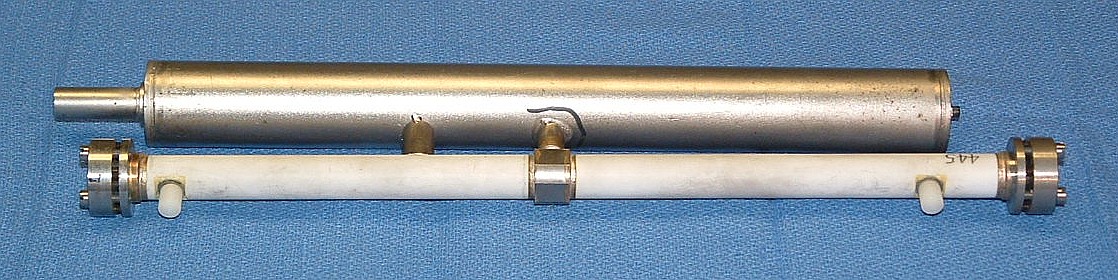
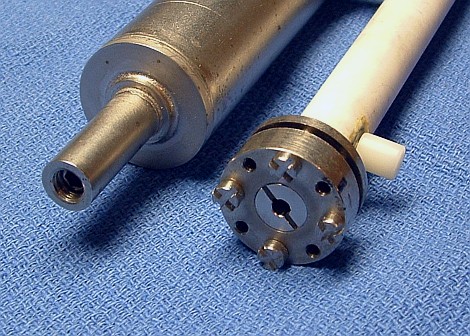
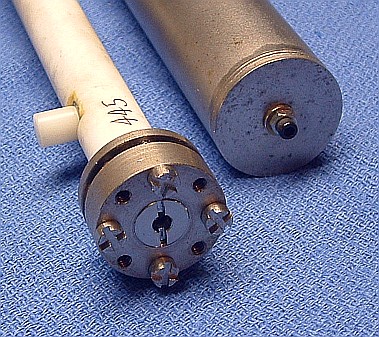
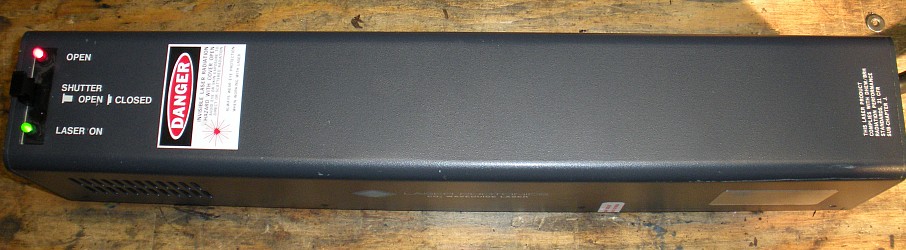
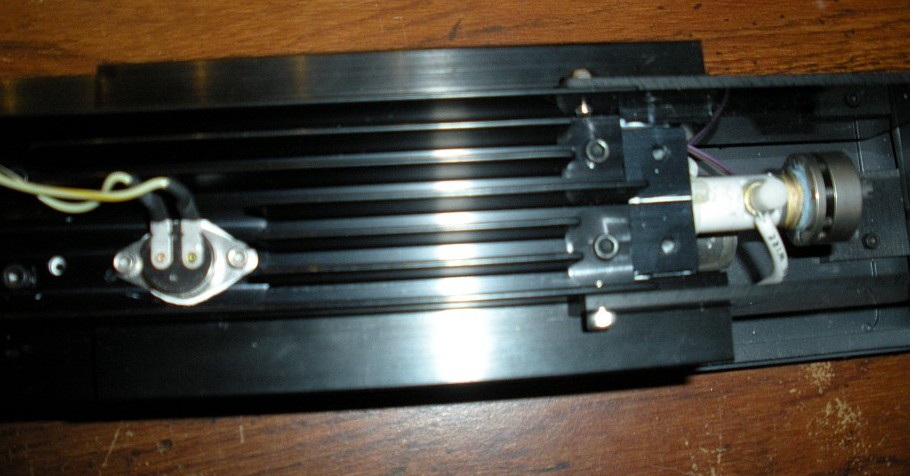
The distinguishing characteristic of the CO2 lasing process that makes these sustained power levels possible is its relatively high efficiency - at least compared to most other common gas lasers. The typical electrical power in to optical power out (wall plug) efficiency of a CO2 laser may be anywhere from 5 to 20 percent or more (compared to less than 0.1 percent for a HeNe or Ar/Kr ion laser). The only well developed laser technology which has a higher conversion efficiency than the CO2 laser is the high power IR laser diode, where a wall plug efficiency of greater than 50 percent is possible.
Unlike the other lasers producing visible or short near-IR light, the output of a CO2 laser is medium-IR radiation at 10.6 um. At this wavelength, normal glass and plastics are opaque, and water completely absorbs the energy in the beam. The 10.6 um energy is ideal for cutting, engraving, welding, heat treating, and other industrial processing of many types of materials including (as appropriate): metals, ceramics, plastics, wood, paper, cardboard, fabric, composites, and much much more.
Needless to say, 10.6 um is totally invisible to the human eye and conventional solid state sensors are blind as a post. Therefore, thermal approaches are generally used to measure beam power or determine beam profile. Companies like Macken Instruments, Inc. sell low cost CO2 viewing plates, power meters, and spectrum analyzers.
The CO2 laser represents the classic heat ray of science fiction. I have no doubt that the Martians in H. G. Wells' "The War of the Worlds" used CO2 lasers powered by cold fusion generators (probably with superconducting electrical backup storage) for their directed energy weapons. :-) (Chemical lasers would have required bulky reactant storage tanks to achieve the number and length of blasts and none were visible!)
The output power of most CO2 lasers is between a few W and a few kW (CW or average if pulsed). The smallest of these look a lot like helium-neon lasers and also used 'brick' type power supplies. Such a 5 W CO2 laser would be similar in size to a 5 mW HeNe laser though forced air cooling might be required. However, some amazingly high power CO2 lasers have been constructed. The largest one might be at the Troisk Institute for Thermonuclear Research (in Troisk, about 80 miles outside of Moscow, Russia). This is claimed to be a 10 MegaWatt laser but that might be a slight exaggeration but not by much. It is truly a CW laser though and would run for as long as power and cooling were supplied. I don't know the exact size of the laser but the room it is in rivaled that of the NOVA pulsed laser at the Lawrence Livermore National Laboratory. (I don't know if it is still in operation.)
For high peak power, there are Q-switched CO2 lasers though they probably aren't that common. One example is the "GEM Q-Switched" from Coherent, Inc.. (Go to "Laser and Other Related Products", "Laser Systems", "CO2", "GEM Q-Switched".)
CO2 lasers are also among the easier types to construct (in a relative sort of way) so they make decent condidates for home-built lasers. See the chapter: Home-Built Laser Types and Information.
Virtually all CO2 lasers are Class IV devices. The safety discussion below assumes a relatively 'small' DC or RF excited CO2 laser, perhaps up to 200 W of beam power. Such a laser could conceivably be constructed at home or acquired surplus. However, keep in mind that the term 'small' here is only relative to a high power industrial laser. A 100 W unit can cut a reasonable thickness of sheet steel and certainly set a big fire at 100 yards. I guess a 100 kW laser would be more dangerous, but few hobbyists have one. :-)
Safety precautions are extremely important for even small CO2 lasers for a variety of reasons:
The power is the big point here. The 9 to 11 um outputs of CO2 lasers are relatively benign; it's just that there are so many watts there that the things are inherently dangerous.
Human flesh including the front parts of the eye are just as susceptible to the 10.6 um energy! Laser burns can be particularly nasty as you may not feel anything initially due to the instant death of nerves and cauterization of surrounding tissue. However, a few minutes later, it will hurt like H**l. The first evidence of exposure to the beam may be the wonderful aroma of burnt flesh - yours!
CO2 lasers are quite good at burning fingers and stuff. Again, this is because of the wattage, not the wavelength (although skin does absorb very well at CO2 wavelengths). People must be careful messing around with materials processing lasers unless they want to be the material being processed!
Never mess around with Class IV lasers without eye protection. Burnt fingers heal; burnt eyes don't.
HV has killed several people working on CO2 lasers. The things run around 20 kV and often, the optics are at this potential. This makes peaking power a hazardous venture.
This is not usually a problem with commercial lasers, but definitely can be a concern with home-built equipment!
Speaking of beam blocks and burning through things.... Take the following with a grain of possible exaggeration. :)
(From: Steve Roberts.)
I have a friend who was working on a 3 kW CO2 laser at a job shop, they were running the optics train in test mode with the interlocks defeated and left the folding mirror assembly off, so the beam shot out and quickly went through a steel door, two cement/fiberboard walls, and partially through a cinder-block wall before they realized their mistake. He even claims it lased quite well when a factory tech left a large monkey wrench inside the resonator. I wouldn't have believed it till I heard a second tech back up his story. Needless to say I never turn my back on him while he's in my lab!
It must be nice to have that kind of single pass gain, because the argon lasers I work on can wink out if you even just lean on the unit and slightly stress the resonator or have even a invisible amount of crud on the optics.
(From: Leonard Migliore (lm@laserk.com).)
That doesn't sound quite right. Even a 3 kW beam has to be focused to get through steel. Cement is even more resistant. Did it take them an hour to realize their mistake?
(From: Steve Roberts.)
It's your typical plasterboard wall. I couldn't remember the word 'plasterboard' late at night when I wrote that. I have watched a 60 watt doubled Q-switched YAG go through them unfocused about a foot from the wall, so I can see a hot CO2 beam going through it easily enough. The laser in question is a Mitsubishi workstation with recirculating flowing gas.
(From: Leonard Migliore (lm@laserk.com).)
The monkey wrench part is pretty reasonable. When I was at Spectra-Physics, we made this great big 5 kW laser called a 975 (the head weighed 9000 lbs). People were always dropping pens, tools and hardware into the cavity, which was such that you didn't want to take it apart enough to get the stuff out. This never seemed to bother the things.
One day, we sold our lab laser to a French customer (Yes, we told them it was used). This required disassembling the laser to put in 50 Hz blower motors. When we did this, we found several pounds of garbage sitting in a quart of vacuum pump oil (pump failure some time before). The laser had been operating perfectly, delivering 6 to 7 kW maximum power with a swamp under the resonator.
This is a righteous piece of industrial hardware.
There are major performance differences between Nd:YAG and CO2 lasers. One reason is that Nd:YAG light is emitted at a wavelength of 1.06 microns in the near infrared, while CO2 light is emitted at 10.6 microns. The material interactions at these wavelengths differ. Most organics don't absorb 1 micron light very well, while they absorb 10 micron light. So, non-metal processing is generally a CO2 application. Metals are more reflective at 10 microns than at 1 micron, so CO2 lasers only weld effectively in the "keyhole" mode, where the irradiance is high enough to generate a vapor channel in the workpiece. Once you get into keyhole mode, the high average power of CO2 lasers makes high speed welding possible. For small spot welds, Nd:YAG lasers are far more controllable.
Also, since there are a lot more Nd atoms in a YAG rod than there are CO2 atoms in laser gas, Nd:YAG lasers can deliver much higher peak powers than CO2 lasers. This makes them better for drilling. Conversely, since it's hard to cool a solid rod, Nd:YAG lasers have problems with high average powers. You can build a CO2 laser with very high power; Convergent has commercial 45 kW units, and much bigger ones have been built.
It's usually pretty clear if a given application is best done with Nd:YAG or CO2. There are a few areas where either ( or neither) are equally good, but, in general, the application areas are quite separate.
Commercial Nd:YAG lasers are available with powers up to 4 kW (continuous) or so. Pulsed Nd:YAG lasers have lower average powers but have much higher peak powers.
CO2 lasers are generally used for cutting materials like stainless steel because they can, in general, be focused to smaller spots, which improves cut quality. You can focus a 1 kW CO2 laser to a 100 micron spot. A 1 kW YAG is generally used with fiber optics for beam delivery and can't be focused smaller than 400 microns or so.
You might expect that since the output beam from a Nd:YAG laser has a wavelength 1/10th that of a YAG laser, a YAG will focus to a smaller spot. However, this assumes equivalent beam quality - which the YAG does not have. At the power levels required for material processing (note that the context here is metal cutting), YAG lasers have terrible beam quality (M2 can be 50 or 70), so they can't be focused as well. The culprit is the YAG rod, which is heated by the pump lamps and exhibits thermal lensing.
Gas lasers don't have as big a problem with thermal lensing, so you can make them real big and still get good beam quality. Self-focusing of a CO2 beam is also seldom seen. What is common in the beam path is defocusing (a beam goes into a pipe 20 mm in diameter and comes out 200 mm wide) and mirages (a beam goes into a pipe round and comes out semicircular).
There's no problem with absorption of light from either a Nd:YAG (1.06 microns) or CO2 (10.6 microns) laser in nitrogen, or in air without contaminants. In practice, air has variable percentages of CO2 and water vapor and also tends to contain hydrocarbons, all of which absorb 10.6 um light.
Both Nd:YAG and CO2 lasers are used for welding stainless steel, with CO2 lasers being used for high speeds welds.
BTW, you might come across the term: "fluence" in conjunction with materials
processing lasers. Fluence is used to characterize pulsed laser processing,
and is the energy of a single pulse divided by the area being affected. Thus,
if you have a 20 joule pulse focused to a 1 mm spot, the fluence is 20/0.78 or
25 J/mm
(From: Professor Siegman (siegman@stanford.edu).)
It's been quite a while since I looked at this, but as I recall:
(From: Harvey Rutt.)
Well Tony may not have looked at it for a while, but thats an excellent
summary!
Some extra points of detail:
Re point one, an important aspect is that the cross section for exciting N2
by electron impact is high at electron energies which can be obtained in a
nice stable discharge, & that at those energies very little else gets
excited. (Look at a multi-kW CO2 laser discharge - it is a pretty faint
glow; very little goes into useless electronic states.) CO2 & N2 molecules
that do end up in higher vibrational states (and lots do; these modes have
temperatures of a few thousand K) tend to cascade down very efficiently &
with minimal energy loss into the upper laser level. The collision cross
sections are such that vibration of the N2/CO2 coupled modes can be at
several thousand K while rotation and translation can stay not far above
300K; the electron energy is funneled to where you want it.
And re point 3, that the lower laser level, E2 in the above can be rapidly
depopulated, partly because you have two levels in Fermi resonance close
together + a third nearby, partly because two of these three are 'overtones'
of the bending vibration, & that (plus helium collisions) is a fast 'route
down'.
Another useful fact is that CO2 lasers have reasonably high gain, so that
efficiency is not too sensitive to small losses, and that the system is
essentially free of parasitic losses such as excited state absorption (ESA.)
In fact the gain is somewhat anomalous, because this is a 'difference
transition' in which *two* states change their quantum numbers, & generally
such transitions are quite weak, this one being stronger than the usual
rules of thumb would suggest.
It also happens that CO2 is 'almost' mono-isotopic ~99% 12C16O2 (13C, 17,
18O are quite rare, less than ~1%) which also helps. And because 16O has no
nuclear spin, half the rotational levels are absent, which ~ doubles the gain
compared to if 17O happened to be the common isotope.
Overall, no one single factor; a combination of helpful circumstances come
together in one molecule. The spectroscopically closely related N2O laser is
far less efficient for example. (Although N2O is NNO, not NON, which reduces
the symmetry.)
I think you will find the *original* CO2 laser (CKN Patel?) had no N2 in it
and was pretty pathetic.
Basically you have a choice of 2 basic families of lasers: CO2 or Nd:YAG
(usually shortened to just YAG). For the time being only these 2 families of
lasers have the efficiency and output power to do large-scale material
processing e.g., cutting, cladding, drilling, surface hardening, welding, etc.
There are major differences between the two types and both have advantages and
disadvantages that must be considered based on the job to be performed or
the materials being processed.
CO2 lasers and YAG's produce very different wavelengths and beam shapes. CO2
lasers are gas lasers that use carbon dioxide as the lasing medium. YAG's are
solid-state lasers that use the element Neodymium (the Nd) diffused in a
crystal of Yttrium-Aluminum-Garnet (YAG) as the lasing medium. CO2 lasers emit
at a wavelength of 10.6 microns (far-infrared), while YAG's emit at 1.06
microns (near-infrared, just below the visible red). Because of these
different wavelengths some materials are better absorbers (or reflectors) of
the 2 different beams. Aluminum is fairly highly reflective to the CO2 beam and
requires almost 40% more power to cut as opposed to the beam from a YAG - to a
beam from a YAG aluminum is almost a perfect absorber. On the other hand, most
carbon steels and stainless-steels absorb CO2 and YAG beams pretty much the
same - very well.
Beam shape. Here there is basically no comparison: Virtually all CO2
lasers produce a beam that is far, far, more symmetrical and even than ANY
industrial-class YAG laser.
The beam shape is important: Think of a lathe. If you use a fine pointed cutter
you produce finer, more precise cuts with less force needed to cut in to a
given depth. If you use a bull-nose bit you take out a much larger piece of
metal with a corresponding drop in the depth you can achieve with a specified
amount of force.
Peak and average power. CO2 lasers are usually operated in continuous
mode while YAG lasers are pulsed.
Beam delivery. Here there are very significant practical differences:
Operating considerations. As was said before, CO2 lasers are gas lasers
and YAGs are solid-state lasers. Gas lasers are very rugged - the material
that actually makes the beam is a gas and therefore cannot be damaged.
Solid-state lasers use a crystal to generate the beam. These crystal rods are
very expensive - several thousand dollars for an industrial size laser. If the
laser is improperly tuned or operated the crystal can be almost instantly
destroyed. Overall efficiency (wall plug to optical output) differs greatly:
Safety considerations. Electrically, both types of lasers can be
EXTREMELY dangerous. Both use high-energy, high-voltage circuits. Servicing
must be done by qualified personnel. However, there are significant
differences with respect to optical hazards:
One big area of hazard is that CO2 lasers are used for material processing.
They do a great job of cutting plastics. Unfortunately, the by-products of
laser processing of organics generally include very hazardous materials.
Carcinogens such as benzene and PAH's (polycyclic aromatic hydrocarbons)
are typically generated in reasonably significant quantities. Certain
materials have even better surprises: You get cyanide out of Kevlar and HCl
out of PVC. It's hard to handle this stuff, and the associated solids tend
to clog filters. Don't cut plastic (any kind) without a fully-enclosed
system that exhausts into scrubbers.
Metal cutting has some other hazards, although nothing is as bad as
plastic. Cutting stainless steel generates carcinogenic Cr (VI), generally
in amounts greater than allowed by OSHA. Most particles generated in
gas-assisted laser cutting have diameters around 1 micron, which is the
worst size for your lungs as they can get all the way to your alveoli and
clog them.
Welding (you can make a nice weld with a 200 W CO2) generates fumes too,
and also generates UV light from the weld plasma. Your glasses can protect
you from the CO2 light but pass enough UV to give you a burn (This is, of
course, a much bigger problem with multi-kW lasers. I have gotten sunburned
skin from a 5 kW welder)
Another issue is that, if you sell a laser, you must comply with the FDA's
regulations as specified in Title 21, Code of Federal Regulations,
Subchapter J because you have become a "system supplier". Sell a system
without the right paperwork and the Feds can drag you away in chains. If
you just build something and use it yourself, you don't need to follow
these regulations. It is safer, however, if you do make an effort to comply
with the physical requirements of the code such as beam guards, warning
lights and safety interlocks.
There are several ways to find out where your CO2 laser beam is:
The simplest is to use Scotch Tape or a piece of paper in the beam. The laser
is turned on for an appropriate length of time, and the burn pattern tells you
where the beam is. This is also quite useful for locating the focus point of a
lens illuminated with a CO2 laser.
The second way is to use phosphor plates manufactured by Optical Technology. A
UV light illuminates the phosphor, which is coated on a metal plate. The
phosphor glows in the visible. However, where the 10.6 micron CO2 laser light
strikes the plate, the phosphor is deactivated. So the position of the beam
appears as a dark spot on a glowing plate. Phosphor plates of different
sensitivity are available.
The last way is to use a co-axial red alignment laser. The Synrad CO2 laser
that I use routinely has one of these, and it makes life much simpler when you
are aligning systems of mirrors, etc. However, one caveat. Zinc selenide is
commonly used for CO2 laser optics - lenses, beamsplitters, beam combiners,
etc. It has the advantage that it passes both CO2 laser light and the red
light of the alignment laser. But the dispersion of zinc selenide is
different at the two wavelengths, so if you are off-axis, the focal point of
the red laser and the CO2 laser will be slightly different.
(From: Jeff Glee.)
If it is possible to lower
the beam power to the single watt range, a Post-it makes a great beam
locator. The dye used to color the paper is temperature sensitive, and
darkens when hot. Depending on the intensity used, it may be necessary to
attach the post-it (I used 3M spray adhesive) to a thin aluminum plate (less
than 0.1") to help dissipate excess heat and prevent flames. Different color
Post-it's react differently, but the best I have found is the bright pink
color. Visually, it is about the same effect as you see on commercial
fluorescent plates. I have yet to try it at higher than about 2 watts with
a 5 mm beam, but given sufficient thermal dissipation (thicker backing, or
copper instead of aluminum), higher intensities should be viewable without
burning.
See the section: On-Line Introduction to
Lasers for the current status and on-line links to these courses, and
additional CORD LEOT modules and other courses relevant to the
theory, construction, and power supplies for these and other types of lasers.
Several modules would be of particular interest for CO2 lasers.
Unfortunately, the on-line manuals (in PDF format) have disappeared
from the MEOS Web site. But I have found and archived most of them:
If MEOS should complain, these will have to be removed. So, get them while
you can! But I doubt they'll complain. And most are also archived at the
Wayback Machine Web Site.
The physical arrangement of most CO2 lasers is similar to that of any other
gas laser: a gas filled tube between a pair of mirrors excited by a DC or RF
electrical discharge. Metal coated mirrors (e.g., solid molybdenum or a gold
or copper coating on glass or another base metal) may be used for the high
reflector (totally reflecting mirror). However, at the 10.6 um wavelength,
a glass mirror cannot be used for the output coupler (the end at which the
beam exits) as glass is opaque in that region of the E/M spectrum. One
material often used for CO2 lasers optics is zinc selenide
(ZnSe) which has very low losses at 10.6 um. Germanium
may also be used but must be cooled to minimize losses for high power lasers.
Other materials that may be used for CO2 laser optics are common substances
like NaCl (rock salt!), CaCl, and BaFl (but these are all hydroscopic - water
absorbing - so moisture must be excluded from their immediate environment).
Many details differ between a 50 W sealed CO2 laser and a 10 kW Transverse
Excited Atmospheric (TEA) flowing gas laser machining center but the basic
principles are the same. While HeNe lasers are based on excited atoms and ion
laser use ions, CO2 lasers exploit a population inversion in the vibrational
energy states of CO2 molecules mixed with other gases.
Additional gases are normally added to the gas mixture (besides CO2) to
improve efficiency and extend lifetime. The typical gas fill is: 9.5% CO2,
13.5% N2, and 77% He. Note how He is the largest constituent and CO2 isn't
even second! (This also means that leakage/diffusion of He through the walls
and seals of the laser tube may be a significant factor is degradation of
performance and/or failure of a sealed CO2 laser to work at all due to age.)
The CO2 laser is a 3-level system. The primary pumping mechanism is that
the electrical discharge excites the nitrogen molecules. These then collide
with the CO2 molecules. The energy levels just happen to match such that the
energy of an excited N2 molecule is the energy needed to raise a CO2 molecule
from from the ground state (level 1) to level 3, while the N2 molecule relaxes
to the ground state. Stimulated emission occurs between levels 3 and 2.
The metastable vibrational level (level 2) has a lifetime
of about 2 milliseconds at a gas pressure of a few Torr. The strongest and
most common lasing wavelength is 10.6 um but depending on the specific set of
energy levels, the lasing wavelength can also be at 9.6 um (which is also
quite strong) and at a number of other lines between 9 and 11 um - but these
are rarely exploited in commercial CO2 lasers.
Here are some of the more subtle details. (Skip this paragraph if you just
want the basics.) As well as the 3 energy levels of CO2 I referred to, there
is actually a 4th involved, about midway between the ground state and level 2.
After emitting, the CO2 molecules transition from level 2 down to this 4th
level, and from there to the ground state (because a direct transition from
level 2 to the ground state is forbidden by quantum rules). Level 2 is
actually a pair of levels close together, which is why there are 2 separate
frequency bands that a CO2 laser can operate on, centred around 9.4 um and
10.4 um (i.e., just above and just below 30 THz). Each of these bands is
actually composed of about 40 different vibration/rotation transitions with
frequencies spaced about 40 GHz apart. The strongest transition is the one
called 10P(20), which is about 10.6 um, so a CO2 laser with no tuning
facilities normally operates at this wavelength. It is
possible to select a particular transition (and hence frequency) using a
diffraction grating instead of one of the mirrors. The exact transition
frequencies were known to an accuracy of about +/-50 kHz back in 1980.
The helium in the mixture serves 2 purposes: (1) He atoms collide with CO2
molecules at level 2, helping them relax to the ground state; (2) it
improves the thermal conductivity of the gas mixture. This is important
because if the CO2 gets hot, the natural population in level 2 increases,
negating the population inversion.
Cooling of the gas mixture is critical to achieveing good power output.
The gas at the centre of the tube is hottest and loses heat by thermal
conduction through the surrounding gas to the walls. As the gas pressure
increases, the thermal conductivity gets worse. So with a smaller tube,
the gas pressure can be higher. This is why the power available from a
properly-designed CO2 laser depends on the length of the tube but not the
diameter (i.e., smaller diameter tube = higher pressure = greater density
of CO2, which compensates for the smaller diameter).
Power output is typically 40 to 80 W per meter of tube length (more or less
independent of tube diameter). Folded optical systems may be used to reduce
the total physical length of the laser. This approach is practical for
output powers of up to a couple of kW.
Power outputs of 10 kW per meter are possible with Transverse Excited
Atmospheric (TEA) designs. The much higher pressure results is much more
available lasing medium - and thus much higher power for a give size laser.
Power output of sealed CO2 lasers ranges from a few watts to perhaps 100 W
(maybe more).
The most common types of excitation are a direct electrical discharge
(usually DC) and radio frequency (RF). Either current control or pulse width
modulation can be used for power control (since this does make sense for a
CO2 laser - output power is directly related to tube current).
To boost power output and provide some redundancy, some CO2 laser have multiple
separately excited discharge tubes which are optically combined. For example,
Synrad Model 48
Seris, a
50 W sealed tube CO2 laser, actually has a pair of 25 W tubes and each tube has
2 RF drivers. Thus, a failure of a single tube or driver will result in at
most a 50 percent drop in output power but not total failure.
Detailed specifications, mechanical drawings, and product manuals, may be
dowloaded from Synrad's
Product Page.
More modern CO2 lasers in this power class - and up to about 500 W - feature
a low or zero maintenance sealed tube. However, very large (e.g. kWs to 10s
of kW) still use a flowing gas design.
(Portions from: Flavio Spedalieri (fspedalieri@nightlase.com.au).)
Controlling the output power of a flowing gas CO2 laser is done with a
combination of discharge voltage and gas flow. As the voltage increased, the
gas flow must also be increased and visa-versa.
(From: Dr. George Wood.)
Therefore, requirements for the power supply to be used with sealed CO2 and
HeNe lasers are very similar. However, due the significantly larger negative
resistance characteristic of the CO2 laser, there is more incentive to push
part of the effective ballast resistance into the control of a switchmode
inverter rather than a simple power wasting resistor.
For example, the dissipation in a 300K ballast resistor at 10 mA, would be
30 W. Depending on your actual needs, this may still be acceptable since it
should simplify the power supply design not to have to deal with the negative
resistance in the current regulator feedback loop itself. However, at the
high end of the range where an 800K ballast is required at 20 mA of operating
current, the corresponding power dissipation would be - ready? - 320 W! This
is probably a bit more than is desirable. :-)
Finding inverter schematics for HeNe lasers is tough enough. Finding them
for C02s is virtually impossible. Most of the CO2 power supply schematics of
any kind I have are based on neon sign transformers for use with home-built
CO2 lasers. See the sections beginning with:
Introduction to Home-Built CO2 Laser. They
have no regulation but may be an alternative at least for initial testing.
However, there is a description of one, the Universal Voltronics BRC-30-25-S,
in the section: Typical Power Supply for a
Sealed CO2 Laser.
The good news is that if you were to design an inverter type of power supply
with an oversize or multiple flyback transformers, I think you would find that
it inherently had a high effective series resistance - possibly enough so only
a minimal external ballast would be needed.
The starting voltage is no problem - that can use any of the approaches for
starting higher power HeNe tubes.
Here are specs for a couple of larger sealed CO2 laser tubes. These and
similar internal mirror tubes have been appearing on the surplus market
and via eBay recently, supposedly originally for a medical application.
Varying the tube current controls output power (I don't know whether the lower
values are at threshold or the relationship is more or less linear). Both
these tubes are water cooled, either via a chiller/recirculator or straight
from the tap.
One thing that is significantly different for a CO2 laser compared to the HeNe
variety is efficiency: The electrical to optical efficiency of a typical small
sealed CO2 laser is around 5 to 8 percent compared to less than .1 percent
for a HeNe laser. However, the efficiency of large (flowing gas) CO2 lasers
can exceed 20 percent.
Some photos and specs of typical larger sealed CO2 laser tubes (those for
which specs are listed above and others) can be found in the
Laser Equipment Gallery (Version 1.68 or
higher) under "Assorted Carbon Dioxide Lasers".
For more information on sealed CO2 lasers and a home-built design, see:
Plans for a Sealed
CO2 Laser.
See the section: Power Supplies for CO2
Lasers for additional comments.
(From: David Crocker.)
The best efficiency is only achieved when tube diameter and gas pressure
are optimal. For example, the optimum gas pressure for a sealed CW CO2 laser
using an 8 mm inside diameter glass tube (cooled to room temperature by a
surrounding water jacket) is about 14 Torr.
For tubes of different diameters, the plasma scaling laws for CO2 laser
operation work as follows, where D is the tube diameter or waveguide cross
section:
This assumes that the temperature of the inside wall of the tube is the same
regardless of D. In practice, small glass tubes perform worse because there is
less surface area (but constant power), hence more temperature drop between the
inside and outside of the wall (another reason why ceramic waveguides work
better then small diameter glass tubes).
Most high power (kWs) CO2 lasers are constructed using TEA (Transverse Excited
Atmospheric) designs. Rather than having a long tube with a electrical
discharge along its length and the CO2 gas mixture flowing from end to end,
a series of electrodes and gas inlets are spaced along the tube. In this
manner, higher pressures can be used since the electrical discharge doesn't
need to go the full length of the tube - only across it. And, fresh gas can
flow to all parts of the tube and doesn't get depleted along the way.
TEA lasers must operate pulsed (a continuous discharge can't be maintained at
higher pressures) and due to the shape of the cavity, the output beam has a
rectangular cross-section. Gas flow is a major design consideration since
the intense electrical pulses are very effective at destroying and rearranging
chemical bonds.
For more information on TEA CO2 lasers, see the CO2 laser manufacturers links
in the section: Laser and Optics Manufacturers
and Suppliers.
Also see the comments on home-built TEA CO2 lasers in the section:
Home-Built Transverse Excited Atmospheric CO2
Lasers.
(From: Paul M. Brinegar, II (montyb@pulsar.hsc.edu).)
Basically, you have a chamber with CO2 laser gas in it. The gas is at
atmospheric pressure (hence the "A" in "TEA"). Two electrodes run down the
length of the chamber, one on the left side, one on the right. These
electrodes are connected to a capacitor bank which, when discharged, sends a
spark/pulse across the gap inside the chamber. The pulse excites the CO2
laser gas, which then begins spontaneous emission. A reflector and an output
coupler outside the chamber form the resonating cavity. The "TE" in "TEA"
comes from the fact that the excitation is performed transverse to the
direction of the laser output, as opposed to down the length of the tube like
in the CO2 lasers being built by folks on this mailing list.
The problem with TEA lasers is that the high voltage pulse causes the CO2 gas
in the laser gas mixture to dissociate into CO and O2. If you don't flow new
gas into the chamber or recirculate the dissociated gas through a catalyst to
recombine the molecules, you limit the pulse rate of the laser. For high
rep-rate TEA lasers, it is not uncommon for the gas to flow at many many many
meters per second through the chamber.
I have worked with two TEA CO2 lasers. The largest one had pulses that were
about 1-2 microseconds long, and the rep-rate was about 10 pulses per second.
It was tunable to any one of about 69 CO2 emission lines centered around 10.6
microns. The strongest lines had output energies of about 150-200 millijoules
per pulse. The output cross section was square instead of round since the
laser used two parallel (or almost parallel) electrodes. After passing
through some collimation optics, the beam diameter was about 3 centimeters,
and the energy density was low enough (measured using calibrated
instrumentation) that you could safely put your hand into the beam when it was
firing single pulses. It felt like a mild electric shock when the beam struck
your hand. When the beam was focused to a point in space, it would cause a
spark to appear in mid-air. I suppose the electric field from the beam
exceeded the breakdown voltage of the atmosphere and resulted in a bit of
ionization. When focused onto a black anodized surface, the laser pulse would
vaporize the anodized coating, resulting in little jets of flame.
(From: Harvey Rutt (h.rutt@ecs.soton.ac.uk).)
CO2 TEA lasers operated with a normal gas mix typically produce a 'spike and
tail' output, with ~~1/3 of the energy in the ~~100nS spike, and 2/3 in the
few hundred ns to 1 us 'tail'. The 'spike' is a gain switched feature - the
'tail' from v-v transfer from the N2.
If the laser is operated with reduced nitrogen the tail goes away; you throw
away about 2/3rds of the energy. If the laser has a short cavity, and is
fairly heavily coupled, the spike shortens.
The exact numbers are very system dependent of course.
It is quite easy to get approximately 50 ns pulses with no tail. The small
Edinburgh Instruments commercial mini TEA laser does just that (we have one).
The big problem with getting power out of CO2 lasers is that when the gas mix
gets hot, the power goes away. Hence, fast-axial and transverse-flow lasers,
which use mechanical blowers to run the gas through heat exchangers.
The fundamental concept of a slab CO2 laser is that you can extract heat from
the laser gas without any moving parts by having a pair of planar water-cooled
electrodes separated by a small gap. The laser gas is RF-excited by these
electrodes.
This is swell for exciting the gas mix but miserable to extract power from;
lasers want to have round beams, not slits (except diodes, but their beams
aren't any good anyway).
To get around this, the Rofin-Sinar lasers use a Tulip resonator (named for its
inventor, not its shape) which has an unstable resonator in one axis and a
waveguide resonator in the other (!!). Power is extracted off of one side of
the slab. The actual output that comes off of this is strangely shaped, but
external correcting optics and knife edges produce something that looks and
works amazingly like a Gaussian beam. The Slab series is described on Rofin-Sinar's CO2 Laser Products page. There are nice cutaway drawings of the
lasers showing the way they work under the "Principle" links.
The smaller (50 to 500 watts) Coherent Diamond(tm) lasers use the same
configuration and are completely sealed. I'm not sure why the big Rofin
units need the external gas fill since the Diamonds seem to run for
years before they lose power. Maybe it's harder to seal a big cavity,
Instead of using a tube with slightly concave mirrors to form the cavity,
an alternative is to use a waveguide and flat mirrors. This works better
than a tube if you are using small diameters. The waveguide is made from a
ceramic such as beryllium oxide (highly toxic!), alumina, or hexagonal
boron nitride, with a round or square shaped hole for the gas. For
example, we used a 300 mm long waveguide of hexagonal boron nitride, bore
1.4 mm square, total gas pressure between 50 and 220 Torr, current between
2 mA and 4 mA. The discharge was in 2 sections, driven in parallel from a
20 kV power supply. We also made a waveguide laser using a length of
precision bore glass tubing.
The whole point for us was to be able to tune the lasers a little (about
each of the 80 or so centre frequencies) which is possible when running at
higher pressures.
However, There ARE many efficient, compact RF excited lasers on the market.
For example, the Coherent
Gem Select 100 is a water cooled sealed tube RF excited waveguide CO2
laser using a folded rsonator. Its rated output power is 100 W but typically
produces 120 W. The laser is only about 7" (H) x 8" (W) x 31" (L) and weighs
under 52 pounds including power supply, and runs on 200 to 240 VAC at 14 A max.
(From: Leonard Migliore (lm@laserk.com).)
It is possible to make an RF-excited CO2 laser with the electrodes in the
form of broad plates that are closely spaced. With such a configuration,
the gas mix can be efficiently cooled by the electrodes. This is diffusion
cooling.
Of course, the discharge area is poorly shaped for power extraction by
stable resonators, so these lasers use complex resonator designs. The
Tulip resonator, used by Rofin-Sinar and Coherent, has a waveguide mode in
one axis and an unstable resonator in the other.
(From: David R. Whitehouse, manager, Laser Advanced Development Center
Raytheon Co., Waltham, MA).)
Although the CO2, N2, and He discharge can be operated either with DC, AC, RF,
or pulses, it appears that the maximum average output power can be achieved
either with DC or low frequency AC applied directly to the electrodes. The
power is less with RF, probably because it is hard to keep a long length of
the discharge uniformly excited. Where the discharge must be pulsed, the
average power may be only 1/10th to 1/8th of the DC value. Also, the optimum
pressure and output coupling conditions change."
A gas dynamic CO2 laser essentially uses a rocket engine as the exciter. :)
The propellants are burned to create a very high velocity, high pressure, high
temperature stream of gases (nitrogen and CO2) in a lase-able ratio. As the
exhaust expands through a nozzle, the temperature of the gases drop very
rapidly. The lower energy levels are rapidly and selectively depopulated
(aided by trace chemicals introduced into the combustion chamber exclusively
for that purpose) while the upper energy levels (populated because of the high
temperature of the gases in the chamber) remain energized. Presto - an
instant, complete population inversion. After a time delay determined by
the relaxation time of those upper energy states, the stimulated emission
begins. The optical resonator cavity is positioned a certain distance beyond
the throat of the nozzle (determined by exhaust gas velocity), so as to
initiate the lasing process at the proper time.
These lasers are quite difficult and expensive, but produce tremendous beam
power. I know this information because I have talked with an engineer who
worked on the design and construction team for several of these ranging from
1 kW up to 100 MW CW for the Star Wars project. He said building a huge
rocket engine and 100 million watt laser at the same time was the most fun
he's ever had. :)
One of the reasons RF is promoted for high-power fast-flow CO2 lasers is that
you don't have internal electrodes that tend to sputter and contaminate the
resonator optics. In the begining, DC fast-flow lasers were, due to the
large pressure drop resulting from the inlet section design, necessarily
equipped with modified roots blowers, which were not very leak-tight,
contaminated everything with oil, gave pressure pulsations. And RF was
more efficient because they could use "standard" turbines which run
smoothly and are oil-free. Nowadays, turbines are also available with
increased volume flow at higher pressure ratios, and so they are used for
DC lasers, eliminating this contamination problem. A good design of cathode
also reduces sputtering contamination a lot, and there you have it: DC
excited lasers are at least as efficient (>20% HVDC in to optical power out).
So now another matter arises: HVDC is WAY cheaper and more efficient
(electrical to electrical) than RF.
One unavoidable loss with DC excitation is the cathode fall - the voltage
drop at the cathode which results in heat dissipation and doesn't contribute
to the discharge. However, there is also a sheath region for RF excitation
and it's distributed over the entire outer surface of the discharge, not
localised at a single electrode. It shrinks with rising RF frequency,
but then the oscillator becomes more expensive. Anyhow, for DC, the cathode
fall is only a few hundred volts for a discharge voltage of many kV, so it's
not that significant.
(From: David Toebaert (olx08152@online.be).)
There is a large difference between fast-flow, slow-flow, and sealed off
operation of CO2 lasers. If you operate sealed off (as I guess Peter Laakmann
does), then a very complicated plasma chemistry takes place involving
dissociation and recombination, interaction with wall and electrode materials
etc. Almost all sealed off lasers use at least a quarternairy mix, or even
one with five constituents (H2O or H2 , CO , or Xe are mostly added). That
way, after a series of burn-ins, bake-outs, refills etc one ends up with a
tube that can have up to 10,000 hours lifetime. But it also reduces the gain
because the mix is not optimised for maximum output, but for long life.
I don't think there is a fundamental reason why RF should lead to less
efficient laser operation (at MHz frequencies, the vibrational kinetics can't
follow the electric field anyhow). If you compare apples with apples, e.g., a
fast-flow 3 kW RF excited Trumpf with a DC excited 3 kW laser - Rofin, WB,
mine :), the total discharge volumes are comparable. If you insist on getting
as much power as possible out of a given total discharge volume, RF might be a
little favoured because you can go higher in power input per cm3 discharge
without deteriorating the glow discharge. Gain will drop because of higher
average temperature, but at first this will be over-compensated by the
increased input. But it won't do any good to the beam quality, so for cutting
applications it's a no-go.
I guess what I'm trying to say is that it's necessary to first decide what
your laser specs are to be (what are the crucial things? Beam quality?
Power? Compactness? ....) before choosing RF or DC, sealed or flowing gas,
etc.
Some (probably older) commercial designs have used the ultimate low-tech
approach of a neon sign (luminous tube) transformer and Variac! See the
section: Description of Typical Small Flowing
Gas CO2 Lasers. These are simple and robust, but don't make optimal use
of the available power. Phase control of the primary (in place of the Variac
or even a motor driven Variac!) could be coupled with tube current sensing to
provide regulation.
For testing of DC excited sealed CO2 laser tubes up to perhaps 2 feet in
length, an oil burner ignition transformer (typically 10 kV at 15 to 20 mA)
or neon sign transformer (12 to 15 kV at 15 to 30 mA) is more than adequate.
Even running half wave rectified with a few (depending on peak voltage)
microwave oven HV rectifiers, or 30 or 40 1N4007s in series, will produce
a substantial fraction of rated power. I tested a 14 W tube using a 10 kV,
20 mA oil burner ignition transformer and a pair of microwave oven HV
rectifiers. The laser produced at least 8 W of beam power. Note that
for this low current, the discharge is not very bright. If you're used
to HeNe lasers, don't be fooled into thinking the tube isn't working as
it burns a hole through your wall and the neighbor's. :)
Except for smaller sealed CO2 lasers where only a few mA are required, linear
approaches are probably way too inefficient to be practical. (See the section:
Sealed CO2 Lasers), Scaling up a HeNe laser
power supply design for use with a CO2 tube requiring 100 mA at 10 kV isn't
realistic. A linear pass-bank would need to use multiple 1,000 V MOSFETs or
1,000 V deflection type bipolar transistors and dissipate 100s of watts to
achieve an adequate compliance range with all sorts of fault sensing to
protect them from excessive current or short circuits. However, as noted, for
small sealed CO2 lasers, this approach could be used.
An inverter is the most viable option for higher power CO2 lasers. Regulation
is provided by PWM (Pulse Width Modulation) of the switchmode transistor drive.
This permits the ballast resistance to be much smaller as the loop response
provides most of this function.
Like most other gas discharge devices, the CO2 laser tube exhibits a negative
resistance when excited directly (e.g., DC or low frequency AC). Therefore, a
higher starting voltage (perhaps 10 to 30 kV) is required to ionize the gas
and then a lower voltage (perhaps 1 to 3 kV) will sustain the discharge. A
variety of approaches can be used to provide the starting voltage including:
a voltage multiplier and capacitor discharge into a pulse transformer or other
pulse technique. An external RF source (even if it isn't used for the main
excitation, see below) or even ultra-violet (UV) light can reduce the starting
voltage requirements. With DC excitation, starting is only required once.
However, where line frequency AC is used for the main supply, starting must
take place on each half-cycle resulting in an output power spike followed by
a period of normal output 120 (or 100) times a second.
Where DC excitation is used with a flowing gas CO2 laser, if the starting
voltage is insufficient, the pressure can be reduced until the gas breaks
down, and then increased for operation.
RF and microwave excitation can also be used for excitation and can be very
efficiently coupled to the discharge. No additional means for starting is
required for these.
And, of course, chemical reactions for the gas dynamic type. :)
One starting point for finding more information on CO2 laser power supplies
would be a patent database. Search for major CO2 manufacturers like Synrad
or keywords like "CO2 laser power supply" or just "CO2 laser". While you
won't find complete plans in most patents, some have a remarkable level of
circuit detail.
If anyone has any CO2 laser power supply schematics (beyond the basic manually
regulated neon sign transformer variety), I would be happy and eager to add
them to this document. Please send me mail via the
Sci.Electronics.Repair FAQ Email Links Page.
The output of the high voltage transformer feeds a rectifier and then the
CO2 laser tube without any additional components. So, there is no filtering
or ballast resistance.
There are separate control loops for voltage and current:
The two loops are virtually identical and include an op-amp buffer, error
amplifier (which is basically an integrator), and reference with potentiometer
for setting the reference sensitivity to external input. The outputs of the
loops are ANDed together (with diodes) and feed the pulse width control input
of the SG3525. Whichever reference setting/input is lower takes precedence.
Thus, the power supply will maintain the tube current at the value selected
by the current select input (which controls the reference) with the constraint
that the power supply output voltage doesn't exceed some selected maximum
value or vice-versa. At least, that's they way it appears. :)
There is also an overload protect circuit which disables the SG3525 (shutdown
input) upon detection of a fault (presumably, a short circuit).
There are inputs for controlling tube current (0 to 10 V or an external
5K ohm pot) and for remote turn-on/pulsed operation (5 VDC).
A photo of the BRC-30-25-S can be found in the
Laser Equipment Gallery (Version 1.68 or
higher) under "Assorted Carbon Dioxide Lasers".
Someday, I may get around to entering the schematic for all to enjoy. :)
(From: David Toebaert (olx08152@online.be).)
This remark really holds for any kind of CO2 laser (the effect gets worse at
higher pressure). It's just nature: it takes time for the molecules to
'meet' one another causing the delay. For a laser at 100 mbar (around 76
Torr) and a typical gas mix, the cut-off frequency is about 3 kHz. Above that
the modulation of the input power is strongly damped and hardly visible anymore
in the output power. Simply think of the discharge as a low pass filter for
the input power, no matter how you excite the discharge. Of course, it's
possible to modulate the input power at much higher frequencies (e.g. an RF
supply can easily be modulated up to 100 kHz, that is, the Mhz signal is
modulated at 100 kHz), but from the point of view of wanting to modulate
output power, it makes no sense. Maybe it's beneficial for other reasons
(e.g., discharge stability).
I am bulding a low flow axial type CO2 laser and I have a question about the
lasing gas. It is a mixture of 9.5% CO2, 13.5% N2, and 77% He.
Would an error in the mixture of the gas cause a lower output power or would
it stop lasing? What tolerance do I need on the mixture? Can I increase
power by increasing voltage and/or gas flow rate of the system?"
(From: John Szalay (john.szalay@postoffice.worldnet.att.net).)
Yes, mixture is very important. It takes very fine tweaking.
In our slow flow system, power is a function of current, not voltage.
Starting voltage is 25 kVDC and drops to 13 to 15 kV once laseing is steady.
We run both fast and slow flow systems. Slow flow takes pains to set mixtures
while fast flow system uses a preset mixture from the factory and is not
normaly adjusted in the field.
(From: Richard. A. Kleijhorst (r.a.kleyhorst@student.utwente.nl).)
The power of the laser is dependent of several things. First thing is the
current and the gas mixture. The higher the current, the higher the power (up
to the saturation point). You can check it out yourself : why do you need just
these three gases (CO2, N and He)to make the CO2 laser work. The energy of
the discharge is first absorbed by the Nitrogen (that's also the "pink"
discharge color which you see in the tube), the Nitrogen transfers the energy
to the CO2 molecule and the heat that arises is carried to the "wall" by the
Helium. Second thing, where the voltage comes in, is the length of the
discharge. The longer the discharge length, the more power, but also the more
power you need to start the discharge (ignition). Further is the gas flow also
of importance. The more "fresh" gas is present and "old" gas renewed, the more
power (if possible you could consider building a fast flow CO2 laser). Also
other factors like the gain, inversion population, resonator design, cooling
and the output coupler mirror have to be taken in account when you want your
laser to give the most power. All these things are to read in more then enough
available books.
(From: Leonard Migliore (lm@laserk.com).)
Gas mix has a tremendous effect on power. That looks like too much CO2 to
me. You would probably get more power with 7% CO2 and 18% N2, but you
generally have to establish the optimum CO2: N2 ratio by tweaking anyway. I
usually start at low CO2 and increase it. The power goes up until a saturation
point. Beyond that, the excess CO2 absorbs photons and the power
drops. Increasing nitrogen increases the voltage. You get more power with more
voltage until the discharge breaks down.
(From larkinsg@solix.fiu.edu (Dr Grover Larkins):
CO2 lasers operate at reduced pressures with a CO2, N2, and He gas mixture.
It's been a while but I seem to recall that 1:2:3 CO2:N2:He worked OK at
roughly 1/2 an atmosphere (Ratios are MOLAR not Pressures!!!!). They can also
work at higher pressures but tube limitations (strength and window mounting)
play a role - 4 Watts is plenty of power to damage eyes, etc. Caution is
advised!!!
(From: David Knapp (david@stella.Colorado.EDU).)
DC discharge CO2 lasers run 30 to 80 torr (1 torr = 1/760 of an atmosphere,
one atm is 14.7 psig). RF driven CO2 lasers can run from 30 torr to over 120
Torr for waveguide operation.
Also, PV=nRT, and for any gas, we have 22.4 liters/mole so number density is
proportional to pressure anyway.
(From: David Toebaert" (olx08152@online.be).)
Fanuc uses a strange gas mix of 5:40:45 (CO2:N2:He) in their fast-flow lasers.
I don't understand it entirely, it seems an awful lot of N2, far above the
optimum CO2/N2 ratio. Of course, it would allow to couple very much energy
into the gas, so maybe the greater input over-compensates the lower efficiency?
However, it should be of no use in a slow-flow laser (to little cooling
capacity). Better stick to a lot of He for those.
My company recently bought some Lumonics lasermark lasers which are supposed
to be CO2 lasers, but I was surprised to see that it contains half as much
carbon monoxide as carbon dioxide. Specifically, the Lasermark IV premix gas
contains 4% CO and 8% CO2 in He and nitrogen.
Why would Lumonics include CO in what is supposed to be a CO2 laser? This is
a continuous flow laser, and as far as I know, lasing only takes place at the
CO2 wavelength. I've flipped through a number of laser textbooks, but none
of them mention anything about deliberately adding CO to CO2 lasers. I did
find out that CO2 will dissociate to CO during the discharge, and that CO
lasers exist, but no mixed CO/CO2 lasers were mentioned.
(From: Andrei Romanov (anrom@aha.ru).)
It is well-known problem: dissociation of CO2 to O2 and CO in lasers with
closed chamber. Some devices have special regenerators of mixture. But I
believe that Lumonics added CO to gas mixture especially to make stable
chemical composition of mixture and, hence, to make stable output power. So
there is also reaction CO + O2 = CO2.
(I worked in 1982-1990 in Gas Lasers Laboratory of the P. N. Lebedev Physics
Institute, USSR Academy of sciences, Moscow.)
(From: Harvey N Rutt (hnr@ecs.soton.ac.uk).)
It is quite common to include some CO in CO2 lasers, athough 50% CO is higher
than I've seen before.
As you point out, in the discharge a chemical equilibrium is set up:
CO2>
If you add CO you push the equilibrium to the left, less CO2 >dissociates, you
keep more of the active laser gas in its correct form, so to speak. It happens
that the CO vibrational level is close to the N2/CO2 sym. stretch level, & can
fullfill a similar role to N2 in the >mix (not quite as well.) Oxygen on the
other hand tends to lead to discharge instability & more problems with
electrodes.
So many CO2 lasers work better with a little CO in the mix; just how much
depends on the details of the laser. It wd *probably* work without any CO; up
the CO2 & the N2 a bit to compensate; but you wd loose some power, & might
have discharge stability problems.
CO of course is very toxic, & cummulative over many hours, so some people dont
like using it.
(From: Andrei Romanov (anrom@aha.ru).)
In the discharge there are a lot of other processes. There are also other
componets: molecules N2O, O2, CN etc, ions O3(-), O(-), CO3(-) etc., excited
molecules and atoms. To calculate all processes is not possible in theory.
The chemical composition is defined by experimental investigation only.
I remember when a group in our laboratory tryed to improve CO-laser by adding
small quantity of N2O in 1989. Theorists had some ideas about it. They did not
receive good result in CO-laser but suddenly they obtained a very high power
lasing in this mixture on levels of N2O molecules (10,8 microns). The output
power of the laser was of the same order that usual CO-laser has.
(From: Harvey N Rutt (hnr@ecs.soton.ac.uk).)
While I would agree these other processes certainly *exist*, they are of very
minor importance compared to the basic CO2 chemical equilibrium, and have
relatively little effect on the laser. It happens that in the past I made
extensive measurements of nitrogen oxides etc in big CO2 lasers; their main
effect related to discharge stability & electrode corrosion processes, they
are too low level to have much effect on the laser kinetics.
The situation in CO lasers is very different to that in CO2; a low gain laser,
notoriously touchy on gas purity etc, with a quite different pumping mechanism
(anharmonic collisional up-pumping & direct e impact as opposed to v-v
resonant transfer).
So while I wouldnt disagree with what is said above, it does not alter
the basic reasons your mix includes CO!
Incidentally, just to further complicate things, a very few CO2 lasers
actually add O2 to the mix; again it suppresses the dissociation of CO2
and production of CO, the odd thing is you'd think it would wreck discharge
stability! For completeness, Xe is often added to small sealed CO2 lasers
(not big, costs too much.) Basically it tailors the electron energy
distribution in the discharge & improves the pumping efficiency.
(from: Leonard Migliore (lm@laserk.com).)
When I was at Spectra-Physics, we added oxygen to the gas mix of DC-excited
transverse flow lasers. These had big, water-cooled copper pipes for cathodes,
and the oxygen slowed down the formation of oxides on the copper. I am not
sure if anyone really knew the mechanism of this effect, but it did work.
(From: Steve Roberts.)
They have a right to their trade secrets. A figure like $800 to reprocess a
CO2 laser tube is cheap, especially when you consider a sealed CO2 has a very
tricky gas mix, often containing Xe, CO, NO2, H20 and half the rest of the
chemical alphabet. A sealed CO2 laser needs a complex mix in order to
recatalyze the CO2, which breaks down into CO and C during the discharge. If
it's a few tenths of a percent off, the laser quickly dies. Often when
refilling a tube, they also pop on a new front optic, something not easy to do
when you need new indium seals.
You didn't pay literally millions of dollars to develop those lasers,
therefore you are only entitled to learn from published documents, patents,
talking to others and whatever reverse engineering you can do, and even
then possibly only for your own use. The high cost is because a company needs
to make a profit to exist and improve, and people need to eat and pay bills.
(From: Sam.)
For some information on sealed CO2 laser construction and the catalyst issues,
see U.S. Patent #4,756,000: Discharge Driven Gold Catalyst with Application
to a CO2 Laser.
WARNING: Before you try this experiment at home, don't forget that certain
concentrations of organic vapors and air are just a bit explosive! At least,
go read the entire paper first. :)
First a general question. Generally speaking are laser tubes
particular about their orientation?"
(From: Leonard Migliore (lm@laserk.com).)
Tubes don't care but some other components, notably the cooling system,
often do. I don't like vertical tubes in a flowing gas laser because dirt
collects on the bottom mirror.
(From: David Knapp (david@lolita.colorado.edu).)
In general (IMO) yes. If you mount the optical axis vertically you risk having
particulates fall onto the bottom optic. Some lasers are designed to have less
of a problem with this (RF excited have less problems with "junk" in them).
(From: Leonard Migliore (lm@laserk.com).)
Copper is highly reflective at 10.6 microns but the normal bend mirror is
coated silicon. With the right coating, you get much better reflectivity
than copper and it doesn't tarnish in air.
(From: David Knapp (david@lolita.colorado.edu).)
AR coated copper can be excellent, so can protected gold and dielectric
enhanced silver on silicon, the latter of which should be your cheapest bet.
(From: Leonard Migliore (lm@laserk.com).)
That depends on the initial beam characteristics of the laser. If the beam
waist diameter, beam waist location and beam divergence are known, then
the focus spot and Rayleigh range may be calculated for any focal length
lens. Unfortunately, the smaller the spot, the greater the divergence. For
1/8" wood, you can generally get a 0.01" kerf that's pretty straight with
an f/8 or so lens.
(From: Leonard Migliore (lm@laserk.com).)
Zinc selenide is a substrate rather than a coating. Very few materials
transmit 10.6 micron light and ZnSe is one of the best. Since its index of
refraction is quite high, it has to be coated with stuff like thorium
flouride to be useful.
(From: David Knapp (david@lolita.colorado.edu).)
Coating is "insurance" that you pay to keep damage possibilities lower
and to make your optics cleanable. They do not *need* to be coated, and
ZnSe is generally used an tramissive optical element for 10 microns. I'm
not sure what the state of the art is in coating dielectric materials.
GaAs maybe?
Your biggest challenge is going to be supplying clean, dry air to your
delivery optics to keep them from getting munged.
(From: Leonard Migliore (lm@laserk.com).)
CO2 optics tend to be expensive because of the materials required. One
rlatively inexpensive source is Directed Light in San Jose. I'm reading this
at home and I don't have their phone number, but it should be easy to get.
Email me with any other questions that come up as you proceed with this
project and I'll try to answer them.
(From: David Knapp (david@lolita.colorado.edu).)
Edmund Scientific sells some. Check out Laser Focus World at your library.
There are many companies advertising for Mid/Far-IR optics.
(From: Sam.)
Leonard Migliore (lm@laserk.com) is with Laser Kinematics provides consutling
services in the areas of cutting, welding, and heat treating.
(From: Leonard Migliore (lm@laserk.com).)
Every plastic or glass that I know of has significant absorption at 10.6 um.
The only classes of materials that have good transmission at that wavelength
are semiconductors such as ZnSe and ionic crystals like KCl. International
Crystal Laboratories sells a product they call "Lens Saver" which appears to
be a salt (KCl) window. Their phone number is 1-973-478-8944.
You may experience some loss of focus quality if you put a window in front
of your lens. Most CO2 cutting systems incorporate some form of air shield
to keep smoke off the lens, even if they don't use it as an assist gas.
(From: Neil Main (neilmain@micrometric.demon.co.uk).)
As far as I know, there are no cheap materials.
ZnSe is very good. NaCl, sodium chloride is often used as an anti-spatter
window in welding. Some of the other alkali/halides also work. The advantage
is that they are cheaper than ZnSe (but still not cheap), the disadvantage is
that they are hygroscopic.
The other technique is to use air pressure / vacuum to blow/suck the fume away
before it hits the lens. Air knives (laminar flows of high velocity air) are
good positioned just below and across the front of the lens.
(From: Chris Chagaris (pyro@grolen.com).)
I think the only material you will find that will pass this radiation and is
inexpensive will be salt windows. Janos
Technology sells disposable salt windows for just such an application.
You usually want the clear aperture to be at least 1.5 times the beam
diameter. And, if you're bending the beam 90 degrees (using a 45 degree
mirror), you have an increase of 1.4X because of the angle of the mirror.
So, the mirror should be at least twice the diameter of the beam.
The smallest diameter mirrors I know of for CO2 lasers are 1", although you
can order smaller ones, I suppose. So, even if your beam starts out at only
1.5 mm, you still need a minimum of 3 mm and might as well use 1" (25 mm)
mirrors unless space is critical.
Another thing that needs to be taken into account is that while the
beam may exit the laser at 1.5 mm (in this example), it won't stay that
small for long. If the laser is TEM00, it will have a divergence of 9
milliradians, so the diameter will increase to 9.1 mm at a distance of 1
meter. If the initial beam diameter is 15 mm, the divergence will be 1/10th
as much or less than 1 mR. Then after 1 meter, its diameter still be less
than 17 mm.
Reflective optics are very common for high-power CO2 applications.
There are a lot of 5 kW and larger lasers doing production welding. If
you use lenses in these things they don't last long because of weld
spatter. Once anything gets on the lens, the high power beam heats it
and the lens is garbage. So, you just diamond-turn a paraboloid and it
focuses the beam quite well, although they are very sensitive to
angular misalignment. The combination you describe sounds like a
welding head with a flat mirror and then a 90 degree deviation
paraboloid; the flat is just there so the beam is collinear with the
incoming beam, making it possible to focus without moving the location
of the spot.
The paraboloids are generally made of copper, which is easy to turn,
reflects 10.6 micron light real good, and can be cleaned with a shop
rag and metal polish when the weld debris gets too thick (I said this
was production welding). I once had a few made with a sputtered
molybdenum coating. Those things were really tough. You couldn't
scratch them or burn them but bare copper is nearly as good. I've seen
gold-coated copper but I don't know why anyone would use it, as the
coating can get damaged and soon you're down to copper.
Polarizers for CO2 laser can be made from:
Cleaning is most critical for higher power lasers. Whereas a dirty HeNe optic
will just result in reduced or no lasing, in a 1 kW CO2 laser, a dirty window
or mirror could actually be destroyed by the absorption of the beam energy.
And, inside the resonator, IR flux may be several times higher than in the beam
delivery system.
Detergent and water may be acceptable for metal or metal coated mirrors but
pure alcohol, acetone, or other anhydrous solvent would be needed for soft
coated optics (e.g., the HR or beam delivery mirror) or those fabricated from
a water soluble or hydroscopic material (e.g., salt windows).
Laser Beam Products has some general info
on Cleaning of Lenses and
Mirrors for CO2 (and other high power) lasers.
Many of these materials are also substantially more fragile and susceptible
to damage than normal optical glass. For example, Zinc Selenide (ZnSe) is a
crystal very commonly used for CO2 laser lenses and windows. Great care must
be exercised in its handling, mounting, and cleaning. Apply uniform pressure
when handling/mounting. Tools like tweezers must be avoided because this
material easily scratches, cracks, and chips. Latex gloves or finger cots
should be worn for handling and cleaning to avoid contaminating the substrate
or coating. (Paraphrased from the Edmunds Scientific Industrial Optics
Catalog.)
(From: Chris Chagaris (pyro@grolen.com).)
The best method of cleaning any optic............ is to avoid contamination in
the first place. Dust should be simply blown off with a jet of compressed dry
air or nitrogen. If the optic requires further cleaning the 'drop and drag'
method would be recommended, using a high quality lens tissue or lint free
cotton swabs made especially for this purpose (which I prefer) and
spectroscopic grade methanol. The solvent soaked swab is dragged under it's
own weight ONLY, slowly across the optic. The solvent at the leading edge will
dissolve the dirt; the trailing part of the swab will absorb the resulting
solution back off the optic. This should be repeated several times. It is
important that the solvent is absorbed back onto the swab and not allowed to
dry into a tide mark of concentrated dirt. Change the swab every time, as
fresh solvent will absorb the contamination better and particles picked up in
the swab cannot be repeatedly dragged back across the optic fingerprints on
any of your optics, as these can be particularly damaging to the coatings and
are very difficult to remove. Avoid ANYTHING that may scratch your optic!!!
If you want to make white marks on black or color anodize, a low-power
(like 10 watts) CO2 laser does a good job. You get better control if the
laser can be pulsed but it's possible to make it work CW.
If you're bleaching the anodize only, not much power is required. If you want
to mark the aluminum itself, you'll want about 104 W/cm2
of Nd:YAG.
What type of laser would be appropriate? What power level must I consider?
What cost can I expect? Where do I start looking for such a beast on the
used market?"
(From: Leonard Migliore (lm@laserk.com).)
Companies such as Laser Machining,
Inc. (now Preco, Inc.), Laser Cut,
Inc., and Jamieson
Laser, all make systems that will cut plywood, but
they vary in table size, laser power and cutting performance.
(From: Ron Wickersham (rjw@crl.com).)
A CO2 laser is most commonly used for wood cutting and decorating.
I suggest that minimum 100 watts be considered, certainly no less than 25.
A used machine may not really be the best for you. In the last year or
so, sealed-off lasers in the 100 watt range have become available with
lifetimes of approx 10,000 hours. If you go with a used laser that has to
be pumped down and supplied with CO2, N2, and He then you get into a lot
of auxiliary equipment that will be priced in addition to the cost of the
bare laser. Additionally, the size of the used laser, power supply, etc
will be huge compared to a new one which will be compact and light.
You can then consider moving the laser head itself around under computer
control to do the wood burning. With a larger used laser, you will have
to buy additional beam-delivery optics that are also expensive and will
require extremely critical alignment. As a first-time builder of a
machine you will have a very high learning curve and make a lot of costly
mistakes if you go that route.
Another thing that you must consider. The laser itself will have a beam
that may be around 1/4 to 1/8 inch diameter. To get to the tiny, hot spot
that will do the cutting, you use a lense to focus the energy. But the
smoke from the burning wood will ruin the lense in a few seconds so it
has to be encased in pressurized chamber with a tiny exit hole that blows
a compressed gas out the same hole the nearly focused beam emerges
from, mthus keeping the smoke away from the lense. The depth of focus is
small if you use a short focal-length lense and the power density is not
as high if you use a long focal-length lense. So you may need to use the
applications department of your supplier to help you with your first machine.
Or work with someone who has an existing machine and learn everything
about it before you undertake to build a system from scratch.
(From: Steve Roberts.)
Some place around two watts of visible light would be a good start for wood
cutting if you only want a pinhole. The only problem is that unless you have
a thin sheet of wood, a tightly focused beam, and assist gas of some sort, you
can end up with a charred edge very quickly. I have actually used a 2x4 as a
beam stop for a 10 watt argon ion laser. You get about 30 seconds of smoke and
fire and then a nice deep pile of charcoal forms and the burning stops. When a
1 kW CO2 is used for engraving wood, it leaves a clean slightly fused edge in
cuts up to 1/8th inch deep in the factory I toured. If you want a pinhole all
the way through a 2x4, you are going to need serious power, a variable depth
zoom and focus and after a heck of a lot of trying, you'll quickly go buy a
thin drill bit. :-) Keep in mind that lasers don't cut a perfectly straight
edge, they cut a tapered hole because of focusing. But 10 to 15 watts of CO2
would be good for cutting model airplane parts out of balsa wood.
Depending on the assist gas, you can get wonderfully clean cuts in wood with
only a faint char layer along the cut. The char often doesn't look black,
it's more of a cherry brown color, very distinct. Surgical CO2s work well
for this, considering they have a nice delivery system in the form of the
surgical arm. Just remember to do 2 things: (1) Add an assist gas jet to the
delivery tip and (2) set up a cross wind to blow the reaction products out of
the work area. Otherwise you can expect to be blinded and poisoned by a
noxious high velocity cloud of smoke and tar, which is what happened to me the
first time I cranked the power up. At low power (few watts) this wasn't a
problem but when I dialed up 30 watts and focused into some pine, I got nailed
by a hot jet of nasty combustion products.
You really need a needle valve on the assist. High pressure air works well
as a start.
I have a beautiful commercially laser engraved sailboat on my desk, burned
3/16" deep by an industrial CO2 laser. The image was created by an etched
brass mask in sitting in front of the wood. The wood passed through the beam,
which was focused into a line, on a moderately fast conveyer belt. I still
love the looks serious woodworkers get on their faces when they see it has no
tool marks. :)
Model airplanes are a booming business, with balsa wood job shops even
offering to take CAD drawings and cut parts for a very reasonable fee. There
even is an off-the-shelf CO2 laser cutting system that does this for sale for
about $15,000. And there is one heck of a market for this now that modern
mass production has got the RC radios down to $200 or less and the engines to
$69, or even better, the electric motors and rechargeable batteries now
available. With balsa, you can go from CAD to aerodynamic simulation to
production in a day or two using modern PCs and a laser.
(From Randy (xoxthorxox@aol.com).)
I am currently operating a 1,500 W Amada LasMac 1212 Pulsar Laser. I have
been able to cut 1/2 plywood at 350 inches a minute at 1/4 power
(Power: 700, Frequency: 1,000, Duty: 35%, Assist gas: 3 kg shop air).
Works great. I experimented on a cut out of the Harley Eagle. It is
very detailed and I was able to maintain razer sharp corners of up to 120
degree planes from the zero point. It is possible to cut virtually
anything on the right laser. but the key there is "the right laser" I
would recommend a CO2 laser of 1000 watts or better for optimum
performance. But since you are talking about a quarter of a million
dollar machine, you might want to look around for other advice. Good luck
to you :).
(From: Master Elf (helper@toontown.com).)
This guy Randy is full of s**t. Cutting wood with shop air is a
fire risk for one, and wood has physical properties that make it
very undesirable to cut. Cutting with oxygen is a no no and nitrogen
makes it cut slow, about 10 ipm at 2,600 watts. That is slower than it
will cut 1/2 inch stainless steel. To suggest you can cut 1/2 inch
wood with 375 watts is a tale only an Amada salesman could dream up.
You can put a etch in it about .01 inches deep at 350 ipm.
(From: Ray Abadie (rabadie@bellsouth.net).)
I guess we are all out to lunch in the model airplane field where
balsa and plywood are cut everyday at speeds upwards of 100 ipm by CO2
lasers in the 100 watt range and shop air to assist the vacuum chucks
in clearing the smoke. Hum...
(From: Master Elf (helper@toontown.com).)
I thought we were talking about 1/2 inch wood, not .090 balsa or
.090 plywood there is a big difference, and we were talking about
assist gas, which follows the beam through the cut to remove the
vaporized material. It is pretty obvious it's not a hazard to vacuum
the smoke away duh...
Seriously though 1/2 inch wood is about the break point for lasers
regardless of power. You can cut it, but not efficiently.
(From: Steve Llewellyn (stevell@indlaser.com).)
Industrial lasers up to 2 kW are used effectively in cutting wood to 3
inches thickness in the furniture business. Steel-rule dies are cut up to
one inch thick with 2 kW lasers in very common use. Shop air - clean and
dry is used as an assist gas in all of those examples. The edge produced
is square, with a dark grey to black color and the carbon is 0.005 to 0.010"
thick and easily removed with a sandpaper rub. Using nitrogen as an assist
gas would clean the surface a little but would be expensive.
(From: George.)
On the laser FAQ regarding CO2 lasers cutting wood. I see there was a bit
of controversy of the settings provided for cutting 1/2" plywood. I have
tried the suggested settings used to cut 1/2" Baltic Birch plywood I
purchased from a big box store and found them to be a bit off. As with any
new material, I expected to make adjustments from any initial
recommendation, especially on organic materials. It did manage to cut
about halfway through the material, but required a large speed reduction to
get all the way through. below I have provided my adjustment to the
settings, plus additional details on the setup that performed the task.
My setup and settings are as follows:
For anyone wanting to use these settings, please make sure your laser has
the capacitance material trace sensor turned off. Anyone one running an
industrial machine like this should be well aware of this, but it can be
easily overlooked and cause a crash when the head expects to sense metal
under it to tell it when to stop and instead there is a wood board.
(From: Leonard Migliore (lm@laserk.com).)
CO2 lasers are often used to cut glass/epoxy boards. They don't do so well
if there's copper on them. You can probably get through a copper-clad
board with an excimer, but the process rate would generally be
unacceptable.
When cutting fiberglass-epoxy, a CO2 laser melts the glass, which burns the
epoxy. There is always some char on the edge from the decomposed epoxy.
(From: Jef Falk (jlfalk@pacbell.net).)
I've seen a 2000 W laser cut copper sheet but it had to be sanded to remove the
reflectivity from the surface. It was VERY slow (read: expensive), required a
full time eye on the beam, and puts a lot of heat into the material.
I would spend around $600 for a laser that did the job. What type of power
would I need. I would like to be able to do a clean cut, but scoring would
probably be adequate. What would a 20 W laser do? How much would they cost
with power supply, and other neccessary gear?"
(From: Mike Poulton (tjpoulton@aol.com).)
The biggest problem is thermal conductivity of the material being cut. If the
total irradiance is too low, the heat will be conducted away and the beam
scattered before it can penetrate the material -- regardless of how small the
beam is. Theoretically, a 1 W laser cannot be focused any better than a 1000 W
laser of the same wavelength. In reality, it can -- but only moderately. This
extra focusing, however, will not make up for the lack of power -- the larger
laser will have a much higher power density In the end, total power
is more important (and cheaper to obtain) than extremely small spot size.
The other important thing to take into account is the transparency of the
material being cut. If this is clear or white plastic, for example, a visible
laser (e.g., doubled YAG) will be highly inefficient. 100 W of 532 nm in a
.1 mm beam will almost certainly cut clear or white styrene, but not
efficiently. A CO2 laser, on the other hand, will efficiently cut almost
anything but rock salt -- styrene included. I would say that CO2 is your best
bet, regardless of the color or lack thereof of the plastic. My best estimate
is that 10 W would cut at a manageable rate, and 20W would cut as fast as your
X-Y table can move. 1 W would not cut it at all. You may be able to find a
used sealed-tube 10 to 20 W CO2 laser for under $1000, but it may require some
work and possibly regassing.
Try looking for used medical lasers -- they have articulated arms which allow
easy positioning of the beam.
(From Leonard Migliore (lm@laserk.com).)
Some basic process questions first:
How fast do you need to cut, and what is the foam density? How narrow a cut
width do you need, and how straight must the sides be?
The generation of a narrow beam reasonably well collimated beam can be
accomplished with a single lens of the appropriate focal length. In general,
you don't gain anything by using a pair of lenses. If, for example, you
were using a Synrad
Model 48 laser (3.5 mm beam, 4 mR divergence) and focused the beam with a
5" lens, you would have a focus spot 0.020" in diameter, and it would only
increase to 0.024" at the edges of a 2" thick part.
The cut width in styrofoam is much greater than the diameter of the laser
beam. The laser vaporizes the foam and the hot gases cut the material
beyond the beam. The cut tends to be V-shaped and widest at the top. The
best results are accomplished by going slowly to decrease the rate of gas
evolution. The actual cutting speeds you get vary greatly with the density
of the foam and even more with the allowable edge quality.
Are you looking at building your own system? There are many cutting systems
on the market with low-power CO2 lasers. If any of them meet your needs, it
will be a lot cheaper than building your own because you generally have to
hire people like me to help you and I cost a lot.
By the way, you get terrible choking fumes doing this. You will need a
first-rate exhaust system to keep from dying.
Any time you laser-cut plastic (at least with a CO2 laser, which is the usual
tool) you get ugly fumes. Most plastics generate some benzene, which is
generally considered to be carcinogenic. A lot of them also form PAHs (I think
that's polycyclic aromatic hydrocarbons) which are bad for you too. Some
special favorites of mine are Kevlar (cyanide!) and PVC (hydrochloric acid;
gets you and the machine too).
PMMA cuts by melting and vaporization, leaving relatively unaffected material
at the cut edge. If you don't rile the cut with a lot of assist gas, the
material on the edge solidifies smooth, giving you a "fire-polished"
edge. Polycarbonate decomposes rather than melts, so it leaves a tarry brown
residue on the edge. You can push most of this out by using a lot of assist
air, but then the edge gets rough from turbulence. I've seen pretty good edges
on polycarbonate 1 mm or less thick. Any heavier and it's visibly darkened.
CO2 is the best choice for Mylar (polyester) film because it's absorbed
well and the watts are cheap. You can also cut Mylar with UV but you end
up paying a lot more per watt. The only reason this might make sense is
that you can focus UV a lot smaller, like if you need 10 micron slits or
something.
Wattage depends on speed. You won't need much. 30 watts cuts it at about
1 meter/second. It's hard to find CO2 lasers with less than 10 watts. I
don't really know the minimum power needed to cut 50 micron Mylar since
most folks want to cut fast.
You don't need an assist gas to cut material this thin, so you could use
a galvanometer scanner. You must, though, focus the beam to a rather
small spot like 100 microns or less. This tends to make your scanner
expensive so it's cheaper to use an XY stage and a focusing lens.
New 30 watt CO2 lasers are about $4000. Used and smaller lasers should
be less; folks on this group probably have some lying around.
Aluminum is second only to graphite-Epoxy as a miserable material to cut with
a laser. We usually use 2 kW of CO2 power to go after 1/8" aluminum. You
could probably do it with a little less. Now, diodes (say 808 nm) couple a lot
better to aluminum than the 10.6 micron CO2 light, but the beam out of diodes
is lousy so you can't get a decent focal spot. I'd guess that 1 kW of diode
light focused to a 200 micron spot would do fine. There are, to my knowledge,
no such animals but there might be soon. Expect the laser to cost $80,000. It
would cut wood too.
It depends on the application of course but laser welding aluminum often
puts less total heat into the part to achieve the same weld as TIG.
People are now welding 10 mm and thicker aluminum in a single pass with high
power CO2 lasers and achieving e-beam like key-hole welds, but less width to
depth ratio. Lack of distortion for sandwich structures can be "good enough to
justify the extra cost" - quote from someone doing it.
People also use pulsed YAG for welding aluminum electronic packages. Here
the requirement is to not get critical components hot - often 80degC. The
electronic bits are obvious but glass-to-metal feed-throughs (a metal rod
passing through a metal tube with the space between filled with glass) are
also heat sensitive. These feed-throughs are a few mm diameter and located on
the wall a few mm from the bottom of the lid weld - and they must not die!
It is possible to cut thin copper with a CO2 laser.
You need enough power, we use a 2.7 kW Bystronic and always use full power.
The lens should be good quality and short(ish) focal length - we use a lens
with a 5 inch focal length. The assist gas should be oxygen and the pressure
should be high. Focus on the surface.
What you are trying to do is couple into the copper surface with as high a
peak power density as possible and cause melting quickly. Molten copper has a
higher absorption of laser light than cold metal.
If you cut slower than maximum speed the risk of miss-cuts is reduced and
back reflections minimized. This dramatically improves the life of nozzles,
lenses, bellows and anti-reflection optics.
It is possible to cut 2 mm copper with only a small burr on the underside
at speeds of 1 meter/minute.
(From: Leonard Migliore (lm@laserk.com).)
Your reference to anti-reflection optics is important; it's not a good
idea to cut copper without them.
These are typically medium to large CO2 lasers. Laser diodes don't have
enough brightness for metal cutting. High-power Nd:YAG lasers have pretty
lousy beams too. Some typical power requirements:
High-speed cutting is done CW, fine contouring is done pulsed.
(From: Leonard Migliore (lm@laserk.com).)
It depends what you want to do. If you want to slice through a foot of
granite, lasers won't do it unless you work for the Air Force. Lasers
do a pretty good job of etching marble (like for tombstones).
You need a lot of laser power focused to a small spot to cut refractory
materials such as stone. I am not aware of laser cutting of minerals
more than 1/8" thick. This takes a laser with 3 kW or so of power
focused to a spot around 0.01" in diameter. Travel speeds are low,
around 10 IPM or so, varying greatly with the material. A lot of stone
is sensitive to thermal shock, so it cracks when you cut it. My
experience with rock is that the response to laser light varies
greatly, but I am unaware of any systematic studies of the
effectiveness of lasers for cutting a variety of types of stone.
The 10.6 micron light emitted by carbon dioxide lasers is absorbed by
most minerals. These lasers are available commercially with power
outputs up to 60 kW, although units with more than 6 kW output are
uncommon and expensive. I believe that most stone cutting has been
attempted with carbon dioxide lasers.
Your question about beam diameter and divergence implies that you want
to cut through a significant thickness of rock, as in a mining
operation. This is not possible with commercial lasers since they won't
remove enough rock to make it worthwhile. For any laser, beam diameter
and divergence are inversely related. As an example, the beam from a
certain large CO2 laser is 20 mm in diameter at its waist and has a
divergence of 3 mr. This can be converted with optics to any
combination yielding a product of 60 mm-mr. Different lasers will have
different diameter-divergence products.
(From: Steve Roberts.)
I don't think you'll do well using a laser to cut stone, but Q-switched YAG
marking systems do a wonderful job of lightly engraving the surface and
discoloring it at the same time from oxidation. However effects vary from
stone to stone. We did a friends wedding present that way, a custom
engraved slab of marble.
(From: Anonymous (localnet1@yahoo.com).)
Contrary to what everyone else has to say, some stone would seem
rather easy to cut by laser unless you are looking for high cut rates.
Using a laser engraver (e.g., a Lumonics 50 W YAG), with a fairly large
aperture (so probably putting out 30 W or so), I have seen deep deep
engravings done in marble and granite. Not only were these engravings deep,
but they were large, in less than a minute I would venture to guess that
at least a few cubic centimeters of granite was removed by scanning the
beam repeatedly over the same spot on the desired engraving pattern. Although
the mark took a fairly long time, if you think about the volume of several
cubic centimeters, and then were to have such a volume again, but in a narrow,
wide, deep mark (i.e., through a relatively small block of material, no
bigger than a few inches, to accommodate for the depth of focus of the laser)
you would cut through your small granite block in a rather short time. Now if
you are wanting to go through large amounts of material, you may again have a
problem (i.e., mining operations), but if you are looking to make small
intricate parts out of something like granite and a saw will not suffice, use
a Q-switched Nd:YAG laser. They seem to work fairly well.
I usually use scissors.
If one wants to build a laser system for cutting fabric, the laser of
choice is CO2. The power level, and consequently the cost of the laser,
is a function of the material and the desired travel speed. The system
cost is a function of work envelope and travel speed.
Some curtains are glass fiber. This is hard to cut and needs higher
laser power than organic fibers.
If I was building a fabric cutter, I'd probably use a 100 watt laser (about
$20,000 new) and put it on a 4' x 8' gantry with speeds around 1,200 inches
per minute. System cost: about $300,000.
That's why I use scissors. :)
You get the maximum cutting speed when the greatest irradiance is delivered
to the bottom of the material. This usually occurs with the focus slightly
below the surface. If the focus is on the surface, the kerf on top is small
but the beam diverges as it gets deeper. As you drop the focus, the spot size
at the bottom is smaller, so the irradiance is higher. This effect has to be
balanced by the greater loss from the out-of-focus beam cutting at the top.
A lot of times, you're more concerned about edge straightness than maximum
speed. A lot of work has been done on die board cutting, and there the focus
is raised above the surface by several mm in order to get a straight kerf at
the expense of cutting speed.
I don't know of any formal work on focus position in wood and acrylic. Most
operators set it where it does what they want. John Powell's book "CO2 Laser
Cutting" has a lot of information on wood and plastic (along with a lot of
information on everything else you can cut).
(From: Dave (dave-a@li.net).)
Its a little more complicated then that. Tee CO2 laser is the workhorse of
lasers. Cuts most anything (though Copper and stainless steel are a bit
funky since it reflects the light easily. You'd need anti-back reflctor
mirrors) For a CO2 laser you need CO2 (very high grade, 5.0) Nitrogen (5.0)
and helium (5.0), -20 kV DC @ 81 mA, a turbo or roots blower capible of
circulating the gas at around 400 MPH (not sure of the metric eqiv), a vacum
pump to bring the chamber down to 150 millibar and keeping it there, glass
tubes, heat exchangers, etc, etc. It's a bit more involved then you'd think.
You'd be bettor off buying on then building one. (you'll save money too)
(From: Junius Hunter (junius@bellsouth.net).)
Well, yes and no. Usefull wattage for cutting metal would typically be at a
minimum of approximately 400 watts of CO2 laser power. A simple slow-flow
design could be managed by someone with good mechanical skills. The cost
would be equal between the resonator structure, power supply and optics. You
would most likely want to have at least a 100 ma power supply. The laser gas
could be obtained easily enough in a pre-mix format from an industrial gas
supplier. The driving question is this; is this laser to be used in any sort
of continuous manner, such as production. In that case, you may be better off
buying a used laser at the desired rating. The cost of doing this in the
basement could easily run several thousand dollars. This is probably still
cheaper than buying a used laser, but then again, buying a used laser will
normally get you a working and ready to go unit.
(From: Dave (dave-a@li.net).)
Yup. (I goofed on the current. For got we are pumping 81ma per tube).
Premixed gas is the easy way out, sorta. It gets tough to control voltage
when you can't adjust the nitrogen and or helium. Then again some people may
not want to anyway. :)
(From: Junius Hunter (junius@bellsouth.net).)
One more thing, DC excited CO2 lasers at this power level (and lower for that
matter) are lethal. Not so much from the laser beam, but from the high
voltage needed for operation. The laser beam may burn, but the voltage can
kill. Keep that in mind.
(From: Dave (dave-a@li.net).)
Yup. We had one customer, who thought he knew what he was doing, kill
himself. Another got a real nice 'zap' but lived to talk about it. We have
the customers sign a waiver if they want to go into the HV section. I still
feel uneasy and always will.
P.S. I still think it's easier and cheaper to buy used/surplus in the long run
with the mistakes, and extra crap you will need to keep the stuff going.
(From: Mike Poulton (tjpoulton@aol.com).)
Serious offers only is right! You probably need a 30W or greater CO2 laser
(30W, when focused, will cut cardboard, wood, cloth, sheet metal, and plastic
-- see note). A used 30W CO2 laser, with a sealed tube and working PSU, will
run around $20,000. If you can do without a sealed tube (which means you eed
to do some serious maintenance and have the laser gas available) it may only
cost $7000. A non-operational unit may only be $800. To cut wood, ardboard,
or many types of cloth, you will need to use an "assist gas" this can be
compressed air for sheet metal (although oxygen would improve it a great
deal), but it must be something inert (or at least non-oxidizing -- CO2 works
well) for cardboard, wood, and cloth. The purpose of this is to blast away
the burned material and to prevent a fire. For sheet metal, the oxygen will
enhance the burning of the metal and make it cut faster and more easily.
Also, I hope you are aware of the dangers of these devices. A 30W CO2 laser
does not give you a second chance in terms of eye damage -- any reflection
(from a mirror or anything else somewhat reflective) will instantly cause
irreversible eye damage. You cannot see the beam (IR), so you must be
extremely careful. Always wear safety goggles when the laser is operating.
BTW, you will need a focusing lens for this (it must be made from a special
material -- the beam will not pass through glass or plastic) which will be
another $200+.
(From: Steve Roberts.)
I recently have been buying used lasers from a medical surplus place and
reselling them, and a few flowing gas CO2s show up from time to time. The
medical types all want sealed tube systems so the flowing gas units are 500
pound useless dogs from the medical places' point of view. My main interests
are visible lasers and laser rebuilding. I also do light shows. However, after
playing with a medical CO2 and carving my name into glass bottles with it,
I have decided I must have one. :-) It's also nice to not need nearly opaque
safety glasses for a change!
CO2 has to be the easyest to use funnest laser I have worked on in a long time,
with just a few watts coming out of the surgical arm, we engraved wood, brick,
glass, then cranking up the power, cut a wine bottle in half. Signing your
signature in glass while wearing perfectly transparent safety goggles is not
something you can do with a fussy argon by a long shot. And with the argon
you'd be scared to death that the light would leak around your nose. The CO2
is a laser that is serious about lasing. The whole thing ran off 115 VAC
single-phase.
This was a sealed mirror tube, like a HeNe. Only you hooked it up to a bottle
of lasing gas neatly left 3/4 full by its previous owner and it had a water to
air heat exchanger. Its only fault was a blocked cooling line as it kept
overtemping itself off. BTW, CO2 does not lase well as it gets warm - it
almost falls off linearly to the temperature of the colling water. We could
see water around the tube but it was not flowing fast enough so it would start
at 21 watts and fall down to zero in about 30 seconds and shut itself off. And
unlike the fussy argon, all the vacuum, gas, and water lines were cheap
plastic. They weren't too worried about leaks either. Non megadollar Swagelock
connectors and joints on the gas system - just off the shelf pneumatics.
If I remember correctly, the atmosphere is quite transparent to the CO2 laser
line (give or take water scattering). Also, they are very easy to modulate
when RF driven instead of DC driven. The Melles Griot catalog lists a drive
frequency of 28 to 30 MHz, and built in modulation capability (just plug in
your signal) to 50 kHz (don't quote me, this is from memory)
I think, that detection would be the biggest hurdle for use in communication
(outside the need for water cooling and gas sources - not all these things are
sealed units like HeNe lasers.
(From: Scott Stephens (stephens@enteract.com).)
A problem with atmospheric - pressure lasers is creating a stable, diffuse
excitation discharge. This may be created using a common, cheap microwave
oven(?). But what type of optical cavity?
I recently read an interesting article, "Experimental Investigation of Large
Volume PIA Plasmas at Atmospheric Pressure" by Brandenburg and Kline in the
IEEE Transactions on Plasma Science, vol 26, April, 1998.
It detailed the generation of a continuous plasmoid volume in a microwave
oven. The oven was modified by (1) installing a 1/4" bolt-antenna, (2) a spark
plug in the bottom center of the oven, and (3) mounting a 1/8" gas feed tube
1" next to it, and (4) surrounding the modifications with a 3"diameter. glass
or plexiglass kerosene lamp chimney tube.
The plasmoid was spawned in the oven by activating the spark plug, which
irradiated the microwave antenna with UV, decreasing the ionization threshold
and creating a spark at the antenna. When the gas flow volume is right (1.2
liters/minute) a large volume, persistent plasma vortex forms in the chimney
tube. If the flow rate is too slow, the plasmoid rises, if its too fast, the
antenna arcs. Having the gas flow offset from the chimney/plasmoid axis is
necessary to insure stability via vorticity of the plasmoid.
Instead of a 1.2 liter/minute airflow, how about CO2? And how 'bout replacing
the glass chimney with an optical cavity? What I have in mind is a copper
sphere; Copper being a good reflector of IR. The sphere would have sections
removed from the top and bottom for gas flow. The sphere around 2"diameter,
could be tuned by inserting a ceramic or glass slug at top and bottom. The
plasmoid vortex axis would be pinned in the sphere. a pinhole in the sphere
side allows the beam to exit, out a mm diameter hole in the front of the oven.
Too bad glass is opaque to 10 micron radiation.
The sphere could be electro-formed (plated) from a graphite-painted balloon,
but how do you polish the inside?
An appropriate diameter (tuned) copper chimney pipe is another thought. This
would require a slit in the pipe to release the IR. It would be nice to create
a linear array of holes, spaced to form a focusing diffraction grating.
Could this line of holes be generated using a computer & printer, reduced
photographically and etched lithographically in the copper? Would the plasma &
radiation quickly deteriorate a fragile foil structure? Any better idea's
(buying a ready-made laser notwithstanding)?
(From: Dr. Mark W. Lund (mlund@moxtek.com).)
My colleague Mike Lines and I tried to make a CO2 laser with a magnetron a
couple of years ago. After solving a lot of problems with microwaves and
waveguides and coupling we couldn't get any lasing because there was no way to
cool the plasma in our configuration. Mike changed the design to a gas
discharge and got it to lase. Then he got married, which ended our
experiments for now :(
The configuration that you propose will probably have the same problem. Your
idea has a new twist because we relied on reducing the pressure to get a
plasma discharge.
(From: Robin Stoddart (stoddart@interlog.com).)
A while back, I decided to go to the Ontario Science Centre. They have a
"high power" CO2 laser there. It is about 40 to 50 feet long with a bore
diameter of about 6". The power supply is rated at 20 kVAC @ 15 A (yes,
AMPS). The OC is about 6" in diameter and has a hole about 1" in the centre
for the beam. The approximate output (are you ready?): 100 W!!!! HA!!! 100
measly watts!!!! What really gets me is the inefficiency of it now: 300 kW
input, 100 W output! That thing should have been able to cut through buildings
and other large objects. It was a gift from France in the 60's or 70's.
HAHAHAHAHA!!! 100 W!!! No joking! :)
Regrettably, the laser is now nowhere to be found. The Ontario Science Centre
had to get rid of it because of electrical problems. (The thing was almost
always NOT working. Very annoying, as that was one of the best demos at the
place.) Anyway, they say that they have acquired a krypton ion laser to show
the people, but I don't think that it will be quite as impressive. So, who's
up for building a twin of THAT beast? You would need a small power plant, a
whole lot of glass, and some 6" diameter resonant optics. Come on, you know
you want to! How 'bout it? See the chapter:
Home-Built Carbon Dioxide Laser for
instructions. :)
(From: Sam.)
I can't imagine that any sort of modern commercial laser will be nearly as
impressive and educational as that beast. Everything is likely to be hidden
behind protective panels and safety interlocks. Sure, laser light is laser
light but the laser technology would be less visible. If they wanted a
replacement to burn things, maybe one of those older flowing gas CO2 lasers
could be substituted - similar 100 W power output, smaller package, lower
electrical bills. Not quite the same but frees up valuable floor space. Any
why a krypton ion laser? Who's going to maintain that? They mmight as well
display an external mirror helium-neon laser (or HeNe laser of any kind!). At
least you can leave the covers off and see the discharge tube and mirrors!
(From: Steve Roberts.)
Having seen the same unit, I'd like to interject that it probably did much
more when it was built as I saw it blow through a brick when I was a kid.
Museums don't usually have technicians that specialize in lasers enough to know
how to spot a bad optic. Those guys are usually sharp generalists who can
maintain anything - a sort of jack of all trades but master of none. Or, the
operator that was trained on it, retired or moved to hopefully better things.
Nor would it surprise me if it were merely misaligned. 100 watts is still an
impressive setup - that was probably a kW or more once. Is it on their webpage?
Tree pruning is probably not a good application for a CO2 laser. Think of
trying to cut branches with a propane torch. It is easy to start fires,
limbs would come crashing down uncontrollably, the speed of anything but a
10,000 W, $250,000 industrial laser would be disappointing compared to a saw,
aiming and focusing the beam - and maintaining it would be quite a challenge,
and CO2 lasers aren't exactly portable. In addition, pilots of low flying
aircraft would not generally appreciate having holes punched in their wings
or elsewhere by accident (no beam stop after all!):
Keep it low tech!
And, no, lasers aren't appropriate for mowing grass either despite the fact
that there is such a thing as laser hair removal and hair does share some
similarity to grass! :)
A 1,500 W electric paint stripper or 1,200 W sander uses 1200 W and
puts out nearly that much in heat or work. A CO2 laser to produce the same
beam power would require 5 kW or greater input! The
laser's effectiveness would also be dependent on the color, texture, age, and
type of the paint and thus one type of laser probably wouldn't be useful for
all situations. Other types of lasers might be even less efficient. And, of
course, there would always be the issues of safety and risk of property
damage: "Oops, left it in one spot too long, sorry about that string of holes
clear through to the far wall". :)
Laser comes complete with control cabinet and power regulator system. The
entire system was gone through and updated just before it was taken out of
commission.
Price: $15,000.00.
Check out some pictures of this beauty at:
Laser Surplus Sales while
it lasts!
Like the respondent below, I haven't studied the Web site or the referenced
patents in detail but from what I have seen, there is more left out than
included. And, it is in those details where viability will be determined.
It's real easy to propose bucket loads of new and improved laser designs.
They're a dime a dozen. :) Making such systems work, and then taking them
successfully to market, is real the challenge!
(From: Anonymous (localnet1@yahoo.com).)
I must admit that I did not have time to thoroughly look into your plans, but
your approximations for weight and size are in error, by orders of
magnitude. First you overlook the fact that lasers with many multiple bounces
per cavity round trip have much lower gain than 'single shot' resonators.
This is due to the fact that a mirrors efficiency is not perfect, and many
cumulative bounds leads to a lower cavity finesse. Therefore, your laser would
have lower efficiencies than normal. Let's say that average CO2 efficiency is
15%. That would mean that you would have to dissipate tens of thousands of
watts in your 3,500 W laser head. This would be a feat, to say the least to
accomplish, and certainly would not be done in a 2 kilogram apparatus. Affects
of thermal gradients are also ignored in your proposal. Although it is good
to an extent to quickly cool the laser gas, when you do this too fast, it
leads to thermal lensing and other optical problems. It is for this reason
that some YAG lasers, and other high power systems, are run a bit on the hot
side at elevated temperatures higher than what the cooling system is capable
of handling. Finally, there would be a very complex optical mechanical system
needed to support this assembly, again, mainly due to the very long effective
bore length, and the high number of bounces. I think you have some
interesting ideas, but get someone working with you that knows a lot more
about CO2 laser design!
(From: Kenneth Ferree (lasersnow1@aol.com).)
You can actually buy a frequency doubling crystal for 10.6 um. They are made
in Russia: AgGaSe2, 5x5x25 mm, (better be sitting down) $5,550 (USD)
each. Type 1, theta = 52 deg, phi = 45 deg, SHG of 10.6 um AR/AR coatings at
10.6/5.3 um.
But CW CO2 lasers can also be made to work on N2O (laughing gas) - replace
the CO2 by N2O. I don't have a record of the exact wavelength(s), but
it is somewhere in the 9 to 11 um region because we were able to use
the same diffraction grating and other optics.
The XA-20 uses an air-cooled RF-excited sealed CO2 laser head and mating RF
power supply which runs on 28 VDC at about 15 A max. Its rated output power is
20 W, though a new system will do somewhat more. The laser can be modulated
(on/off) at up to a rate of to at least 10 kHz so that variable power control
can be implemented via Pulse Width Modulation (PWM). If recycled as a marking
or cutting laser, this permits precise control of laser output on the fly.
The laser head enclosure is about 36.5 inches in length with the rectangular
all metal sealed RF-excited tube being about 29 inches long. The
remaining space is for a cooling fan at the HR-end and the delivery
and aiming system at the output-end. There appear to be three-screw
adjustable mirror mounts on the tube. The RF enters via a pair of
coax cables. The only other connection to the head required for running
the laser is 115 VAC for the fan. And there is a thermal protector that
can be included in an interlock circuit to shut down the system if the
baseplate gets too hot.
I was given a Xanar XA-20 head (minus the delivery and aiming system)
and RF power supply, and picked up a 28 VDC
power supply on eBay. The only thing required to run the laser beyond that
is a normally open switch to turn it on via the modulation input on
the RF power supply. After some quick testing using a pushbutton switch,
I constructed a little control box
providing for adjustable power via PWM of about 1 percent to 99 percent
via a knob (along with a full on override). I don't know what variable
power capability was provided in the original system. It runs at about
6.5 kHz since these types of lasers are supposedly most efficient between
5 and 10 kHz. Something about gas circulation/cooling. And, running at
95 percent may actually produce a slightly higher power output than 100
percent but I have not confirmed this with measurements as I still have to
set up a power meter that won't be melted by this laser. :)
The beam close to the laser head aperture is between 1 and 2 mm in diameter.
When set at 5 W, a red construction brick begins to glow.
At 20 W, the spot becomes white hot incandescent and almost too bright
to watch in a fraction of a second. Little black crators are left behind
along with a fine black halo 3 or 4 mm in diameter surrounding eash spot.
I don't know if the halo is simply some artifact of the thermal event or
in the actual beam profile.
With a wavelength of 10.6 um, the divergence is rather high but suitable
optics can be added to control this. The components of the original
hand-piece would perhaps be of use in this regard. I was given a short
focal length germanium lens to try but need to arrange for a stable
mount. At these power levels, the consequences of an optic accidentally
shifting while the beam is on could be, shall we say, unfortunate.
So, one doesn't use duct tape and bailing wire. ;-)
If anyone has more information on the XA-20 like detailed specifications
and/or an operation and service manual,
please contact me via the Sci.Electronics.Repair
FAQ Email Links Page.
Here is a summary of the specificatiohns:
Two of the relevant patents are:
Applications include small to medium size laser engraving and marking
systems such as those from Epilog Laser.
The 3800H and 3802H are called "waveguide" lasers NOT because they use
RF but because the bore is quite narrow (less than 1 mm) and designed
to act as a waveguide for the 10.6 um lasing wavelength. The mirrors
are probably planar. See the section:
Waveguide CO2 Lasers.
Photos of both of these lasers, as well as one of their predecessors,
can be found in the Laser Equipment Gallery
(Version 2.24 or higher) under "Hughes CO2 Lasers".
The only major components inside the toaster oven-size enclosure of the 3800H
are the laser tube on top and a pair of high voltage power supplies below deck
that look similar to large HeNe laser power supply bricks,
except that these produce 6.6 kV at 2 to 4 mA (adjustable). There is
a PieZo Transducer (PZT) at the HR-end of the tube for cavity length tuning,
but using it requires a separate "dither" controller, the 3870H. In
"Automatic" mode, it applies a low frequency signal to slightly change
cavity length and locks on to a peak of the gain curve based on
current feedback from the dischage (which correlates with maximum output
power). There are also "Manual", "Ramp", and "External" modes.
The tube is all metal-ceramic (BeO!) with a large "gas can" in the center
and the high voltage applied to the ends. The maximum output power listed
on the safety sticker is only 5 W for the 3800H. But its tube is only about
10 inches in total length. I would have assumed it to
have dual anodes with a center cathode, but measurements of the voltages
when turned on seem to be the exact opposite. Normally, the cathode should
be away from the mirrors to allow for better heat dissipation (which is
mostly at the cathode) and to prevent sputtering damage to the mirrors.
However, this sample of the 3800H laser seems
to have it backwards. But, the power supplies are simply marked "6.6 kV
at 2-4 mA" with no polarity indication
and the color code (red) would normally imply positive output. At first
I thought that perhaps the power supplies somehow failed in s peculiar way
resulting in reverse polarity (as impossible as this could be). However,
there is a current meter in the return circuit and that reads the correct
direction. So, it's still a mystery. Here is the HV circuit:
Measurements were made with a Simpson 260 with HV range extending resistor
(read: poor excuse for HV probe) and meter polarity was confirmed with a
low voltage DC power supply. Although not entirely conclusive, there isn't
any evidence that either the power supplies have been replaced or that the
meter had been rewired.
The unit I have is apparently quite dead. Although the tube draws current,
it is erratic - more of a stuttering than a continuous flow - and there is
no detectable output. I don't want to power it for any length of time until
the polarities have been confirmed since I'd expect incorrect polarity to
totally ruin the mirrors in a very short time.
If anyone has more information on this or similar Hughes CO2 lasers,
please contact me via the Sci.Electronics.Repair
FAQ Email Links Page.
Here is some basic info:
At the Lasers & Laser Applications Division within the Department of
Physical Chemistry of the Vinca Institute of
Nuclear Sciences, which has long time experience in R&D of the molecular
gas lasers and their components, a
mini TEA CO2 laser head has been developed with the following characteristics:
The mini TEA CO2 laser head operates in a slow axial flow regime. The
typical gas mixture is CO2/N2/He. Typical consumption of the gas mixture
is less than 0.4 l/min. The laser can also operate in the fundamental mode
(TEM00) by inserting an aperture (about 6 mm in diameter) into the resonator.
Under these conditions the output energy is 1/3 of that obtained in
multimode operation. Diameter of the laser beam in TEM00 mode is about 6
mm and beam divergence is of the order of several mR. Under
special conditions with a nonconventional CO2/N2/He/H2 gas mixture the
specific laser output energy is approximately 30 J/l. In this case the
extracted laser output energy is 440 mJ (from only 16 cm3 of
lasing volume).
A similar tube is used in the Laser Photonics model:CT-55-A000, circa 1989.
It's good for at least 3 W. Here are a couple photos (courtesy of
Matthew Dickson).
If anyone has more information on this or similar Laser Photonics CO2 lasers,
please contact me via the Sci.Electronics.Repair
FAQ Email Links Page.
Also see the section: Steve Discovers the Fun of
CO2 Lasers.
Here are various assorted notes and comments on various models.
(All of these so far are from: Steve Roberts.)
From the user manual for the 541, the gas mix should be: 4.5% CO2, 13.5% N2,
and the balance (82%) He. From the pressure chart on the side of the unit: 0
to 15 watts, set needle valve for 20 Torr; for 16 to 40 watts, set it for 25
Torr.
The tube was made of Pyrex with a half inch bore and cooling jacket. The
jacket was put on using a glass lathe. (Something no well equipped shop
should be without - it looks something like a machine lathe but with its
headstock and tailstock designed to hold glass pieces up to perhaps a foot in
diameter while they are rotating with multiple gas torch heads on movable
swivels along the sides.) The distance between the electrodes was 24" with 31"
between the mirrors. Two salt windows of some sort were carefully epoxied to
the tube with TorrSeal. A plastic piece with O-rings held the tube into the
mirror mounts and sealed the salt windows from the atmosphere. The HR (High
Reflector) mirror was silicon, the OC (Output Coupler) was ZeSe, I could not
measure the radiuses without loosing alignment, something I was unwilling to
do on a customer's laser.
The PSU was a phase controller of some sort in front of the commercial neon
sign transformer they used to power the unit. A 15 KC, 30 mA transformer did
24 watts maxed out on the power meter. They didn't rectify the AC.
Compared to the argon lasers I usually work on, the CO2 requires much looser
tolerances. All the vacuum hoses were low cost plastic and not much attention
was placed on the hose fittings. With the exception of the Swagelock needle
valves, all the fittings were hardware store stock - something I would never
dream of doing on an HeNe or ion laser. In fact, leaks seemed to be tolerated
well.
The power measurement on these units is usually nothing more then a Peltier
cooler element in reverse hooked to a water cooled heat sink with an adsorber
on on one side. Anybody know what coating they use on the adsorber? When I
tried my carbon dust visible adsorber on the CO2 it burned the PM sensor. The
Peltier based PMs can be calibrated by winding a Nichrome loop around the
sensor disk, it's 10% accuracy at best, but thats not bad for a home made
system. You are measuring the heat flow passing through the peltier, and are
not too concerned with the heat sink temperature on its back side.
Cooling was REALLY critical. The customer's laser had a blocked cooling loop.
It would start but then the controller would shut it down. It measured water
temp using a thermister in the return line from the cooling jacket. As you
pinched the cooling tubing, you can watch the power shoot down as the gas
heated up. The heat exchangers were small 3 layer radiators about 1 foot
square with a 6" muffin fan behind them and the single coolant pump was rated
for 22 liters a minute. Kinda like the postal truck heater cores in surplus
catalogs.
The distance from inside edge of electrode to inside edge of other electrode is
22 inches.
A 1.25" diameter 2" long section at each end of the tube has a plastic fitting
glued to it with TorrSeal and an O-ring on the face of the butts up against
plastic in the mirror mounts that hold the mirror. A clamp slides over the
tube and screws into the mount pressing the face of the fitting into the
plastic of the mirror mount for a gas tight seal using the oring.
In an unusual twist, the plastic of the mounts has a metal cooling jacket
around it, to chill the plastic and the optics.
One third of the way down the tube from the anode-end is a metal clamp around
the tube about two inches long with a 110 °F Klixon switch on it - the
overtemp shutdown sensor. The back side of the clamp is made of PVC to
accommodate expansion.
Gas flow in and out of the tube is right at the outside edge of each
electrode, so the gas is flowing through the electrodes, but yet is 2.5"
from the optics at each end. Water and gas flow is via 1/4" OD glass tubes
sealed to the cooling jacket and bore. these are bent back at right angles
to make the tube assembly more compact.
1 inch diameter optics were used, a Si mirror at the HR, and a ZnSe OC.
One the unit I have, someone misconnected the water cooling hose and the ZnSe
optic dissolved. :(
The power supply is a 5.3 kV, 150 mA heavy duty custom wound transformer
followed by a full wave bridge and two .1 uF, 10 kV filter caps. At the
cathode-end, an Eimac/Varian 3-400Z vacuum tube was used as the current
regulator. The card that drove the tube was fried beyond belief or I'd trace
the schematic and post it. I suspect this one did much more then 24 watts.
:-)
If this is the flowing gas generation, Power is varied by the gas
pressure knob (labeled power) with tube current held constant.
Usually where they die is the Teflon block under the tube that holds
the vacuum hoses and gas feed, it cracks from stress and the tube
doesn't quite get enough vacuum to start. It should have about 13.8 KV in
the HV supply and half that across each part of the tube when no
plasma lit.
If it's a flowing gas laser, change the oil on the vacuum pump immediately
and run flushing oil followed by a good grade of vacuum pump oil. They
never bother to change that oil and its hard on the pump!
I got a call from the gent whom I buy my used lasers from today, a rather
cryptic "Just get up here and bring your tools, Drop whatever your doing,
and bring a extra set of safety goggles". He's a man of few words, and that
speaks volumes. So I drove the hour and a half. It was worth it. I finally
got in something that doesn't weigh 160 pounds for the head alone and is
much less then 6 feet long. And - does much more then 50 watts out of a 37
inch tube. It was however expensive. Much more expensive then the scrap
Sharplans I've been getting.
What was almost better then getting the unit was the fact that it came with
complete electrical blueprints, the operators manual, and the full engineering
and repair data in a 3 ring binder with multiple copies of the 100 or so
foldout pages. :-) The critical control circuits are quite simple: opamps and
SCRs. It uses a filtered 60 Hz line waveform and comparators to drive 4 SCRs
to phase control the transformer primaries for a constant tube current in one
leg of the tube with the others track the monitored one.
What he wanted me to do is fire it up for him, he's never seen a working
laser, but the mix tank was empty. :-( I did try to get the tank filled
while I was there but the local place wanted $167 dollars for the fill and
$2.50 a day for tank rental. As the company that filled this tank was 125
miles away and is not a national brand, the local place would not take the
tank in trade or swap it. $170 for an hour of lasing wasn't worth it.
Besides, if he knew it works, it would have cost more, if he would have sold
it at all. The customer just wanted the electronics and controls. Eventually
I'll fire up one for him.
Alas, although the head and arm was available, the only thing I was allowed to
take from the supply was the vacuum pump and the needle valve assembly, the
later fortunately being in a remote box for controls that was not sold. I got
a empty CO2 tank for my troubles, and a full nitrogen tank. The unit only has
299 hours on it being the prototype for a new medical protocol and thus was
not allowed to be used for anything other then the microsurgery study it was
designed for. But I also got the pressure versus power data for several tube
lengths.
The design is well, bizarre.
It's a Merrimack 850.
There are 3 anodes, 2 cathodes and gas flows from both cathodes and out the
center anode. Two transformers power an anode at the end of the tube, and
sharing a anode in the middle. The power is rectified and filtered DC, one
bridge and filter cap for each transformer. The cathodes are centered
between the anodes. Each anode is limited to 25 mA. 4 LEDs in series with
one of the the ballast resistors to indicate current via a fiber optic link
to a light meter. The supply is CONSTANT current, they vary the gas pressure
from 5 torr (starting) to 85 torr, at 65 watts. The power control knob is
literally a geared down needle valve with limit stops.
A array of solenoid valves purges the tube, backfills it with mix before
starting, and bypasses the power control valve during starting. It also
repressurizes the tube when shutting down and protects it from overpressure.
A complex circuit monitors tube pressure and remaining gas, warning when the
tank is "down to 200 psi and approximately 30 minutes of lasing at full
power remains" and it shuts down at 10 psi above what the regulator is set,
about 12 psi. There is a pretty complex array of ballast resistors to
equalize the currents. The transformers are 18 kV, drop across the tube is
5 kV starting and 8.8 kV at max current. The total tube current is 85 mA max.
Tube details:
Mirrors on flanges with soft indium metal gaskets. No bellows are required
as they compress the indium wire to change the mirror position. There are
no external mirror mounts - it's supported by two thin plastic blocks, so more
like an internal mirror HeNe laser tube. Made in 1984. It has a ceramic bore,
internal diameter unknown at this time, surrounded by a large diameter
cooling jacket. The outer diameter of the bore looks like 3/16". The mirrors
are cooled before the water jacket, a pair of thermisters maintains constant
temperature by turning on and off the pump.
The bore is glassed into the jacket with a glass to ceramic seal. There are
several bore sections, probably aligned on a tensioned tungsten wire while the
glass was sucked down around the bore on a glass lathe using a weak vacuum
and a swivel fitting. there is a diverging lens at the output end, followed
by a collimating lens before it goes into the arm, this indicates a high
divergence. Its probably a waveguide laser, using the bore walls as bounce
paths to extract every possible bit of power, but till I can run a gas that
won't lase down it and see what the spot looks like, I wont be able to
measure the diameter (WARNING: Do this wearing laser safety goggles, many
gases may lase besides CO2 mix!)
The 37" long tube produces 65 watts when powered by two 20 mA discharges. It
will run quite well off two standard 15 kV, 60 mA neon transformers. Power is
varied by adjusting the gas flows with a needle valve assembly. The head
Includes a power meter sensor. It's a waveguide tube with mirrors sealed on
with replaceable indium seals and looks sort of like a 37" long water cooled
HeNe laser tube weighing in at only about 2 pounds. (However, it isn't sealed
and does need a tank of CO2 laser mix gas and a vacuum pump to run - see
below). Laser head is a light weight 4 foot 6 inch long by 6 x 5 inch grey
metal case.
The recommended CO2 laser mix is (listed on side of tank): 8.704% Co2, 15.21%
Nitrogen, balance helium. Spec in book is 9:15:balance.
From the book:
The OC is ZnSe (transmission not specified, no other details available.)
HR is silver coated germanium with a overcoat on the silver to protect it.
Doesn't say the radius, but specifies it as 99.4 % reflective.
Arm Optics Cleaning (from the Merrimack manual):
Copper Mirror:
Finger, NOTTTT!!! more like sterile chemwipe!
The Coherent Laser Group
has a better explanation of drop-and-drag cleaning. Search for
"optics cleaning".
Comments on CO2 Laser Efficiency
Until the advent of the diode laser, the CO2 laser was by far the most
efficient laser in existence. Why?
Comparison of CO2 and Nd:YAG Lasers for Industrial
Applications
(From: Richard W. Budd (rbudd@ibm.net).)
Operational Hazards with CO2 Lasers
(From: Leonard Migliore (lm@laserk.com).)
Detecting or Locating CO2 Laser Beam
(From: Larry (lhh@nac.net).)
On-Line Introduction to CO2 Lasers
There are a number of Web sites with laser information and tutorials.
Links to Information on CO2 Lasers
For an introduction to CO2 laser technology, see:
Types and Excitation of CO2 Lasers
Basic Principles of Operation
(Portions from: David Crocker.)
Types of CO2 Lasers
Although there are many types of structures for CO2 lasers, the most common
are probably:
Flowing Gas CO2 Lasers
This was the way the earliest CO2 lasers were constructed. The tube was not
sealed but required an active pumping system and gas supply to operate. Such
lasers are very easy (in a relative sort of way) to construct (see the chapter:
Home-Built Carbon Dioxide Laser). Many
older medical lasers of this type are now becoming available surplus at
attractive prices. These have maximum power outputs in the 20 to 100 W range.
See the section: Descriptions of Typical Small
Flowing Gas CO2 Lasers for some examples of commercial units.
In commercial lasers, the tube voltage is either mechanically or electronically
coupled to the flow valve or ('witty valve' as it is known). As you increase
the voltage, the flow valve is opened in proportion to the power setting.
Sealed CO2 Lasers
Commercial sealed CO2 lasers have much in common with sealed HeNe lasers.
However, you can't just take an axial flow CO2 design, seal it up, and expect
the laser to work for more than a few minutes. The discharge process breaks
down the CO2 to produce CO and O2 which quickly poison the lasing process.
There ARE a number of solutions to this problem including the addition of
other gases like H2 or H20 (water vapor) to the gas mix to react with the
CO and O2 to regenerate CO2 or the use of a high temperature (300 °C)
cathode to act as a catalyst to stimulate recombination.
"There is a catalyst specfically developed by NASA for ambient
temperature conversion of CO to CO2 during laser operation. This
catalyst, available from STC Catalysts,
Inc., has reduced operating costs as much as 75% in some applications."
      Maximum               Supply
      Output    Beam        Voltage        Tube       Tube Size
      Power   Diameter   Start Operate    Current  Diam/DLgth/TLgth
     ---------------------------------------------------------------
       35 W   1.5-2 mm   30 kV  10 kV     7-25 mA   2.35"/24"/31"
      120 W    ??? mm    40 kV  25 kV    10-30 mA   3.20"/52"/60"
(DLgth is discharge/gas reservoir length corresponding to the rather large
diameter listed; TLgth is total length which includes the much narrower tube
extensions and mirror mounts.)
Transverse Excited Atmospheric (TEA) CO2 Lasers
One problem with electrically excited axial CO2 lasers is that there is an
upper limit to the gas pressure at which a discharge can be maintained. This
is well under 100 Torr. Unlike helium-neon and many other gas lasers, the
CO2 laser will operate up to atmospheric pressure (and probably beyond) with
gain/power output proportional to pressure. Thus, 10 to 20 times more power
would be possible running at 1 atm.
Slab Type CO2 Lasers
(From: Leonard Migliore (lm@laserk.com).)
Waveguide CO2 Lasers
(From: David Crocker.)
RF Excited CO2 Lasers
CO2 lasers can be operated using radio frequency (including microwave)
excitation instead of a direct electrical discharge but this results in more
complex resonator/electrode configurations, more complex driving electronics
and additional safety issues. Depending on the size and type of laser,
maximum achievable power output and efficiency may be lower as well.
Gas Dynamic CO2 Laser
(From: Mike Poulton (tjpoulton@aol.com).)
Comparison of DC and RF Excitation
(From: David Toebaert (olx08152@online.be).)
Power Supplies for CO2 Lasers
While there is little information on power supplies for helium neon lasers
in the public domain, there is even less for CO2 lasers.
Typical Power Supply for a Sealed CO2 Laser
The Universal Voltronics BRC-30-25-S power supply is designed to drive CO2
laser tubes of up to about 35 W of optical output requiring up to 200 W input.
The unit provides a starting voltage of more than 30 kV with an operating
voltage of around 20 kV at up to 25 mA of tube current. I imagine that a
power supply for larger tubes (up to 120 W or more) would have a similar
design. It is a fairly simple switchmode type that appears to be based on
the AC line front-end of a PC power supply, jumper selectable for either 115
VAC or 230 VAC (the typical doubler/bridge configuration). A half-bridge
MOSFET chopper provides 300 V p-p to a high voltage transformer that looks
sort of like a large TV flyback (though its internal construction is unknown).
Voltage/current control is via pulse width modulation using an SG3525 chip
coupled to the gates of the MOSFETs via a drive transformer with two output
windings driven on opposite phases of the PWM waveform.
Electrical Modulation of a CO2 Laser
Low frequency modulation can be achieved by pulsing or chopping the electrical
power to the discharge. As the frequency is increased, the effect of the
varying input decreases and above a few kHz, disappears entirely. The output
of a DC or RF excited CO2 laser are both CW beams.
Gas Fill
You might think that a CO2 laser uses, well, CO2. However, a CO2 laser
using only CO2 would be very inefficient. Other gases, mostly nitrogen (N2)
and helium (He) are required to achieve any decent level of performance. The
N2 molecules are raised to a high vibrational state by electron collisions (in
electrically excited CO2 lasers). Collisions between the N2 molecules and
ground-state CO2 molecules then excite the CO2 molecules to the upper lasing
level. The He serves as a buffer gas and provides for cooling, principally
achieved by collisions with tube walls, which must be maintained at no more
than a modest temperature, often by flowing water.
Composition and Pressures for CO2 Lasers
(From: Paul (paulfr@lineone.net).)
Why is There Carbon Monoxide in Some CO2 Lasers?
(From: Ngiam Shih Tung (stngiam@pacific.net.sg).)
About the High Cost of Sealed CO2 Laser Refills
This is a somewhat different situation than for, say argon/krypton ion or
helium-neon lasers where a large part of the cost is due to the incredibly
high level of purity and elimination of all traces of residual gases and
any other contamination.
CO2 Chemical Laser
Here's an interesting twist on the usual boring CO2 laser. The following is
the abstract of the paper entitled "CO2 Laser Using Electrochemical
Transformation of Organic Compounds" by K. Midorikawa, H. Tashiro, and S.
Namba, Applied Physics Letters 44 (4), 15 February, 1984:
"A novel CO2 laser using electrochemical transformation of organic compounds
(ECTO) has been developed. CW CO2 laser action was obtained by applying an
electric discharge to the air, which contained organic vapors such as alcohols
and benzene derivatives. The CO2 molecules produced by the chemical reaction
in the laser tube and the N2 molecules contained in the air was excited by the
discharge. The ECTO CO2 laser produced an output power of 7 W, which was
comparable to the power obtained from a conventional CO2 gas mixture."
Optics
A Discussion on CO2 Laser Optics
(All questions from: Ray Abadie (rabadie@bellsouth.net).)
"I am planning the conversion of a medical 35 W CO2 laser system for light duty
CNC cutting of wood up to 1/8" thick. The unit is complete and functional
except it has no final optics. The plan as it stands is to eliminate the
articulated arm and remount the now vertical tube (bean up) vertically (beam
down) or horizontally. The unit is of the flowing gas, water cooled variety.
I have the design of the electronics for coupling of the drive subsystem of
the movable table to the pulsing of the laser pretty well down but the optics
are giving me fits (guess I should have paid more attention to college
physics). The laser is to be stationary, mounted either vertically (beam
down) or horizontally with a 45 degree mirror "bend".
"I understand that for minimal loss the front surface mirror at the 45 degree
bend should be of a material appropriate for far-IR operation. I have heard
copper, is this correct?"
"The desired cutting action should produce as vertical a cut as possible
(i.e., minimum "coning" of the beam) of the minimum width practicable. To
minimize the beam diffusion effect of the smoke I intend to use a vacuum
table for workholding (which should suck away some of the smoke) and
experiment with a Nitrogen shield. What final optics would yield the desired
results?"
"I have read that optics for use in this region of the spectrum and at these
power levels must be specially coated (ZnSe?)."
"Finally, does anyone know of an affordable source for the optics (and
possibly tje mirror)."
What Materials Pass or Block the CO2 Laser 10.6 um
Wavelength?
"I need information on plastics which will pass and block 10,600nM far infra
red from a CO2 laser. Personal experience shows Perspex (Methyl
Methacrylate) blocks that wavelength extremely well and is ideal for a
viewing port to watch the laser at work cutting wood, etc. But I also need a
plastic (or easily machinable glass) that I can use to pass the IR with
minimal attenuation so I can keep smoke and spatter off the ZnSe lenses."
Required Mirror Diameter for CO2 Laser Beam
Steering
(From: Leonard Migliore (lm@laserk.com).)
Reflective Optics for CO2 Lasers
(From: Leonard Migliore (lm@laserk.com).)
Polarizing Optics for CO2 Lasers
(From: Juozas Reksnys (rexnys@uj.pfi.lt).)
Furthermore polarizers can be air or water cooled for HP applications.
0.1 mrad is small quantity and therefore is necessary to avoid noises of
radiation in beam , beam displacement on detector etc.
CO2 Optics Cleaning
Since CO2 lasers operate at a wavelength 10 times longer than most other
common lasers, there are a variety of materials used in their fabrication
including some that would be affected or even dissolved in water or other
common solvents normally used for the cleaning of hard coated glass optics.
Not only may there be soft coatings, but the substrate may be easily damaged
as well. Therefore, it is essential to be know exactly what is safe for your
optics. The best source for this information is obviously the manufacturer of
the laser or optical components in question.
Marking, Burning and Cutting Lasers, Costs
Marking/Engraviing Lasers
(From: Leonard Migliore (lm@laserk.com).)
Small Wood Burning Lasers
"I'm looking for a laser which is suitable for engraving wood under the
control of a PC. I have some of my own bas-relief sculptures scanned in 3D
that I would like to transfer to wood furniture panels as a serious hobby.
Large Wood Cutting Lasers
CO2 lasers can be used in a factory under controlled conditions for production
wood cutting. However not everyone agrees on their capabilities. Here is a
short discussion:
Cutting Printed Circuit Boards
"Does anyone know if you can laser cut printed circuit boards, i.e. a
copper clad glass/epoxy composite? I'm looking at thicknesses up to
12 mm. If so, what type of laser, what kurf sizes to expect, what power
levels, what is the process (i.e. ablate, melt and/or burn), and what kind
of cutting rates can I expect?"
Plastic Cutting Lasers
"I would like to cut through thin (~2 mm) styrene plastic. It is thin enough to
cut with an exacto knife. (It is usually scored with an Xacto knife and
snapped out.)
Cutting Styrofoam with a CO2 Laser
The traditional method of cutting styrofoam sheets (up to a few inches thick
or more) is to use a hot wire on an electronically controlled XY table (like
a flat bed plotter). One problem with this somewhat low-tech approach is that
the path of the hot wire must be continuous so certain shapes like rings or
anything with interior holes cannot be cut in a single operation with a wire
that is attached above and below the styrofoam sheet.
Cutting Polycarbonate with a CO2 Laser
(From: Leonard Migliore (lm@laserk.com).)
Cutting Thin Mylar Film with a CO2 Laser
(From: Leonard Migliore (lm@laserk.com).)
Aluminum Cutting Lasers
(From: Leonard Migliore (lm@laserk.com).)
Aluminum Welding Lasers
(From: Neil Main (enquiries@micrometric.co.uk).)
Cutting Copper with a CO2 Laser
(From: Neil Main (neilmain@micrometric.co.uk).)
Steel Cutting Lasers
(From: Leonard Migliore (lm@laserk.com).)
Stone Cutting Lasers
"I'm interested in finding out about using a laser for cutting stone. I know
the basic physical principals but know little about laser cutting
technology. I figure natural stone is a combination of materials including
quartz, feldspar, and various metal salts. Can one type of laser be used to
cut these various materials all at once? How much power and time is
required? How narrow is the beam and what is its divergence?"
Fabric Cutting Lasers
(From: Leonard Migliore (lm@laserk.com).)
Focus Position and Cutting Speed
(From: Leonard Migliore (lm@laserk.com).)
Large Cutting Laser - Not Quite a Basement
Project!
"I am looking for a schematic for a laser that can cut anything."
Continue Dreaming
Well all of us had fantasies at one time or another! :-)
"I am conducting a laser experiment for my High School Science Fair. I would
need a fairly high powered laser which could cut things like wood, cardboard,
cloth, and metals. If anyone has such a laser and has no use for it at the
present time I would be willing to buy it at a reasonable price or if you
would like I could pay for shipping and use it then send it back. We could
figure out the details of that situation at a later time. Serious offers
only."
Miscellaneous CO2 Laser Tidbits
Steve Discovers the Fun of CO2 Lasers
Also see the section: Description of Typical
Small Flowing Gas CO2 Lasers
CO2 Laser Communications
(From: Charles P. McGonegal (CPMCGONE@uop.com).)
Novel Idea for CO2 Laser
Perhaps another use for old microwave ovens or a variation on "Hey Mon, I put
my sneakers in the microwave." :-)
The World's Most Inefficient CO2 Laser
A commercial CO2 laser using a 4 foot tube with a 1" bore powered by a
15 kVAC, 60 mA neon sign transformer can generate 50 to 100 W. A determined
amateur can build a similar CO2 laser in their basement. See the section:
Description of Typical Small Flowing Gas
CO2 Lasers. Compare that with the following (followed by some additional
comments):
CO2 Laser for Tree Pruning?
This question was actually asked on a laser related discussion group by
someone who shall remain nameless and probably had had too high a dose of
Sci-Fi! He figured it would be easier to aim a laser at a high branch than
climbing a ladder and would be a good excuse to build a laser! After all,
CO2 lasers may be used for production wood cutting. (See the section:
Large Wood Cutting Lasers.)
Besides, even a bushel of chain saws and ladders is going to be a lot less
expensive than ANY cutting laser! :)
CO2 Laser for Paint Removal
Yeah, hmmm, grrr. ;) I sort of think laser paint removal runs in the same
category as laser tree trimming - more trouble than it is worth. Even if
a laser could do this, it would need to be HUGE and probably require much
more power than a sander or heat gun, not to mention cost and portability.
If You Have the Space and Power
Here's a little item that might make you the envy of the neighborhood:
Plasmatronics, Inc. 10 Kilowatt CO2 Gas Laser System. Built in 1984 for
General Dynamics for research in the Star Wars program. Original cost was
$1,500,000.00 paid for by you, the taxpayer!
High Power Compact CO2 Laser?
The authors of the information at the following Web site:
Super Laser Page
claim to have invented a CO2 laser that (according to them) will be
significantly smaller and lighter than conventional CO2 lasers of similar
output power. They haven't completed a prototype as yet (December, 1999) but
the site links to a couple of patents. Of course, we all know what that
means. :)
Frequency Multiplication of CO2 Laser?
With the popularity of frequency multiplication (2X, 3X, 4X) of YAG and other
solid state lasers, how about doing this for a CO2 laser? Well, the first
problem is that few materials are known that would be suitable. And, the
efficiency is probably terrible. And, you would need 16X or so to have a
visible wavelength. By the time you did all that, your 100 W CO2 laser might
produce about as much 662 nm red light as a $5 laser pointers. :)
Laughing Gas (N2O) Laser
(From: David Crocker.)
When added to a normal CO2 laser mix, even 0.1 percent of N20 would
significantly reduce the gain and affect the electrical characteristics
of the discharge as noted in the paper:
P. Bletzinger, D. A. Laborde, W. F. Bailey, W. H. Long, Jr., A. Garscadden,
and P. D. Tannen, "Influence of contaminants on the CO2 electric-discharge
laser", IEEE Journal of Quantum Electronics, vol. QE-11, July 1975, pt. 1,
pp. 317-323.
Small Commercial Sealed CO2 Lasers
Coherent Xanar XA-20 Medical CO2 Laser
This system is/was used in a number of medical/surgical applications.
Although the systems presently have the
Coherent name, the actual laser is built by Laakman/Synrad. See
Industrial Laser Solutions - Synrad
Celebrates 20 Years for some more info.
Synrad 48-1 and 48-2 RF Excited CO2 Lasers
These use tubes that appear similar to the one in the Xanar, above.
But the tube itself is of all aluminum construction except for
viton seals for the mirror mounts and gas-fill/RF ports. The tube box
structure and electrodes are extruded while the end-plates are machined
and welded in place. The mirror mounts are simple circular disks with
three screws bearing on the periphery for adjustment, which are sealed
with a dab of Epoxy after alignment. While not being hard-sealed,
the tubes have a typical shelf life in excess of 4 years, and 10 years
or more with little degradation is not unheard of. The 48-1
requires one RF driver while the 48-2 requires two RF drivers and
is essentially a pair of 48-1 cavities in series. Also
unlike the Xanar which has an RF power supply remote from the laser
head, the RF driver(s) of Synrad 48 laser are normally close-coupled to the
tube using the internal capacitance of the electrodes in conjunction
with an internal tuning inductor as part of its resonant tank circuit,
resulting in a very compact lightweight and efficient system.
  Specification                    48-1              48-2
-------------------------------------------------------------------
  Nominal Power Output             12 W              27 W
  Minimum Power Output            9.5 W              23 W
  Guaranteed Power Output         7.5 W              20 W
  Wavelength                          10.5 to 10.7 um
  HR Mirror                           Si, 3 meter RoC
  OC Mirror                             ZnSe, Planar
  OC Reflectance                   95%               92%
  Beam Diameter                            3 mm
  Beam Divergence                          5 mR
  Transverse Mode        TEM00, rect. at exit, circ. in far field
  Polarization                Linear, vertical, 50:1 minimum
  RF Frequency                          45 to 46 MHz
  RF Power                        120 W            120 W x 2
  RF Drive Circuit              Single transistor oscillator
  Power Control           Pulse width modulation 0 to 100 percent
  Modulation Frequency                  0 to 10 kHz
  Optimal PWM               5 to 10 kHz at 95% for maximum power
  Cooling                          Forced air or water
  Tube Power Diss. Max            110 W             220 W
  DC Input                   28 VDC at 11 A    28 VDC at 22 A
  Total Power Diss. Max           310 W             620 W
   (RF driver and tube)
  Tube Dimensions                2"x2"17"          2"x2"31"
  Laser Dimensions WxHxL       2.8"x3.89"17"    2.8"x3.89"31"
   (Includes RF driver)       (Add 0.25" for top cooling fins)
  Laser Weight                   9 Pounds         18 Pounds
Hughes 3800H Waveguide CO2 Laser
The 3800H is a very small and very simple DC-excited self-contained air-cooled
waveguide CO2 laser dating from 1984.
There were other Hughes waveguide CO2 lasers based on the same
technology with the 3800H probably being the lowest power.
The model 3802H had two tubes like the one in the 3800H joined end-to-end
and 4 HV power supplies. Versions with a "-T" (e.g., 3802H-T) had circuitry
in the laser head to regulate the tube temperature by varying fan speed.
Adjusting the temperature would allow some control of cavity length to
select any one of the lasing transitions around 10.6 um. (Or at least,
that's what the manual says!) Those versions without this option had a
simple fan on/off switch. (Water cooling could also be used since there
were plumbing connections to the baseplate.)
     Black +-------+ Red      -12 kv (open circuit)
  +--------| PSU 2 |------------------------------------+
  |        +-------+                                    |
  |                                                     |
  |  Black +-------+ Red      -12 kv (open circuit)     |
  +--------| PSU 1 |------------+                       |
 _|_       +-------+            |         +---+         |
////                         ___|___      |   |      ___|___
                            |    |  ------|   |------  |    |
                      PZT ---||   ========     ========    | ====> Out
                            |____|__------|   |------__|____|
                                          |   |
                                          +-+-+
                                            |
                                        - +-+-+
                                          | M | 10 mA full scale
                                        + +-+-+
                                           _|_
                                          ////
VINCA Mini TEA CO2 Laser
See Patrick's VINCA
Mini TEA CO2 Laser for a series of photographs and some description.
(Also linked from Patrick's
Homepage).
Laser Photonics CO2 Laser Tube
This is a small metal-ceramic tube with dual anodes and a center cathode.
Other than the following photos, I do not have much more information on
it except that the price was around $4,000!
Descriptions of Typical Small Flowing Gas CO2 Lasers
Commercial Versions of the Type of CO2 Laser You Could
Build
These are the type of CO2 lasers used for various medical/surgical applications
(we won't get into the gory details!). Photos of typical units can be found
in the Laser
Equipment Gallery. The first one described below is a self contained unit
only requiring 115 VAC power on a roll-around base (like all that other medical
equipment you know and love). The plasma tube along with its HeNe pointing
laser was mount on the side vertically with the articulated beam feed head
exiting from the top. These are both basically the commercial versions of the
sort of CO2 laser you would build at home.
Coherent 541
Gas flow path: Premix tank at 2,200 psi, normal tank regulator set to 50 psi,
then a solenoid valve, then a fine adjust regulator at 0 to 10 psi, a sensitive
pressure gauge, a check valve followed by a needle valve, then a Tee with a
solenoid valve to atmosphere followed by the tube. The fine adjust regulator
was a critical part of setting up the system for repeatable adjustements. The
vacuum pump and a dirt trap were on the other end of the tube. When the laser
is shut off, the gas solenoid valve closes shutting off gas to the tube. The
other solenoid valve opens venting the tube to atmosphere, thus preventing the
pump oil from backflowing into the system. A 0 to 40 Torr mechanical gauge
was on the high (feed) side of the tube.
Sharplan 733
.
Electrodes are nickel tubing, 0.6" diameter, .8" long, with beam passing
through them (collinear with bore). Electrodes have 1.6" dia 1.8" long
section of cooling jacket around them. The remainer of cooling jacket is
0.870" diameter. Bore (best eyeball measurement) is 0.3" diameter with a
3 mm long gap between the electrodes and the start of the bore. The
electrodes are surrounded by the water jacket wall with a 0.1 millimeter
gap between them the two.
Sharplan 1060
The main transformer is 5.3 kV at 220 mA. There are three wires going to the
CO2 laser tube, one to the middle one on each end. There are a pair of
Eimac 8163/3-400Zs power triode tubes in the high voltage power supply.
The two 3-400Zs are ran as grounded grid current sources, two HV
transistors for each tube drive the cathodes with something like -12 V.
Watch out for the nasty voltage doubler capacitors on the HV tranny!
Hams love to buy those 3-400Zs and their sockets if you ever scrap
it. The tubes actually act as a constant current circuit and do the
overdrive square wave pulses for the "bone digging mode". BTW, stay
out of pulse mode if you like to keep the thing running.
                 HV+
                  o
                  |
          |=======^=======|  Laser Tube
         /                 \
 anode  [+]               [+]  Anode
 HVgnd [---]   3-400Zs   [---] HV Gnd
 -12 V  [=]               [=]  -12 V Constant current control
Merrimack 850
Everybody wants more then 50 watts. Well, here it is. And, compact and light
weight too.
   Tube length (in)    Max Pressure   Start pressure   Pwr-Max     Pwr-Out
  --------------------------------------------------------------------------
         37             98-104 Torr       17 Torr      65 Watts    58 Watts
         44            105-110            13           88          68
         24             81-87             10           47          38
         16             79-85              7           31.5        26
         16-low pwr       80               7           27          24
Pwr-Out is what is delivered to the articulated arm.
"Cover the reflecting surface with a mild household detergent (JOY) rub the
mirror surface with a clean finger, rinse with distilled water, dry with
filtered blown air. Check the surface for spots, discoloration of the
mirror will not necessarily impair its reflectance."
"Silicon mirror has soft coating on surface - DO NOT use water. Cover the
reflecting surface with absolute (pure) alcohol and drag a lens tissue
moistened with alcohol over the surface. Let the mirror dry by evaporation."
I may be contacted via the
Sci.Electronics.Repair FAQ
Email Links Page.