Notes on Linear Polarizer and Circular Polarizer Sheets
Version 1.10 (13-Feb-2026)
Copyright © 1994-2026
Sam Goldwasser
--- All Rights Reserved ---
For contact info, please see the
Sci.Electronics.Repair FAQ
Email Links Page.
Reproduction of this document in whole or in part is permitted
if both of the following conditions are satisfied:
- This notice is included in its entirety at the beginning.
- There is no charge except to cover the costs of copying.
Introduction
This is basic information on the plastic sheet linear and circular polarizers
used in various kits. It is not intended to be a
treatise on polarization optics and applications; There is some specific
information in the various kit manuals and a Web search will turn
up way more than you want or need to know. ;-)
There are up to 5 types of polarizing sheets that may be included. Sorry. ;-)
All are light gray and look the same upon casual inspection.
They are useful over most or all of the VIS wavelength range though most
of the applications relevant here use a red HeNe laser at 633 nm.
Note that for most applications where the output goes directly to a photodiode,
pieces of one of the CP sheets are the only type needed since they can act as
an LP or QWP for the input.
- Linear polarizer with adhesive on one side: Where two LPs
are included, this type will be the smaller piece. The adhesive is handy
for sticking the LP to a photodiode or optic (uusally on its output-side)
but is otherwise undesirable because it will collect debrie if not stuck
to something. And leaving the protective film in place may not be an
option since it id birrefingent and messes with the polarization. This can
be avoided by sticking the LP to something like a microscope cover slip.
I have not found a common solvent that will remove the adhesive without
destroying the underlying plastic.
The polarization orientation is parallel to one of the edges.

- Linear polarizer without adhesive: Where two LPs are included,
this will be the larger one. Except for the adhesive on one side, it is
the same.
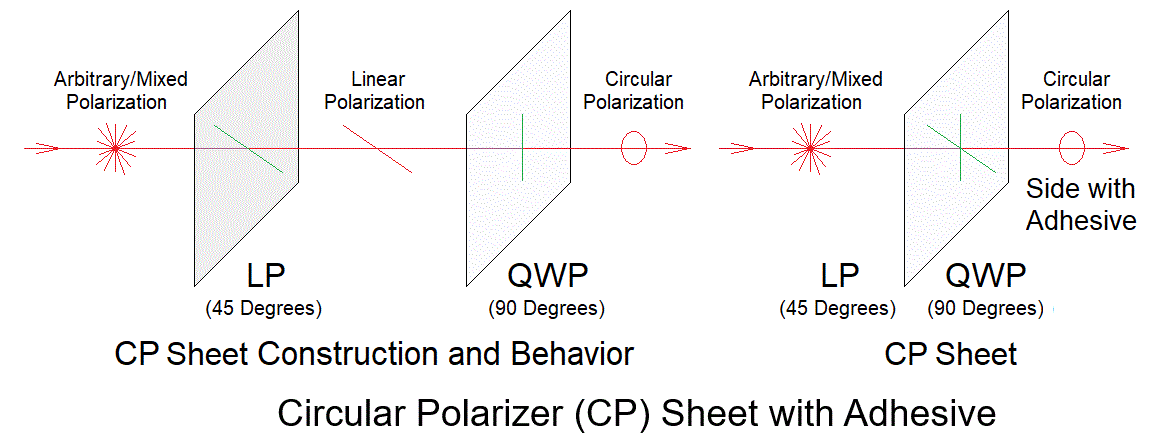
- Circular polarizer with adhesive on the QWP-side: Where two or
more CPs are included, this will be the smallest. The LP is oriented
at ±45 degrees and the QWP optical axes are at 0/90 degrees.
So for example, this can be used as an LP at 45 degrees
stuck directly to a photodiode (like the one in the SG-OR3 optical
receiver or facing the photodiode in a 10780F optical receiver)
as the QWP will not affect what the PD
sees. I have not checked if these are RCP or LCP. ;-)
- Right circular or left circular polarizer without adhesive
(RCP or LCP): These will be the larger of the pieces of CP sheet
(and probably only one of RCP or LCP).
The LP is oriented at 0/90 degrees (parallel to one of the edges and the
QWP optical axes are at ±45 degrees.
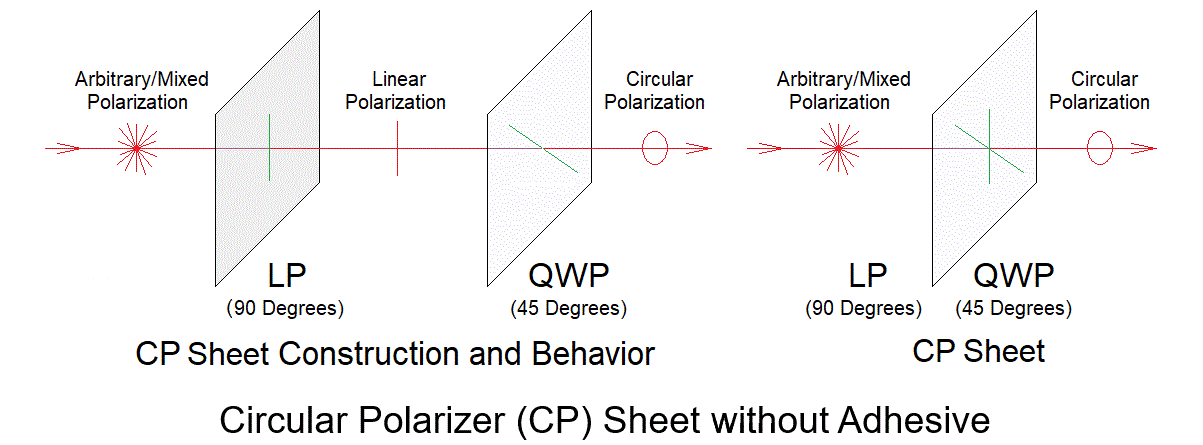
The difference between RCP and LCP is in the relationship of the LP to QWP
orientation (±45 degrees) and will probably be irrelevant except for
the advanced course. ;-)
These sheet polarizers can be cut into any desired size with a pair of
scissors. For use with a typical photodiode, 5x5 mm or even less is large
enough. And the piece can be glued directly to the face of the photodiode.
An adhesive like 5-minute Epoxy can be used where one of these without
adhesive needs to be stuck to something as well as to coat the adhesive-side
to protect it. Epoxy is non-birefringent.
Note that because they are both sandwiches, in principle it may be possible
to separate them to obtain LP and QWP sheets. However, that adhesive is
tough and the result may not be useful.
For our purposes, the CP sheet can be used in several ways. Here are 2 of
them:
- As a linear polarizer to combine two orthogonal detected
polarization components from an interferometer as described above
except that the polarization axis will be set to plus or minus 45 degrees.
The output will be circular polarized but that is irrelevant since
the destination is likely a photodiode which is polarization-insensitive.
- As a QWP to shift the phase of one selected polarization component
by 90 degrees with respect to the other. In this case, the input is the
QWP-side and the output is the LP side. The output may go directly to a
photodiode.
These create a so-called Type III Quad-Sin-Cos detector and is probably the
simplest configuration..
For the CP with adhesive, these orientations are automatic when a piece is
cut lined up with an edge. For the CP without adhesive, it must be
rotated 45 degrees in both cases.
There is a thin transparent protective film covering
both sides of the LP and CP sheets.
The film must be removed on either side where the polarization matters
as it is highly birefringent. One side of the sheet may have an adhesive
backing. The protective film can be left in place on that side if the
polarization doesn't matter, as where the beam goes directly
to a photodiode. Or in that case it can be removed and the
LP or CP sheet can be stuck directly to the photodiode.
Or it can be stuck to something that is NOT birefringent like a glass
window or microscope cover slip. However, if the protective film is
removed from the sticky-side without replacing it with something,
dust may collect there.
To confirm if a specific sheet is LP or CP if not marked, temporarily
remove the protective film from both sides.
Then rotate a known LP in front of it or pass
the beam from a linearly polarized
laser through it. The transmitted intensity will be fairly
constant for the CP-side of the CP sheet regardless of relative
orientation, but will go to nearly zero for the LP when the
polarization axes are orthogonal.
If you are totally confused by now, feel free to contact me at the link above.
But this stuff is confusing even for experienced laser jocks. ;-)
-- end V1.10 --